Monday, February 14, 2011

Who in QLD government is using Web 2.0 or Gov 2.0 tools?

The Queensland State Archives recently commissioned a whole of Government
Recordkeeping and Web 2.0 online survey to investigate how Queensland's public
authorities were using Web 2.0 and social media2 tools to conduct government business.

The survey also asked public authorities about the policies and procedures they had in place to guide the business use of Web 2.0 tools by public sector staff.

While the survey focused on exploring how records of Web 2.0 activity were kept, it provides some useful insights into the extent of Web 2.0 and Gov 2.0 activity across the Queensland government.

There were 135 responses from 193 authorities invited to participate.

The full survey is available in PDF from http://www.archives.qld.gov.au/downloads/recordkeeping_web_survey_report.pdf (this link now works!)

Here are some highlights, paraphrased from the survey:
  • Over half the responding Queensland public authorities are currently using, or intend to use, Web 2.0 tools for business purposes.
    • All State government departments (13) responded, with 10 indicating they are currently or would soon be using Web 2.0 tools (76%) 
    • Forty-seven local government agencies responded, with 23, slightly less than half (49%) indicating they were currently or would soon use Web 2.0 tools for business purposes.
  • The most common uses by public authorities of Web 2.0 tools are to provide information, promote, or receive feedback on services or products. Community consultation is also commonly undertaken using Web 2.0 tools.
  • Public authorities are using Web 2.0 tools on externally hosted websites, on government websites and on government intranets.
  • Web 2.0 tools are used by and in diverse areas within public authorities, including communications, marketing, corporate services, IT, community engagement and customer services functions.
  • Pertaining specifically to record-keeping, while most responding Queensland public authorities had recordkeeping policies in place, they had not yet developed and implemented recordkeeping policies which specifically address Web 2.0 records.
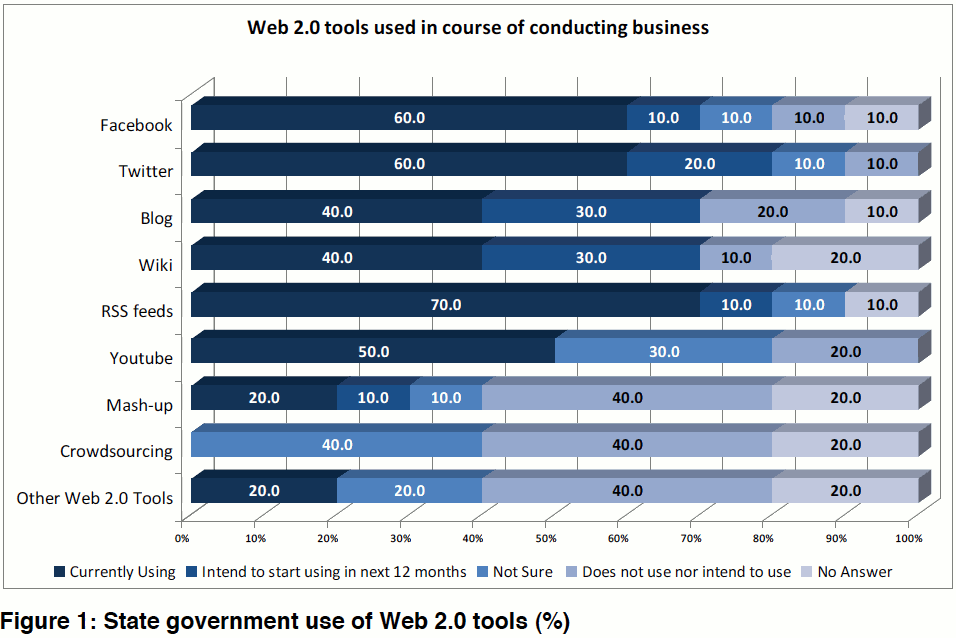
So what tools or services were State government agencies using?

RSS feeds - which I wouldn't consider a Web 2.0 technology, ranked the highest, with 70% of state agencies already using the technology.

Facebook and Twitter were the most common services used,  with 60% of state agencies currently using these services, followed by YouTube at 50% current use.

Blogs and wikis were also quite popular, with 40% of state agencies already using these tools.

Agencies didn't indicate any current use of crowdsourcing, however 40% of agencies indicated they intended to use crowdsourcing tools in the next twelve months.

Mash-ups received a small mention, alongside other Web 2.0 tools.


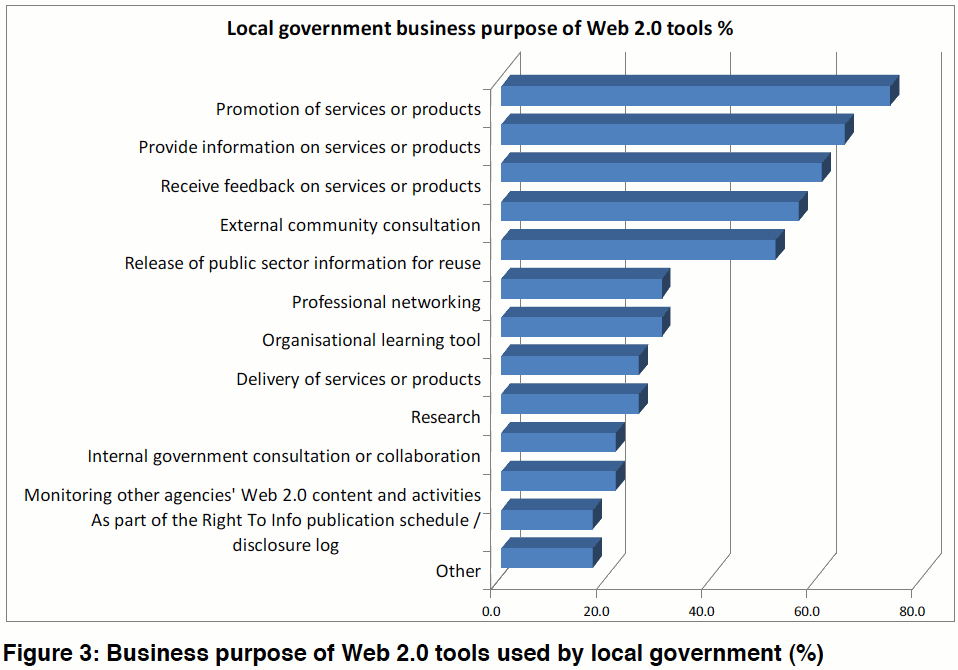
Why did local government use Web 2.0?

It's interesting to see the diversity of uses for Web 2.0 services and technologies - for promotion, information, feedback, consultation, information release, professional networking, organisational learning and so on (see graph below).

It's clear that Web 2.0 services and tools have enormous horizontal utility in organisations which, in my view, supports the case for social media not being the sole preserve or under the control of government communications units.


Web 2.0 policy

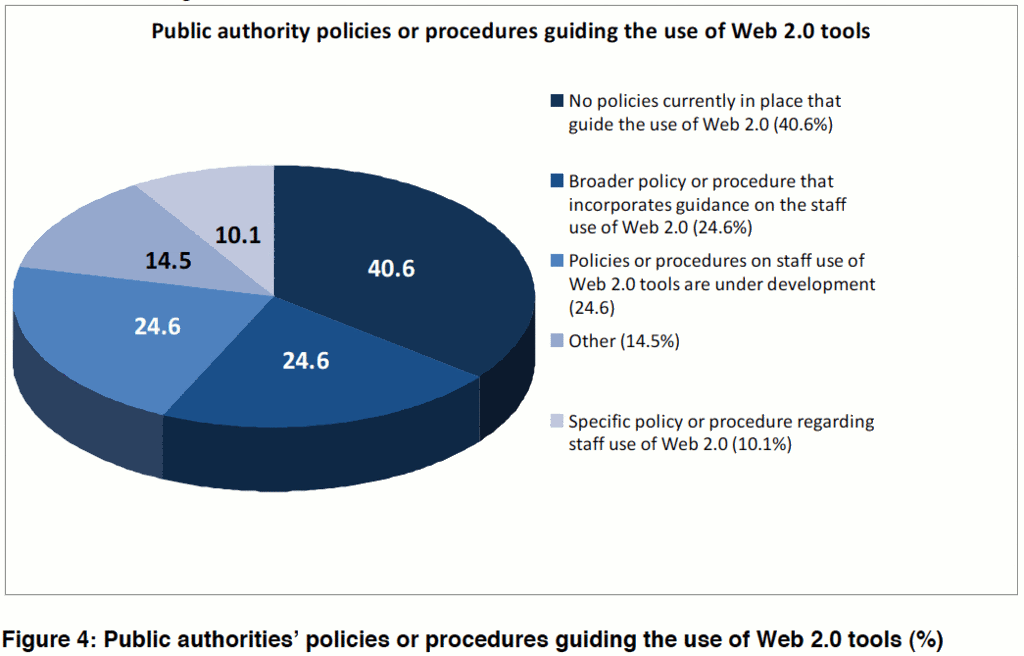
Finally, there's still an enormous gap in the area of policy and procedure for Web 2.0 use.

Over 40% of Queensland public sector authorities who responded to the survey did not yet have guidance in place to support, educate and guide staff in the use of Web 2.0.

In many other cases guidance was specific to a particular medium (such as Twitter) and did not adequately cross all the different forms of social media and Web 2.0 channels.

I believe this remains an area of significant concern for government agencies. It makes it more difficult to identify, flag and address inappropriate use of digital channels, or to educate and support staff on how to use these channels effectively and appropriately for their own benefit as well as the organisation's.


Read full post...

Saturday, February 12, 2011

Learning from the social media policy mistakes of the Commonwealth Bank

Last week the Commonwealth Bank received a panning for its new social media policy.

Going beyond guidance for staff in their use of social media, the policy made it a requirements that Commonwealth Bank staff tell their managers about any negative comments about the bank they see online. The policy also required that staff do everything in their power to have these negative comments removed from the internet, under risk of disciplinary action or even dismissal.

You can read the CBA policy online, courtesy of the Business Spectator. Pay particular attention to Point 4 "Material posted by others" and point 6 "Breach".

These parts of the policy particularly raised the ire of the Financial Services Union (FSU), one of the bank's largest staff unions, and led to a media storm throughout last week.
"The FSU believes the policy is so broad that it goes beyond conduct which the bank could legitimately claim involved damage to its reputation or interest and/or was such as to give rise to a concern about an employee's implied contractual obligation of good faith and loyalty," the union says.

Reference: SmartCompany - Commonwealth Bank social media policy raises questions over control of employee actions online

Now I applaud the Commonwealth on taking a step all organisations should, having a clear policy and guidance for staff to help them understand how to 'not stuff up' when using social media, how to avoid conflicts of interest and prevent the media portray a staff member's views as reflecting official bank policy.

I also applaud the bank's efforts to listen to social media and address customer issues expressed online. Realistically organisations should respond to customer comments in social media channels in a similar manner to which they'd respond to customer comments in person, by phone, email, fax or other channels. It is even better if they employ monitoring tools to proactively identify and address comments that aren't made specifically to the organisation.

However it is both impractical and highly inappropriate for organisations to ask their staff to monitor and police the actions of their friends or total strangers under penalty of disciplinary action - whether in online social media channels, or offline (at pubs and BBQs).

I'm not sure what steps the Commonwealth Bank took to formally or informally consult staff when developing their social media policy.

I'm not sure whether the Commonwealth Bank referenced best practice examples of social media policies from other organisations, such as the Online Database of Social Media Governance.

I am also not sure whether the Commonwealth bank is mature enough as an organisation to treat its staff as adults, to trust the people they employ and to effectively encourage them to be the Commonwealth's biggest advocates and supporters online.

However I am sure that when an organisation attempts to place unworkable and inappropriate staff policies in place they will fail. Internally and publicly.

Organisations that introduce inappropriate staff policies will reduce their public reputation, reduce their attractiveness to top people and set staff relations back years.


When I attended the Garner Symposium late last year (to speak on a panel with Andrea Dimaio and Ann Steward), I also went to a session on Banks and Social Media to see how they were doing in coming to terms with new mediums for communication and engagement.

The impression I walked away with was that Australian banks, in general, were several years behind the Australian Public Service in their acceptance, adoption and support for social media use by staff.

Sure they used social media tactices for advertising campaigns, however these were at arms length. Social media was not seen as a set of tools that could support and re-energise internal cultures, underpin collaboration and innovation or transform 19th century institutions into 21st century financial powerhouses. In many cases the attitude was "block and penalise" rather than "train and manage".


I hope that, given their relative maturity, government agencies will learn from the mistakes of the CBA in this case and avoid endorsing social media policies that are unworkable, onerous or inappropriate.

Given the experience of the Commonwealth Department of Finance and Deregulation, the Victorian Government, the Victorian Department of Health, the South Australian Government and, also last week, the Queensland Government , I think the public sector is currently in safe hands.


Stung by the public and staff backlash, the Commonwealth Bank has rapidly agreed to work with the FSU to make its policy workable. I'm sure we'll hear more as this progresses.


Articles
A non-exhaustive list of articles discussing the Commonwealth Bank's social media policy

FSU posts
Posts by the Financial Services Union about the CBA social media policy

Read full post...

Wednesday, February 09, 2011

Where do good ideas come from? (hint - increased connectedness)

This is a thought-provoking video that looks at where good ideas - innovation - comes from.

It raises an interesting point about the correlation between connections and innovation. That the more we interact and connect with others, the more likely it is that we can combine our partial ideas, our hunches, the greatest the prospect of a breakthrough idea.

That's a powerful argument for improving the connections between public servants, between government employees and citizens and for facilitating better connections between citizens - through the use of digital technologies.

Read full post...

Tuesday, February 08, 2011

When government crowdsourcing doesn't work (careful you may laugh)

Here's an excellent example of where crowdsourcing doesn't work.

The City of Austin decided to crowdsource a new name for its Solid Waste Services Department.

It received plenty of ideas and votes, however few were meaningful or useful - though a number are quite funny.

However don't take this as a lesson that crowdsourcing doesn't work.

Use Austin's experience as an example that crowdsourcing, as a strategy, must be applied in a considered and appropriate manner. Where possible the goals should be specific, meaningful and valuable to the community.

(thanks for the link James!)

Read full post...

Monday, February 07, 2011

Open Government drinks with Delib co-founder Chris Quigley tonight in Canberra

Chris Quigley of Delib is in Australia at the moment, on a trip around capital cities talking about Open Government from a UK and US perspective.

Today and tomorrow he's in Canberra meeting with various people around the traps (and speaking at the Gov 2.0 lunch).

Tonight, to welcome Chris, we're having informal drinks at the Wig and Pen from 5.30pm.

If you're in town and available, drop by - just look for the Gov 2.0 table at the back.

Who is Chris Quigley?
Chris's experience crosses viral marketing, social media and e-democracy. He has an ongoing interest in how people, business and government interact, and how the internet (especially social media) are changing relationships.

He has been working in the Open Government space for almost ten years across both the UK and the US. He was involved in some of the earliest crowd-sourcing projects in the US, under the former President George Bush.

Chris's company, Delib, was asked by the current US government to build an ideas-sharing website to "crowdsource thoughts" about how to design a portal that would monitor the US's $787bn (£510bn) stimulus plan. The result was recovery.gov.

Chris was also involved in the design of the UK government's 'Your Freedom' website, designed to allow UK citizens to discuss laws they wanted to see changed or removed. The site received 11,546 ideas, 72,836 comments and 190,175 ratings.

Alongside his Open Government work, Chris is also a co-founder of The Viral Ad Network, a specialist automated syndication platform for branded content and of Rubber Republic, a specialist viral ad agency (which also has a strong interest in socks).

Learn more about Chris in The Guardian's article, "The man opening up government".

Read full post...

Good read: Nicholas Gruen on Gov 2.0 in Australia and cultural change

Alex Howard over at GovFresh has a great article and video interview with Nicholas Gruen regarding Gov 2.0 in Australia and some of the challenges of the required cultural change.

Read it over at Nicholas Gruen on Gov 2.0 in Australia and cultural change.

Read full post...

Friday, February 04, 2011

Ten reasons why blogs are more useful than email newsletters

Sometimes it surprises me how much some organisations like using email newsletters over other tools like blogs.

They spend weeks or even months crafting news items, bundle them together into a single email and then send them out to a subscriber list - sometimes without even using a system to measure the response rate or manage the bounces, making it impossible to prove a return on their investment.

I've long been a fan of blogs over email newsletters, here's some of the reasons why:
  1. You only have to publish one story in a blog at a time
    Email newsletters tend to be an collection of stories all published at once. With a blog, each post is a new 'story' so you can focus on one at a time rather than having to work on three, five, eight or ten different stories all at once.

  2. You can publish blog posts at your own pace
    Often with email newsletters there's a 'need' to publish regularly - every week, month or quarter. That often means uncovering some kind of 'new' content on a topic, even if there's no new information.
    With a blog you can spread out your posts over time, giving the impression of more regular updates and building your audience's engagement habits without necessarily writing any more content.
    In other words, four blog posts posted over four weeks is more effective than posting a newsletter once a month with four stories.

  3. Blogs boosts your search ratings
    It is very valuable to have results high in search engines and blogs, unlike email newsletters, get listed. In fact as blog information changes regularly (as often as you post), this means that search engines often rate blogs higher than static websites which rarely change. That's an enormous boost to peoples' ability to find and make use of your information.

  4. Blog posts can be available forever
    Sure you can keep an online archive of your email newsletters, however a blog is much easier to search and reference for people who wish to read back in time as well as forward.

  5. An email newsletter is a soliloquay, a blog is a dialogue
    Email newsletters are almost always one-way outwards communications tools. Blogs, on the other hand, are multi-way. Sure you can have a blog without comments - just like an email newsletter - however you can also support active public discussions. That provides more flexibility and options for how, why and when you communicate and allows blogs to support a wide range of inbound and two-way engagement strategies.

  6. You can leverage your blog's reach through syndication and social media
    With blogs you can provide an RSS feed that can be used by blog aggregators, news sites and other feed reading mechanisms to greatly amplify your reach. You can also leverage social networks such as Facebook and Twitter to increase your footprint even further.
    On the other hand email newsletters are largely bound by the limits of their subscriber lists. They may be re-emailed by a few recipients, however cannot tap into broader syndication or social media channels to amplify their reach.

  7. Blog post approvals don't have to tie you in knots
    The classic reason email newsletters are late is that they are waiting on lots of approvers - often different people for each news item. This complex process can mean that even if nine of your news stories are approved, you're left waiting three weeks for approval on the tenth before you can email. By then the email is a month late and your audience has lost interest and trust in your ability to deliver to deadline. With blogs, if you have nine posts approved and one still in approvals that gives you nine posts you can publish over the next three weeks while waiting for the tenth. That means you can maintain regular activity and keep your customers informed and engaged without any loss of reputation.

  8. People can subscribe to your blog
    Just like with email newsletters, with the right blog tools people are able to subscribe to your blog for updates by email or by RSS. This is more of an equaliser than an advantage, however it does mean that blogs, with their other advantages, aren't at a disadvantage in this area.

  9. A blog isn't restricted to being a blog
    Email newsletters are good at being email newsletters, providing synopses and links to news stories, but aren't usually able to provide other functionality. A blog isn't necessarily only a blog, it's a highly interactive website. You can use a blog to also deliver static information, multimedia presentations, social media tools, web services and anything else you'd provide on a 'normal' website.

  10. Your blog can be an email newsletter too!
    With the right blog tool, or with a small amount of work, you're able to bundle up your blog posts for the last week or month and send them out as an email newsletter as well. This basically allows you to have the best of both worlds - the targeted alerts of an email newsletter backed up by the flexibility, search ranking and longevity of a blog.

Now I'm not saying that email newsletters don't have their place. They are very effective at 'push' communications. When you're confronted by a newsletter every month in your inbox you're quite likely to read it.

However why limit yourself to just that email newsletter when you could build a blog and use an email newsletter as one of your push tools?

The blog gives you the advantages of multi-way communication, greater leverage and amplification, more flexibility in when and how you publish content and the content becomes much easier to find.

Build a blog and use your newsletter to drive traffic to it. That way you'll get the best of both worlds, targeting and flexibility.

Read full post...

Bookmark and Share