Thursday, January 31, 2013

Let's crowdsource the Style Manual for government

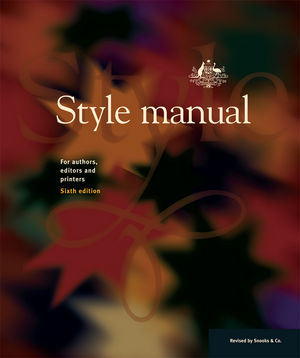
The Australian Government Style Manual:
For Authors, Editors and Printers, 6th Edition
image via Wiley Press
 
When I joined the Australian Public Service in 2006, one of the first manuals I was made aware of was the Style Manual: For Authors, Editors and Printers.

The Style Manual was the bible for communications professionals and senior executives in the APS, containing detailed advice on how to plan, design, write, structure, edit and publish content that met the standards expected of Australia's Government.

The Style Manual was, for the most part, practical; clearly and concisely written while covering a vast range of material in a relatively short 550 pages.

From my perspective the Manual only had one major flaw - it was a print-only publication with a price tag for purchase ($44.95).

What this meant, in practice, was that agencies never had enough Manuals to go around.

While Communications team always had quite a few, and many senior executives had their own copies, many people across departments, who wrote policy, program documents, business cases and other materials for a living, didn't have ready and ongoing access to a Style Manual.

Sure the price wasn't that much (and many people bought their own), however when an agency has hundreds or thousands of staff who could benefit from access to the Style Manual, the cost quickly added up.

Another issue caused by the print-only nature of the Style Manual was the speed at which it updated.

At the time I joined the public service the latest edition, the 6th, was four years old. It was already out-of-date due to rapid changes in web communications. Now the 6th Edition of the Style Manual is over ten years old, it is far out of touch with modern writing approaches and channels.

The first Style Manual was published in 1966 and, on average, editions had been published every six years. That may have been fine in the 'old days' when there were three mass media and before desktop computers and the internet, however it fails to meet the speed of change today.

So I was please earlier this week to see that the Australian Government was going to be going to market to update the Style Manual. However, when I looked into what was initially proposed I was concerned:

The Department of Finance and Deregulation (Finance) is preparing for an approach to market in mid 2013 seeking to form a joint arrangement with a suitably qualified provider to develop, publish and distribute the 7th edition of the Style manual for authors, editors and printers (Style manual). 
Phase 1 of the project involves consulting with industry in order to explore and better understand potential business models under which the 7th edition could be produced, published and distributed. Finance is particularly interested in business models where the provider recovers development costs through collecting revenue from selling the Style manual, rather than Finance providing the capital to develop the 7th edition....
Government News summed up the situation well in their article, Paywall to surround official government Style guide.

I believe it is time for a rethink of how the Style Manual is constructed, managed and distributed, matching the modern technologies we now have.

Here's my proposal.

Let's crowdsource the Style Manual

The principles under which the government Style Manual should operate, in my view, are as follows.

The Style Manual should be:
  • developed by the people who most understand it and need it - development of the new edition should involve writing and media experts, but also should involve the people who use these mediums for government every day, the users of the current 6th Edition Style Manual. Many of these people have suggestions for improvements and ideas for extensions to the Manual which aren't commonly captured or respected in a centrally managed updating process.
  • readily available - to all government officials and to all organisations and individuals who engage or contract with government on the platform and in the place of their choosing.
  • continually current - a 'living document', updated on an ongoing basis to reflect changing communication channels and language usage.
  • relevant - a communal document, with communications specialists (particularly those in government who rely on it) able to participate in its development and ongoing updating so that it addresses their needs and reflects best practice, prompting engagement and use.
  • accessible - meeting the WCAG 2.0 AA accessibility standards
  • useful - providing examples, templates and allowing people to pose challenges and respond with advice and ideas in an active communal way.
  • open and transparent - the style guide should support and reinforce the government's stated open government agenda.
On this basis, I see the 'native' format being a cross between a wiki and an online community, a living Style Manual where people can search for and reference all the content, plus additional examples and templates that cannot be delivered effectively in a print publication.

Every piece of guidance in the Style Manual would support a discussion, with the community of public servants able to ask questions, debate points of style and offer improvements, which could be implemented through a managed consensus and voting approach.

To support people who needed an offline Manual, or who prefer a printed version, regular (perhaps annual) print versions could be released from the website for departments and other organisations to print (at their own cost or via the site) as books or distribute as ebooks across mobile platforms.

If a revenue model is critical, perhaps the site can charge government departments - not individuals - an annual subscription fee based on their headcount. With around 260,000 public servants, a charge of $2 per head would be more than sufficient to cover the running costs of the site, meaning a large agency with 20,000 staff would pay only $40,000 for an annual subscription for all staff, equaivalent to buying 800 copies of the current 6th Edition Style Manual book (one book per 25 people), while a smaller 500 person agency would pay only $1,000 per year.

This subscription fee would allow full access to the online Style Manual and the right to print as many copies as they chose (at their own cost), as well as including full access to enewsletters and the ability to both suggest edits to the guide and to participate in the community, asking and answering questions related to 'gray' areas in style.

Outside organisations may be able to pay for this access as well, at a higher rate.

In summary, we need a government Style Manual. It provides a basis for standardisation of language and common understanding within and without government.

It needs to always be current and accessible, to engage and support the community by going beyond what a book or website can do by fostering a community of communicators within government - whether they use paper, video, voice or the web as their mediums for communication.

We have the technology today to do this in a cost-effective and managed way. It doesn't require a book publisher or distributor to achieve this goal. In fact these companies are often the worst placed to deliver the outcome as they are tied to legacy investments.

Finally, we need the Style Guide to demonstrate and support the government's open government agenda - something a book publisher, seeking profits, would be disinclined to do.

Read full post...

Wednesday, January 30, 2013

Eight business models for government open data

Alex Howard has written an excellent article over at the O'Reilly Radar listing eight business models for government open data, a handy list for those in government agencies attempting to justify to senior management or Ministers why releasing government data is important and valuable.

The models listed in Alex's article, Open data economy: Eight business models for open data and insight from Deloitte UK, were identified by Michele Osella, a researcher and business analyst in the Business Model & Policy Innovation Unit at the Istituto Superiore Mario Boella in Italy.

(Note that these are classified in Europe as Public Sector Information (PSI) reuse cases.)

I've included the list of eight business models below and embedded Osella's presentation on the topic as a reference - it provides more detail and case studies on each.

From the article:
  1. Premium Product / Service. HospitalRegisters.com
  2. Freemium Product / Service. None of the 13 enterprises interviewed by us falls into this case, but a slew of instances may be provided: a classic example in this vein is represented by mobile apps related to public transportation in urban areas.
  3. Open Source. OpenCorporates and OpenPolis
  4. Infrastructural Razor Blades. Public Data Sets on Amazon Web Service
  5. Demand-Orientated Platform. DataMarket and Infochimps
  6. Supply-Oriented Platform. Socrata and Microsoft Open Government Data Initiative
  7. Free, as Branded Advertising. IBM City Forward, IBM Many Eyes or Google Public Data Explorer
  8. White-Label Development. This business model has not consolidated yet, but some embryonic attempts seem to be particularly promising.

Read full post...

Tuesday, January 29, 2013

LiveBlog from Open Gov miniconf

Today I'm at the Open Government miniconference at Linux Conf 2013.

I'll be liveblogging part of the day.


Read full post...

Can governments crowdfund (some of the time) rather than tax?


Taxation has become the accepted approach used by most governments to raise most of their funds.

In its simplest form it involves taking a percentage share of the income earnt by citizens and other eligible entities, such as corporations and putting all this money in a big pool for the government's use.

The government then decides how to spend this money - providing public services and infrastructure, welfare and health care, and paying for the machinery of government.

Taxation is often supplemented by other revenue raising approaches including 'user-pays' tolls or levies and the sale or rent of goods, public assets or rights.

While there's plenty of debate over how the money in government's pool is spent, the main approaches used to raise these funds have remained largely unchallenged for centuries.

With the rise of the internet, however, another approach to funding government is becoming more viable - crowdfunding.

Crowdfunding involves asking people to provide funds for worthwhile projects on a micro-scale, many individuals each donating a small amount.

This isn't a totally new approach. Rich philanthropists have donated millions for worthwhile causes, communities have come together to fund (and build) small public works and individuals have adopted park benches and potholes for many years.

However the internet has lifted crowdfunding to a new level, with the potential to cost-effectively raise millions of dollars through tiny individual donations in a managed way.

The practice is already beginning to grow in the US, as illustrated in the video below. US platforms like Neighbor.ly already exist and new ones, like Citizinvestor are sprouting.

A european platform, Brickstarter, is being built with a pilot planned with the Finnish city of Kotka later this year.

In the Netherlands, a foot bridge is being crowdsourced by Rotterdam's government, testing the concept for broader use.

There's even some use in Australia. ScreenWest (WA's government film financing body), has a crowdfunding project in partnership with Pozible to support the funding of WA films.

While it is still too early to tell how useful crowdfunding will be for governments, the crowdfunding approach has been successful in raising funds for arts projects and commercial products, even for establishing the world's first Tesla museum (which I've invested in).

Micro-financing, a related approach supporting people to lift themselves out of poverty with loans too small for banks to bother with, has also proven successful in many cases (I recommend checking out Kiva, which I use).

Perhaps, over the next few years, rather than debating tax increases or expenditure cuts, governments will consider broader, internet-enabled options for funding some activities or infrastructure - such as crowdfunding.

All it takes is an open mind and a willingness to innovate in revenue raising.  As the video below illustrates, this is already starting to get underway.


Read full post...

Friday, January 25, 2013

How much of Australia is represented by federal politicians tweeting?

Recently Twitter announced (as reported in Mediabistro) that 100% of elected US Senators and 90% of Representatives were using Twitter, and mapped the country to show electorate coverage by state.

I track the use of Twitter by Australian federal politicians  through my Australians Politicians on Twitter Google spreadsheet (about 66% use the service), and decided to similarly map Twitter use across Australian electorates and states.

I found there are some major holes in Twitter use outside of metropolitan areas, as shown in the map below by electorate.

Note that my data is current as at 21 January 2013.

Australian House of Representatives Twitter users by electorate

Zoom in for city electorates and click on an electorate for the details of the tweeting member.

Representative tweeters by tweets
I've scaled the map below by number of tweets to show the level of activity by member.


Representative tweeters by followers
The picture looks a little different by followers, which has been scaled by member in the map below.

Australian parliamentary Twitter users by state (Senate & Reps)

At least by state, every jurisdiction has at least a few federal twitter users, and the maps below take in Senators as well as Representatives, giving a total level of tweeting by elected members by state and territory.

Federal parliamentary tweeters by state/territory by tweets
Click on the map to see the total tweets by all elected members in a state or territory. 


Federal parliamentary tweeters by state/territory by followers
Again the picture is a little different by followers, due to the impact of Kevin Rudd (Queensland) and Julia Gillard (Victoria), the most followed Australian politicians.


More to come...

I am in the process of mapping tweeting levels by political party and identifying the 'tigers' who are using the service very actively, compared to other politicians.

I am also mapping government agencies in a similar way - crosschecking around 840 tweeting federal, state/territory and local governments to find out who are the most active and most followed tweeters.

Keep an eye on my blog for more of this information over the next few weeks.

Read full post...

Wednesday, January 23, 2013

Register now for the first free Gov 2.0 lunchtime event in Canberra for 2013

Canberra's free Gov 2.0 lunchtime events continue for the fourth year in 2013, with the first monthly event featuring two great presentations:

  • “R.I.P. to the media release, hello crowd sources” on the use of social media in real-time emergency communications by Darren Cutrupi of the ACT Emergency Services Agency, and 
  • "The British Invasion - how Gov 2.0 is taking the UK by storm" on the state of Government 2.0 in the UK, from British-based Ben Fowkes of Delib UK.
Update: Note that Ben isn't able to give a presentation on the UK GovCamp that was scheduled on 19 January as it was delayed due to snow.


For more information, or to register, please visit the Eventbrite page at: http://gov20february2013.eventbrite.com/

Read full post...

Tuesday, January 22, 2013

Is it time to abandon the term 'Government 2.0'?

What's in a name? that which we call a rose
By any other name would smell as sweet;

Romeo and Juliet - William Shakespeare 
The term 'Government 2.0' was coined a number of years ago now, as a way of describing a set of new opportunities and activities for governments and citizens enabled by digital technologies and the internet.

While many definitions for Government 2.0 are out there, the basic premise is that new technologies can improve the effective governance of nations.

This can occur both through governments reforming their activities, processes and transparency to be more 'citizen-centric', focused on the outcomes for communities than on ticking procedural boxes, and through citizens having greater involvement and influence over how they are governed.

However beyond this basis premise, Government 2.0 is a catchall for a range of very different activities - the release of data in reusable forms, the development of improved citizen engagement approaches and platforms, more direct political involvement by citizens via websites and social networks, the innovative use of digital technologies to redevelop government services, the breakdown of silos within agencies and more.

Many of these activities also have their own names, open data, connected government, digital democracy, crowdsourcing, open government, egovernment, digital innovation and so on - and these terms are often confused with or used instead of the term Government 2.0.

In my experience many public servants, media commentators and the majority of the public are unaware of or have different understandings of what Government 2.0 actually means. The term is not in any dictionaries I'm aware of and is used very differently by different governments and agencies.

If a term, such as Government 2.0, doesn't have a common meaning within government or with citizens, can it communicate what we want to say effectively?

I'm still undecided over whether Government 2.0 remains a useful term. It certainly helps bring together a disparate group of people working in closely related fields - citizen advocacy, open government, community engagement and egovernment, finding points of similarity and synergy that support all their work.

The term has a basis in reality - we can see the changes occurring in society, from the increasing influence of epetitions and online advocacy to influence policies, the move towards open data and copyrights across government, changes in both how government agencies and politicians engage, communicate with and influence their constituents and, more critically, changes in how citizens engage, communicate with and influence politicians, political parties and government agencies in turn.

Social media has helped citizens to form groups and movements and has allowed governments to win (or lose) hearts and minds. Increasingly agencies and politicians are bypassing mainstream media to communicate directly with citizens, cutting out an unreliable middleman.

So we need some kind of term or terms to describe how our society, government and politics is changing - and will continue to change.

But should that term be Government 2.0?

If not, what should it be?

Below is a great webcast from Tim O'Reilly, widely credited with creating the term 'Government 2.0', speaking about what Gov 2.0 means to him and why he created it.

Read full post...

Bookmark and Share