


 Posts
Posts


On Friday (29 August) Peter Gershon submitted his review on the status of the $16 billion Australian Government technology budget to the Federal Government for consideration, as reported in a number of places, including this Australian article, Gershon submits govt ICT review.
The Australian article reports that,Sir Peter said his recommendations involve a major program of both administrative reform and cultural change within the Australian Public Service.
I'm eagerly awaiting a look at the recommendations of this review, with my particular interest being in ensuring that the online channel continues to be a lower-cost delivery medium for government information and services, used flexibly to ensure citizens receive the most effective, as well as the most efficient, outcomes.
"With sustained leadership and drive at Ministerial and top official levels, and by providing the enablers of change with the necessary resources, not only in funding terms, but also skills of the right calibre, the Australian Government through implementing these recommendations can drive significant improvements in its use of ICT.
"I am confident that the recommended actions and proposed changes can be successfully implemented over the next two to three years, and will deliver substantial benefits to the Australian Government," Sir Peter said.
As a relative newcomer to the public sector one of my largest challenges has been dealing with how ICT is managed in government in terms of culture, structure and accountability. It is very different to my personal experience working with and managing IT teams in private enterprise.
There are specific laws and standards which are mandatory for government, but do not hold as much force in the private sector - such as around accessibility and security. There are also different drivers when the profit motive is removed.
The largest difference I've noticed has been in the level of application of technology for governance structures that in the private sector are more commonly managed through contracts and professional relationships, making them more adaptable, lower cost and placing business systems under business control.
Judging from the positive outcomes in the UK after Sir Gershon's 2004 Independent Review of Public Sector Efficiency report, I hope that in Australia we move forward with his requirements in order to unlock more of the potential of ICT to be a forward-looking and innovative facilitator in the Australian government's relationships with citizens.
Sunday, August 31, 2008
Gershon review submitted to federal government | Tweet |


Friday, August 29, 2008
IE8 public beta now available | Tweet |
It's going to be a busy six months for web teams, addressing WCAG 2.0 (the new W3C Accessibility Guidelines) and the release of Internet Explorer 8.
For those who want to stay ahead of the game (like me), the second IE8 beta is now available for public download here.
As I've now switched almost totally to Firefox for home use (due to it's superior Australian English spell checker, ability to resume a session after a PC crash, better support for plug-ins and superior adherence to web standards) and therefore have limited need for IE7 on my laptop, I'm about to give IE8 a try.
It will be very interesting to see how some leading sites (including those I manage) function.
I expect that there will be a rapid take-up for IE8 by home users, up to 35% of the market in the first three months (I'll allude back to this post three months after launch!)
Any organisation who isn't ready for either the IE8 or WCAG 2.0 shift runs the risk of having their website become less accessible to the market.
That's food for thought when there's a legal obligation to meet accessibility guidelines.
Finding egovernment inspiration in Alabama | Tweet |
If you're looking for inspirational egovernment ideas, the CIO 100 Award from CIO magazine are a great place to start. The annual Awards honor organisations creating business value via technology innovation.
For 2008 the State of Alabama was the only state government to win an award, for its egovernment initiatives, involving the delivery of over 130 egovernment services via the Alabama.gov portal.
Some of these services include live online website help, a 'virtual Alabama' powered by GIS technology, the deployment of video conferencing for distance learning, a range of online processes for ordering and renewing licenses, online payment, and many other online services.
While Alabama is the only state to win, a number of US government departments were alsorecognised with awards, including,
- the U.S. Department of Housing & Urban Development
- the California Department of Health Care Services
- the District of Columbia Water and Sewer Authority
- King County, Washington
- the Massachusetts Developmental Disabilities Council, and
- Miami-Dade County Public Schools.
Thursday, August 28, 2008
Australia rated 6th in global egovernment study | Tweet |
Brookings University recently released its report Improving Technology Utilization in Electronic Government around the World, 2008 (link to PDF).
This ranks the government websites of 198 nations, reviewing 6-10 sites in each nation.
Australia ranked 6th, behind South Korea, Taiwan, the US, Singapore and Canada, up from 8th position last year.
As a benchmark this is great - it's better than our Olympic ranking (on substantially less funds per website than we spend on medal winning athletes), and substantially better than our global population ranking of around 50th.
However this study compares governments against other governments, rather than with citizen expectations.
While I do use other governments' initiatives to stimulate my thinking, I'm more interested in what our citizens want.
I also regularly refer to AGIMO's fantastic work on the use of government services online, and the 2006 e-Government Strategy, Responsive Government. There was also the (now superceded) Guide to Minimum Web Site Standards.
However none of these provide a citizen-centric view of what government sites need to provide that can be used to provide numerical ratings for each government site.
I'd love to have such a ranking available as I used to have in the private sector - using Global Reviews - to provide guidance as to what our citizens want, and the relative importance of different functionality. This would greatly assist my team and I'm sure other online groups, to prioritise online developments inline with citizen desires.
Has anyone seen a study in Australia or elsewhere on the community's expectations of how citizens should be able to engage government online?
The blind leading the sighted | Tweet |
I've just been reading the State of the eNation report on the Beijing Olympics website, where they invited disabled web users to test the accessibility features of the site.
While they found a number of the worst issues commonly reported by these users had been addressed, the remaining accessibility problems still made it very difficult to use some parts of the site.
In my past roles, and from what I've witnessed across other organisations, in many cases while companies might engage Vision Australia or a similar organisations for 'spot checks' of websites when they had the funds for it, companies have often relied on interpretations of the web accessibility standards by web professionals rather than referring to staff with first-hand experience.
My team is currently building an internal reference group to oversee the accessibility of our website and intranet, drawing on staff with vision, hearing and movement impairments.
I wonder how many other government agencies could - or already are - doing the same.
Wednesday, August 27, 2008
UK government launches online video news channel for public servants | Tweet |
The UK has been operating an online 'television' channel for public servants, LocalGovTV, featuring government initiatives and egovernment examples for some time now.
The service has now launched a regular news channel featuring the latest news on public sector developments within the UK.
While it is necessary to register to view the service, it contains some very interesting insights into what is occurring in public governance in Britain, particularly in the egovernment area (on topics such as Telecare).
Summary of take-aways from the Driving Interoperability and Collaboration in eGovernment conference | Tweet |
A frantic day catching up yesterday, so I did not get to write this post until this morning.
On Monday I presented at Ark Group's Driving Interoperability and Collaboration in eGovernment conference in Brisbane.
There was a great line-up of speakers, and I had a long list of take-aways from the day.
Here's my key ones. Note these reflect my perception of the speakers' topics - not necessarily the words they used.
Overall takeaways
- There's a lot happening across the egovernment front at all levels of Australian government, with enormous benefits beginning to be realised for the government, for constituents and for business
- egovernment initiatives still remains highly siloed, with little information being shared between governments, departments, or even within agencies
- virtually all state and federal governments recognise the need to follow whole-of-government approaches, but are doing so only within their own governments, not across jurisdictions in a co-ordinated and managed way
- Enormous cost and time benefits could be realised with more centralised co-ordination (not control)
By speaker
Kim Denham
(CEO Australian Computer Society)
- Broadband is a critical utility for Australians.
- It's crucial to ensure that Australia has an appropriate network in order for long-term national success
Dominic Feik
(Director Business Services, Dept of Innovation, Industry and Regional Developments Vic)
- A successful business case is a good story, supported by evidence, relevant to stakeholders
- Storyline is critical - provides structure for the case
- Use case studies to build a picture of the outcomes
- Create and manage a stakeholder list - develop a clear strategy on how to influence and engage key decision makers (sometimes has to be from a distance)
- Use 'guided' rather than 'blank slate' consultation
- Number one reason for project failure is if the wrong people/skills are attached to the project team
- Other reasons for failure include:
- Poor consultation
- Poor research
- Too much focus on implementation, not enough on business case
- Searching for benefits in the wrong places
Gary Shaw
(Director Information Queensland)
- QLD government has a state-wide address verification system, usable across state government websites, intranets and applications (I want one at Federal level!!)
- QLD has done a fantastic job in developing a geospatial system - involving collaboration across many government agencies.
- There is insufficient collaboration across Australia government
Qld invested $7.5 million in a geospatial display system (building a metadata atlas and other tools),
WA invested $26 million in a similar, but separate system (more bells and whistles),
NSW is looking to invest in such a system - separately
Vic is looking to invest in such a system - separately
Federally AGIMO is investing in such a system
Surely Australian government only needs one such geospatial system - open enough to support the needs of various states and levels of government, and provided/managed centrally as a national public good.
This would support the needs of businesses and individuals to deal across council and state borders, rather than requiring them to use separate tools for separate jurisdictions.
Tim Turner
(Lecturer at UNSW@ADFA)
- Government has focused on a 'one-size fits all' approach to online, but recently moved into portals based on demographic ('youth', 'family') and 'live event' models ('moving home', 'starting school').
- While AGIMO indicates that 60% of the internet using public has visited a government site at least once in the last twelve months, there is not much detail on how/why they visited or how frequently.
- Key limiters to government engagement online appear to be (from AGIMO):
Usability, navigation and content
Knowing what can be transacted (promotion)
Wanting to deal with a 'real person' (little work in Australian government on real-time online contact via video, audio or text) - Government also needs to considered the relationship that constituents have with government.
- Identifed four key relationships/roles:
Customer - single-session interactions, commercially oriented, no identity requirement, expects the same experience whether public or private organisation providing product/service
Client - multi-session interactions, relationship orientated, 'professional' engagement, identity required, expects the same experience whether public or private organisation providing product/service
Citizen - single-session interactions, about business of government, preference for anonymity, no commercial alternatives
Subject - multi-session interactions, usually initiated by government, heavily rules/procedural based, identity required, no commercial alternatives - Government services (process/tone/approach) need to take into account the relationship the constituent has with the service - people shift from one relationship/role to another across different engagements.
- For transactional engagements (Customers/Citizens) - improve usability and appearance of trustworthiness
- For relationship engagements (Clients/Subjects) - improve usability and evidence of justice
Jonathan Gray
(Senior Researcher, NICTA)
- Some great tools now coming out of NICTA
- Seeking government agencies to partner with to pilot pre-commercialisation of IT-related solutions
Jo Bryson
(Executive Director Office of eGovernment, WA)
- Ongoing need to break down silos within and between organisations. Critical factors in doing so are;
- Awareness and understanding
- Consultation and engagement
- Promotion - Need to share information, not withhold it
- Is a significant mental shift for many long-term public servants, but a necessary one for effective governance
- ICT will only realise true business benefits with a business-centric approach NOT technology-centric
- WA has developed a great set of checklists for Ministers' offices (PDF) and Secretaries to appropriately question CIOs to ensure that business value is top-of-mind (great tool - should be used nationally!)
- There is real business value in electronic transactions over physical ones
- Physical network accounts for less than 25% of Medicare's business
- Estimated that move to electronic transactions has effectively reduced Medicare's necessary headcount by 50% (compared to headcount required if all processes remained manual)
- Implemented ability for customers to check their interactions with Medicare online (publicly available but not yet being promoted)
- Has developed a national medical backbone for providing and billing services across GPs, specialists and hospitals (ECLIPSE), which has enormous benefits for the health sector (but is largely invisible to constitutents)
Tuesday, August 26, 2008
Are you really listening? Using the internet to listen and meet customer needs | Tweet |
I've been reading a fantastic book recommended to me by my DGM, What Got You Here Won't Get You There by Marshall Goldsmith.
It discusses 20 habits that hold back successful people and key behavioural changes that can help overcome them.
One behaviour discussed is listening, where Marshall makes the statement,
80 percent of our success in learning from other people is based upon how well we listen. In other words, success or failure is determined before we do anything.Listening is a regular theme in management and self-help books, however what struck me in this case was that effective and active listening isn't only a key attribute for individual success.
It's also a key factor in organisational success.
Many government agencies spend a great deal of time and money on listening.
We engage in market research, hold community consultation sessions and ask stakeholder groups for input. We consult subject matter experts, implement feedback systems and even share information with other agencies.
Then we attempt to pull all of this data together in meaningful and useful ways to guide policy and service delivery.
Most organisations find listening a difficult and challenging process. Across the private and public sector some organisations shine but most are poor at listening.
If we're all spending so much money on it, why is this so?
Possibly because the process of listening is never perfect. It can involve the wrong groups, or fail to share information widely enough.
'Listening' may be an activity undertaken periodically, rather than constantly, and by specific groups or individuals, rather than seen as a responsibility for the entire organisation.
When listening the context may not be understood, or organisations may simply fail to accept and absorb what they are hearing because it doesn't match the preconceptions of staff or management.
Some organisations even shy away from listening altogether, as either they fear what they may hear or they believe they already know what their customers want.
I've learnt three key things about organisational listening in my working career.
- Customers are telling us more about what they want every time they interact with or talk about us
- The more organisations listen the better they become at understanding and meeting customer needs
- Listening is a continuous two-way process
Working in the online industry I've only learnt one further thing about listening.
- The internet is the most effective and cost-efficient tool for listening ever invented.
It allows individuals and organisations to share information and converse with larger and more diverse groups on an ongoing basis at extremely low cost.
It can capture every aspect of these interactions, removing the ambiguity of memory or creative interpretation (although still allowing filtering through preconceptions).
It can also capture behaviours - not simply what people say, but observing what they do, how they interact with information and services.
Most organisations do not yet understand this and make limited use of the information flowing through their web servers, or reachable via search engines and social networks.
However, those that understand it gain enormous benefits.
I've been given many reasons as to why organisations do not use the internet to listen (my response is in the brackets);
- Not everyone is online (not everyone attends focus groups either!)
- Our existing systems work fine (how can you know this if you're not listening?)
- The internet is new and untried (the people using it are your existing customers)
- We don't have the expertise (employ someone - as is done for market research)
- We don't have the budget for it (you don't need a budget)
- Our IT team won't let us (you don't need IT involved)
- We don't like to be first mover (you're not)
- It's too hard (it gets easier)
- We're scared about what people may say (they're already saying it - go listen)
- No-one will take us seriously (is your goal to improve customer service or protect egos)
- We already have a website (creating a radio ad doesn't make you an expert at talkback)
I will be blogging later in the week on ways in which organisations can use the internet to listen.
Monday, August 25, 2008
Asking staff for feedback on your intranet | Tweet |
I'm a big believer in asking customers what they want and regularly checking how satisfied they are with the services provided.
Where this relates to our Agency's intranet, our staff are my customers.
In some ways this is a great group to have as customers
- They work in a controlled environment (using the same software and systems)
- They have some similar needs and goals
- There are more opportunities to influence their behaviour than with external customers (via different communications channels, policies, processes and standards)
- They often know what they want and need!
- They understand the material better than my team
- There is less tolerance for failure (no product recalls, or money back guarantees possible)
- They often know what they want and need!
An intranet is not essential to the operations of most businesses or agencies. Organisations existed long before intranets were possible.
However information is essential to their operations. The more efficient an organisation's internal information flows, the more effectively they can operate and compete.
An intranet's value is in its ability to get the right information and services to the right people at the right time - in accurate, usable chunks. If an intranet doesn't provide the right information, or deliver it appropriately, it will be bypassed.
Collecting feedback is essential in identifying who need what information when, and tracking the changing needs of staff over time.
Staff already know what they need (most of the time) - as intranet managers our job is to get what they need to them.
My intranet goals
Since taking over the intranet team about a year ago, my goals have been to;
- Understand intranet use within the organisation
Benchmark and track how people used the intranet - content and frequency
Benchmark and track what people thought of our intranet (perceptions governing usage)
- Improve the intranet's effectiveness in supporting organisational objectives
Identify issues and improvements (continually)
Track the effectiveness of changes
- Increase engagement with the intranet
Encourage staff to move from passive readers to active users
Provide opportunities to innovate and contribute
Achieving these goals
To achieve these goals I've worked with my team, and others in the agency, to put some systems in place to capture information on the behaviours of intranet users and their usage of the system.
We've also put several different feedback mechanisms in place that improve our understanding of what our customers (staff) need - and allow us to improve on an ongoing basis.
They include,
- Effective intranet reporting systems, for ongoing site and search usage
We use Webtrends for traffic, supported by Mondosearch for search reporting - A six monthly user satisfaction survey (moving to annual) for big picture snapshots
Using ATOSurv - a great survey tool developed within the ATO - An external survey facility useful for rapid and brief spot surveys on specific topics
Using SurveyMonkey - which allows us to provide survey results easily to groups across the agency - A page feedback system for rating individual intranet pages and collecting useful comments regarding improvements
This is a custom-developed extension to our CMS. Only implemented a few weeks ago, it has already been used over 300 times to rate various pages in our intranet and leave feedback.
Why go to all this trouble?
Together these tools provide my team with the management information necessary to manage our agency's intranet system.
They provide a continuous picture of intranet activity and satisfaction, allowing us to both understand the overall trends and deal with spot issues with individual pages or topics.
The result of this is that we are better able to;
- give staff access to the information they need to do their jobs more effectively
- give teams across the organisation feedback on how staff uses the information they provide
- give management input on how rapidly staff are adopting and applying behaviours, policies and systems mandated by the organisation
- provide our customers with a better service experience
What do you think? (yes I'm listening!)
Saturday, August 23, 2008
Web 2.0 University coming to Australia and New Zealand | Tweet |
One of the challenges with the Web 2.0 phenomenon is to gather an effective picture of what Web 2.0 actually is, and how it can be applied for the benefit of your organisation and customers.
It's often a case of the Blind men and the Elephant - the view people take away is based on which part of the elephant they encounter.
So I'm please to see that Steve Collins of AcidLabs is bringing Web 2.0 University to Australia and New Zealand, with the first Executive Bootcamp to be offered at Web Directions South.
Web 2.0 University provides a leg-up for business leaders seeking to explore, understand and use Web 2.0 business techniques and technologies to improve an organisation's effectiveness.
It was founded in the US and has been extensively used by Fortune 500 companies as a business education solution to bring senior executives up to speed on what they need to know about Web 2.0 methodologies.
Friday, August 22, 2008
Website/intranet redesign or realignment - is there good reason for change? | Tweet |
My team's web designer forwarded me the article Good Designers Redesign, Great Designers Realign from A List Apart earlier this week.
It looks at the justification behind design decisions - whether to change the design, layout and information architecture of a website or product - dividing it into two camps.
Redesigners - who base their decision on emotional responses to aesthetics.
It’s been 2 years since our last redesign.
Our current stuff just looks old.
A redesign would bring new traffic to the site.
Realigners - who based their decision on strategic objectives and user needs.
Market trends have shifted. Should our website be adjusted accordingly?I don't believe the line is ever that clear cut, sometimes aesthetics are used to sell strategic changes and sometimes vice versa. I also do not agree that realigners are 'better' designers (for whatever value of 'better').
Our users’ needs have changed. Do we need to adapt?
We’ve added 3 new sections and a slew of new content to the site over the last 12 months. Are we presenting content as effectively as we can?
Our current website does little to convey the strength of our product offering.
Does our online presence enhance or devalue our overall brand perception?
However I do feel the article does touch on a key factor for management, of websites or any other system or people, perceptual versus objective truth.
Often as web managers we are the closest to our own sites, seeing blemishes that are less visible to others. On the other hand we may also accept and overlook fallacies and faults that others perceive as major flaws. It's a little like being in a relationship. We often simultaneously see more and less in our partner than others can from an external perspective.
Therefore when deciding whether to make design or IA changes it is crucial to step outside our own emotional engagement and seek the views of our audiences, our peers, management and neutral parties.
Otherwise we may - knowingly or unknowingly - be primarily driven by our own personal views or emotional responses, while publicly justifying changes based on organisational goals or audience need (or simply on the ultimate reason that 'it looks better').
I can think of times in the past where for personal or organisational reasons I've redesigned a website or intranet simply due to aesthetics. I can think of more times when there were reasons driven by audience needs or organisational realignment.
I can also remember times when I made aesthetic choices, but justified them as strategic decisions.
These are the decisions to be guarded against as they are, in my view, the most likely to lead to errors of judgment.
It's about being honest with yourself and understanding your own drivers.
Do you operate as more of a realigner or redesigner?
What would your peers say?
The first 5,000 days of the web, and the next 5,000 days | Tweet |
There are a lot of perceptions and assumptions about what the internet is - or isn't. All of us make them - drawing conclusions about our world, often in the absence of reliable current knowledge, is part of being human.
Personally I feel the need, from time to time, to get out of my own headspace - cast aside my preconceptions and judgements - and look as objectively as possible at what is really occurring around us.
I find TED talks a fantastic way to achieve this, and recommend the following talk by Kevin Kelly about the first 5,000 days of the web - and the next 5,000 days.
We've come so far, and there is so much further we can go.
Thursday, August 21, 2008
Merging government intranets | Tweet |
With regular changes in departmental structures across State and Federal government, there's significantly greater need for public agencies to have the skills to manage the merger and demerger of intranets and websites than is faced in most sections of the private sector.
The NSW Department of Primary Industry has taken the step of sharing some details of its intranet experience during the merger of four government agencies.
With the kind permission of Kate Needham's team, I've linked to their presentation, which provides some insights into the challenges faced and the lessons they learnt through the process of developing a world-class intranet.
Good examples of organisational blogging | Tweet |
There's still limited activity in the Australian corporate or government blogging area, however in other parts of the world this channel for customer or citizen engagement is growing rapidly.
However not all organisations appear to be using the medium well. In July the Wall Street Journal reported on a Forrester Research study of 90 blogs run by Fortune 500 companies. The study found that Most Corporate Blogs Are Unimaginative Failures.
The article stated that,
...most B2B blogs are “dull, drab, and don’t stimulate discussion.” Seventy percent stuck to business or technical topics, 74% rarely get comments, and 56% simply regurgitated press releases or other already-public news.It went on to say that this isn't the death knell for corporate blogging,
Forrester doesn’t recommend that businesses give up on blogging, however. Instead, it suggests that they spice the blogs up. Most B2B bloggers publish irregularly, don’t stick to it for very long, and rarely inject personality into their posts. That’s a formula for failure. In order to make a blog lively, a business has to offer visitors something more – musings from an executive, insight into how a product decision was made, something funny. Forrester cites Sun CEO Jonathan Schwartz’s blog and Tibco’s “Greg the Architect” videos as good examples of B2B blogs.Forrester's study recommended for strategies for corporate blog success,
- Strategy One: Be A Conversation Starter, Not A Spoiler
- Strategy Two: Make Blog Content Entertaining, Easy To Digest And To Use
- Strategy Three: Connect The Dots Between Events And Community Involvement
- Strategy Four: Invite Thought Leaders, But Coach Them On Community Etiquette
There's some excellent examples of blogs that bring personality and relevance to organisations, without being disrespectful towards customers or the brand.
Cyberwar - how can governments protect their digital border? | Tweet |
Border control is really only a recent development in the evolution of nations.
For thousands of years we can distinguish nations by their common language, culture, cuisine and other shared characteristics.
However, with a few exceptions, it is only in the last few hundred years that the physical borders solidified into boundaries that delineated the majority of nations into tightly defined geographic areas of governance.
The internet more closely reflects the situation of hundreds of years ago.
Separations online are more reflective of language and culture than of national borders. People are able to freely visit websites from other nations, no passports or security checks, again with a few notable exceptions.
However with the prospect of cyberwar it may become necessary for nations to rethink this position, as illustrated in the recent war between Russia and Georgia.
While there has been limited reporting in press and television (who prefer the images of an actual physical conflict), potentially the most damaging front of the war has been online.
Up to 60 percent of Georgia's online assets have been attacked online, in a cyberwar that started several weeks before actual Russian troops began engaging Georgian forces.
The cyberwar forced the Georgian President to relocate his personal site to the US, ironically using Google services as a more secure solution than could be provided by the Georgian government during the conflict.
This isn't the first cyberwar, and won't be the last - Estonia and Lithuania have also faced large-scale attacks in cyberspace.
It is still unclear whether the Georgian attack was conducted by the Russian government, or by freelance supporters. In either case it does flag the need to protect the digital borders of a nation.
So who dies in a cyber attack? Some might consider cyberwar as an amusing sideshow to the bloody spectacle of a war fought with guns and bombs.
Consider that the aim of a nation making war is to diminish or destroy the capacity of a foe to wage war, thereby making the winning nation able to impose it's will on the losing nation.
This doesn't necessarily require a war involving military action. What is required is to destroy capacity.
What is the impact of destroying a nation's banking system, its telecommunications network or its ability to manage food distribution?
What is the impact of bringing down the electricity grid, taking water utilities offline, crashing all the electronic systems of government departments, hospitals, airports and businesses?
A combination of some or all of these actions would cripple a modern nation such as the US or Australia, at least for a period of time.
By crippling them a foe could achieve a similar outcome to a limited war - even a smaller nation, or non-nation, without the ability to engage in an effective military action.
Nations face these threats now, and will continue to do so in the forseeable future, and it requires different types of soldiers and generals to wage or resist these attacks.
It is also necessary for governments to think beyond the security of government systems, to also identify commercial systems that require government protection.
The US is already thinking in this way - and expressing this publicly - as reflected in
the excellent interview with US Homeland Security chief Michael Chertoff in Wired, Chertoff: I'm Listening to the Internet (Not in a Bad Way).
Chertoff clearly recognises the threat extends across all systems with internet access,
There is an interdependence on the internet that puts a premium on being a responsible citizen. If you fail to protect your own assets, it doesn't just affect your assets, it affects the assets of everyone linked up to you.The CIA is also gearing up to combat this new form of warfare, led by CIO Al Tarasiuk as reported in CIO magazine, Inside the CIA's Extreme Technology Makeover.
In Australia we don't talk quite so much publicly about what the government is doing to protect the digital security of our citizens - rightly or wrongly.
However I believe it is important for everyone involved in the online area to spare a thought now and then for the importance of their digital assets and the potential risks we face in this arena.
You might be titled an IT Manager, Systems Administrator, Webmaster or Online Manager, but you're also potentially a front-line soldier in the event of a cyberwar against Australia.
Victoria's eGovernment resource centre nominated as a global egovernment mover & shaker | Tweet |
The Victorian government's eGovernment Resource Centre has been nominated in the 9th annual global edemocracy award for the Top 10 Who Are Changing the World of Internet and Politics.
The prestigious award seeks to recognise the innovators and pioneers, the dreamers and doers who bring democracy online. It is managed by PoliticsOnline and the World eDemocracy Forum.
The eGovernment Resource Centre is the only Australian nomination in the shortlist of 25 sites, alongside the UK Prime Minister's office, myBarackObama, the euObserver and other influential egovernment and edemocracy sites from around the world.
Vote for the eGovernment Resource Centre at PoliticsOnline
Wednesday, August 20, 2008
egovernment online participation - New Zealand-style | Tweet |
I really admired the efforts of our New Zealand cousins in the egovernment arena as I've mentioned before.
One of their initiatives is their ParticipationNZ wiki, which is allowing NZ public servants to collaboratively develop, assess and reflect on the overall approach to online participation by government agencies.
If your agency is considering participating in the online arena, this is a great place to find global best practice examples of actual participation policy and initiatives.
Becoming a more effective change agent in government | Tweet |
I'd like to thank Kate Carruthers, a formidable change agent and renaissance woman, for prompting this post through a presentation she's published on SlideShare, Enterprise 2.0 and stakeholder resistance.
One of my key roles and, I believe, a key role for many in the online arena, is to be a change agent for digital channels.
I've led, been involved with and witnessed both effective and ineffective change initiatives over the years - hopefully learning something over the journey.
When I am seeking to be a change agent I consider four things;
- Whether the change is meaningful - that it deliver real value to internal or external groups
- How to overcome resistance to change - bringing people with me
- The process for successful implementation of change - making it work
- Embedding change into behaviours, processes and systems - creating lasting value
Is the change meaningful?
Change by itself is neither good nor bad. Good changes in one organisation can be bad changes in another - either because the change was unnecessary (or even detrimental), wasn't sold well, execution was poor or it was not embedded into ongoing practice.
Change is about the future - which we like to think we can predict, but actually do very poorly. We hope and plan for change with an assumption that it will make the future brighter. My experience has been that a realistic balance between optimism and pessimism is necessary for those seeking to introduce change to ensure that they don't get carried away with the change itself and downrate the consequences.
Assessing value
So given that change can have a different impact in different organisations, and can have unforeseen consequences, how should change agents go about assessing whether a change is meaningful, irrelevant or detrimental?
I don't have a magic formula for doing this. There are many measures of value - from time and cost savings to audience satisfaction and organisational flexibility.
Any meaningful change needs to generate one or more of these benefits. The benefits must, in the views of those affected by the changes, outweigh any negative consequences.
We're only human
Unfortunately as those introducing a change are usually those who benefit from it (financially or otherwise) there is a tendency for change projects to make rosy predictions of benefits but downplay consequences and risks. It can also be much harder to be the public voice saying "don't do this, it will be bad for us", than one of the chorus in support of a change.
The best any of us can do is make an objective assessment of the change's benefits and risks and then, during the change's implementation, adapt as necessary to ensure that it provides value and minimises negative consequences.
I fall back on a mantra that meaningful change creates its own meaning by being responsive and adaptable.
Many of the negative and positive benefits of a change only become clear during or after a change occurs. A change must evolve to ensure that it delivers value as these are revealed.
Overcoming resistance
It is a common myth that people resist change.
However life changes around us every day, we must constantly change our location, our knowledge, our behaviour, our attitudes, our tools and our networks to address it.
Humans are adaptable - it makes us one of the few species able to survive and thrive in virtually any environment on this planet.
When introducing change into organisations, my experience is that most resistance is not due to the changes themselves. It is related to the way in which the change was introduced, the communication that takes place and the level of involvement with the changes themselves.
They're not wrong!
One key mistake I've seen change agents make is to introduce change because the old way of doing things was wrong or inferior.
This is almost a sure way of creating resistance as it make the people who created and manage the existing approach wrong or incompetent.
If you tell someone that they are incompetent, you will not make them want to help you.
I've fallen - and still fall - into this on occasion. It's not a deliberate step, it's an error of not thinking through my own words clearly enough.
A much better approach is to acknowledge that the current approach is right - it achieves the outcome and is entirely appropriate based on how it has developed from the past. However if the situation has changed, or if there are new technologies or systems available, it is possible to build on the current approach and make it easier for those involved and/or improve the customer service provided.
In the vast majority of cases people want to improve themselves, they want to improve their organisations and they want to improve their customer service. A change is another step on this journey and is simply a more formal approach to doing what they were already doing - a process of continual improvement.
Looking within
So when I face resistance I look first at what I have failed to do to help people be involved with, understand and influence the change. Nine times out of ten if I'd done something better, the resistance would be much less - or non-existent.
One of the key areas I look at is how much time I give people to reflect on and consider a potential change. Increasing the lead time can help enormously in allowing people to follow their own journey of understanding the value of a change - and also can help bring out any critical flaws in the change before it becomes a project.
Planting seeds
So these days I think of introducing change as planting seeds that will grow in the future. This approach is focused around establishing the preconditions for change to happen, like putting oil in a car before the gears grind to a halt.
I regularly plant seeds through telling people about new things by email (and relating them to existing context), through water cooler conversations, through participation in different groups, speaking at events and mediums such as this blog.
As gardeners know, you should plant many seeds, they should be planted in fertile ground and nurtured over a long time.
So I try to disseminate the seeds widely, identifying other change agents, influencers, decision-makers and gatekeepers within the organisation - the fertile ground where seeds can survive. I nurture them through ongoing engagement, by-the-way updates, by providing examples of success - and failure - by others and through constantly seeking opportunities to share.
I don't run strict metrics - ten seeds planted, one seed sprouts - as the value of an idea is dependent on the audience, not the innovator.
I also avoid getting trapped in 'owning' an idea. If someone wants to pick up and run with an idea I'll empower them to do so and step back into a supporting role - letting them take on most of the responsibility and the credit. Any failure is shared.
More to come
I discuss my last two points, successful implementation and embedding change in a future post.
I do appreciate all of your comments and viewpoints - they help me change myself to become a more effective change agent.
Driving egovernment services after they launch | Tweet |
Next Monday (25 August) I'll be speaking at the Ark Group's conference on Driving Interoperability and Collaboration in eGovernment in Brisbane on the topic of Driving ongoing improvements in online services provision.
If you're attending, please come and introduce yourself at some stage through the conference.
If you won't be there, I'll be making my presentation available after the event at my Slideshare site.
Thank you to everyone who contacted me with suggestions on my presentation via my blog post, email or in conversation.
Based on the feedback I've shifted the focus from eMetrics to a broader look at the importance and process of drive ongoing improvements after an egovernment site is launched.
I will make mention of a few points raised by people, such as,
- why launching a site doesn't mean lasting success
- the importance of factoring in an ongoing development/improvements budget
- the importance of establishing (realistic and measurable) goals
- appropriate use of metrics to assess site performance to goals (and why not to use Hits)
- cross-channel measurement - how web influences other channels (to meet goals)
Tuesday, August 19, 2008
Keep up to date with egovernment news, with the Victorian government's eGovRC Toolbar | Tweet |
Victoria has possibly the best egovernment site in Australia at the eGovernment Resource Centre.
I use it regularly to monitor egovernment news and research online tools and trends.
I have also found their eGovRC Toolbar useful as a fast and simple way to access information and news from their site.
The toolbar works in either Internet Explorer 5.x or later and Firefox 1.x or later.
Learn more and get the eGovRC toolbar at the Victorian government's eGovernment Resource Centre.
Mapping the social media landscape - a guide for understanding | Tweet |
It can be very daunting for communications professionals to build an understanding of the social media landscape, grasping its scope and diversity and use this knowledge to select the right tools to meet their communications needs.
On occasion I've spoken to other marketers and PR professionals who have said that the sheer diversity and complexity of the social media landscape makes it easier to simply avoid the area, rather than spend the time necessary to make good decisions.
Increasingly organisations will need to take their first steps into this area - social media is in widespread use by internet users and they are talking about you.
The first step to understanding any landscape is to map it - fortunately there have been a few efforts in this regard already.
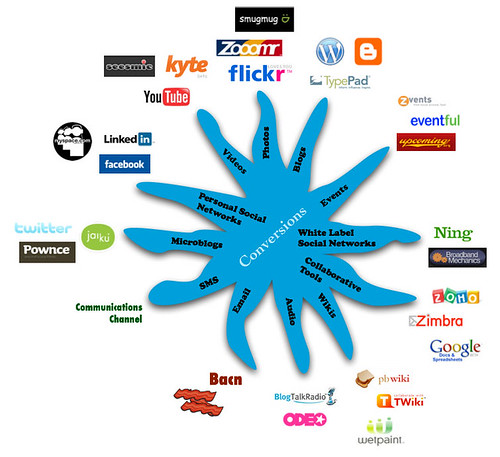
Possibly the first consolidated attempt was by Robert Scoble, who published the Social Media Starfish last year.
Pictured below, the Starfish provides one way to visualise the different categories of interactions and capabilities of the different social media tools.
A video explanation of the Starfish is also available as below.
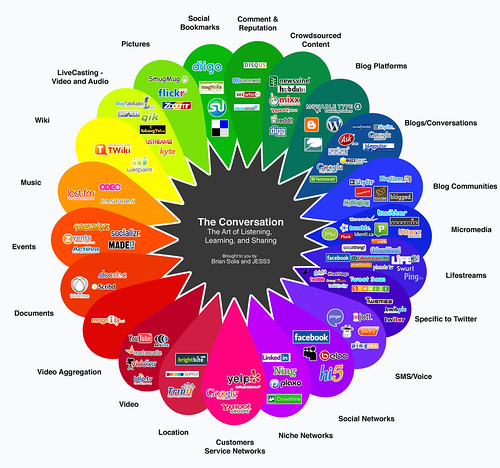
A second approach, released more recently, is the Conversation Prism, pictured below.
This was released by Brian Solis, principal of Future Works and author of PR 2.0.
In a report in ZDNet, Brian describes the Conversation Prism as a tool that "helps chart online conversations between the people that populate communities as well as the networks that connect the Social Web." The article, ‘Conversation Prism’ helps corporations visualize social media strategies, provides a good overview of how the tool works.
Of course these maps are only a start. The social media environment is evolving as technology improves and smart people come up with new ways to facilitate human interactions via digital channels.
However now that we do have these maps, we can begin to understand the social media landscape in more detail, and apply the right tools for our communications needs.
Monday, August 18, 2008
Making website error pages helpful - 404 no more | Tweet |
If you've ever mistyped the name of a webpage, or used a hyperlink to visit a page that has been removed, you've probably seen a website's 404 - page not found 'error' page.
This code is meant to communicate that the web server hosting the website could not find the page you requested.
The default 404 error page for websites, as illustrated below, is generally not very helpful for users.
The default is largely a dead-end page, without clear pathways to the site's homepage, top content, search, sitemap or other navigational aids.
There are no mechanism to provide feedback, alerting the website's owner of the issue, and uses codes and terminology which many internet users would not understand.
If your website error page looks like this, you may want to consider creating a custom error page - one that provides a more effective message, and navigation options to your audience.
My personal preference is to remove all mention of '404' or 'error' - the numerical code can alienate non-technical users, and is largely meaningless to them anyway.
Calling the page an 'error' could be construed as it being the user's fault that they reached this page. This is neither relevant nor helpful. The goal is to get the user to the content they need, not to tell them that they are at fault.
Many government agencies have already made these types of changes to their 404 error pages. Below are several examples of them in action.
- A very helpful page is the ATO site error page, which provides ample navigation to the top sections in the site, plus routes back to the homepage and to leave feedback.
- Another example is the Australia.gov.au error page, which directs the user to the homepage, sitemap and FAQ page, plus provides quicklinks to three of the top current government campaigns.
- Centrelink's error page is also helpful, with links to their homepage, search and A-Z list, plus a way to provide feedback on the site.
- The Attorney General's department error page isn't within the site's usual design template, but still provides an avenue to get back to the home page.
- The CSA website error page (which my team manages), is a simple, but communicative page. We've renamed it from being an error, to simply reporting that the page could not be found, and provide some avenues to get to the correct content via search and sitemap.
Changing an intranet from 'talk at' to 'talk with' | Tweet |
Traditional media tends to talk at consumers rather than talking with them.
This is often due to the one-way mediums used and is also a reflection of the self-centric world view people and organisations tend to develop.
Humans tend to carry over existing ideas, approaches and methods into new mediums, and then figure out how they have to change them. The early days of movies, with stage show-like productions is a classic example.
This tendency has also led to ten years of websites and intranets falling into the same pattern of talking at their audiences, with the new new thing only now being to talk with them.
Our audiences, also used to being talked at, sometimes find it a little confronting to suddenly be asked what they think, though the last ten years have changed this to some degree.
One of my challenges for my agency's intranet is to influence the approach of our content publishers and consumers from talk at to talk with.
It's a tiny change in words, but can be life-changing for an organisation or individual.
Our latest initiative in this area has been to add a page rating/feedback system, which allows any staff member, on most pages of our intranet, to tell us whether the contents met their needs fully, partially or not at all.
They can then leave feedback as to why the content didn't meet their needs, to allow the content owner to consider and reassess the page and make any necessary changes.
We allow staff to make comments as frequently as they like, and do not protect any pages from commentary (although certain pages are excluded as they are either transitory news stories or purely navigational pages).
The only restriction on staff is that they are identified when submitting a rating and/or feedback. This is to ensure the system is used responsibly and prevents any anonymous biasing of page content - either to the positive or negative.
Content authors can view the ratings and feedback for their pages, and centrally we can view all ratings and feedback, to help identify areas of improvement.
Since introducing the system in the second week of August, we've received an average of more than 30 ratings per day, with feedback on over 100 pages in the intranet. There's a good spread of 'yes', 'partially' and 'no' ratings, indicating that our staff are willing to tell content owners when they've provided exactly what was needed, as well as when they have not.
We're now working with content owners to help them take full advantage of the system in adjusting content, where required, to more fully support our staff and thereby help them in their jobs.
Centrally my team is using the system to identify areas where our intranet currently lacks content important to staff and support our other measures of staff satisfaction.
This type of feedback system isn't particularly new or leading edge in itself, but the impact it can have on the organisation is profound.
In the short-term we are forming a better understanding of staff needs and building towards more of a two-way interaction with them to support them in their roles.
Over the longer-term we're creating greater engagement and participation in the intranet as a staff support tool.
We're also supporting the success of content authors and owners. While we have a fantastic group of authors now, who are committed to ensuring our staff have what is needful, the page rating/feedback tool adds a layer of accountability to their actions. They can more rapidly identify how successful they have been and make their content even better targeted.
This type of interaction system is a lot of work to run and manage. It requires more effort to interact with others and continually improve than it does to write content, tick the box and move on - never to review it again.
However the rewards for the organisation are immense.
- Improved staff morale - as they are heard and supported
- Better customer service - as staff can access appropriate content and support
- Greater intranet engagement - allowing the system to become a strong staff support tool
- More effective organisational management - the system increases managerial understanding of staff needs
Sunday, August 17, 2008
Managing a cross-agency/government project online | Tweet |
I believe that one of the keys to successful projects is to maximise time spent on the project goals and minimise time spent dealing with project tools.
In the past I've seen projects fail or delayed due to the difficulty in managing project teams across different areas of a single organisation or, worse yet, across organisations.
The tools used to manage project teams often do not translate across organisational silos.
Fortunately, in a connected world, we can do better. Below is one vision of how to run a major project (at low cost) using secure and well established online tools.
You'll see most of them in my Top Tools list - and, yes, I've eaten my own dogfood.
- Create a secure Govdex group to centralise project information and allow project team members to collaboratively develop project documents (as wiki pages)
- Use a Yahoo group or Google group to manage an email discussion list and calendar
- Use Mindjet to brainstorm the project
- Use Google docs to collaboratively work on project tasks and formal documents such as a risk register and issues list
- Use Basecamp or Copperproject for project timelining and gantt charting
- Use Webex for video conferencing across the team, or free voice conferences via Skype
- Use Flickr or Photodump to store photos and images
- Create and manage a project blog/diary via Blogger (public or private)
- Share PowerPoint presentations via Slideshare
- Share project videos via YouTube
Saturday, August 16, 2008
How should intranet teams spend their time? | Tweet |
Catherine Grenfell of Step Two Designs has written an excellent article on how intranet teams should spend their time, divided between day-to-day maintenance, new projects and initiatives and relationship management with internal stakeholders.
She left out one small area - networking with peers for fresh ideas and approaches to common issues.
For this, the Intranet Peers in government group is well worth a look (it's operated by Step Two as well).
Trialing Windows Live Writer | Tweet |
This is a quick test of the use of Windows Live Writer to produce blog posts offline - for those rare occasions where I am not connected to the internet.
The tool lets me
- Set up my blogs
- Write posts
- Save them for later publishing
- Send them automatically when I connect
It picks up the categories from my blog, and largely uses my blog styles.
I like the spellchecker in Firefox better however!
Setting the date and time of publishing is a little odd as well.
Friday, August 15, 2008
Does government assess online channel risks effectively? | Tweet |
When chatting with a friend about risk management via IRC recently, he referred me to the essay The Psychology of Security.
This is quite a good paper discussing how poor humans are at understanding and assessing risks and their impact on security.
Most of the time, when the perception of security doesn't match the reality of security, it's because the perception of the risk doesn't match the reality of the risk. We worry about the wrong things: paying too much attention to minor risks and not enough attention to major ones. We don't correctly assess the magnitude of different risks.
Gain versus loss
One area it explores is how most people are more worried about the risk of a potential loss than inspired by a potential gain - even when the probability is the same.
When the same risk is presented in two different ways, as the probability of a gain or as the probability of a loss, people respond differently, as illustrated in this example from the essay,
In this experiment, subjects were asked to imagine a disease outbreak that is expected to kill 600 people, and then to choose between two alternative treatment programs. Then, the subjects were divided into two groups. One group was asked to choose between these two programs for the 600 people:In this experiment A = C and B = D, so logically both groups of subjects should choose the same option.
- Program A: "200 people will be saved."
- Program B: "There is a one-third probability that 600 people will be saved, and a two-thirds probability that no people will be saved."
The second group of subjects were asked to choose between these two programs:
- Program C: "400 people will die."
- Program D: "There is a one-third probability that nobody will die, and a two-thirds probability that 600 people will die."
Yet most people (72%) choose A over B, and most people (78%) choose D over C. People make very different trade-offs if something is presented as a gain than if something is presented as a loss.A familiar or known risk is underrated
Another area discussed was how people tended to worry less about the familiar than they did about the unfamiliar and have difficulty assessing risks outside their experience. To quote from the essay,
- People exaggerate spectacular but rare risks and downplay common risks.
- People have trouble estimating risks for anything not exactly like their normal situation.
- Personified risks are perceived to be greater than anonymous risks.
- People underestimate risks they willingly take and overestimate risks in situations they can't control.
- Last, people overestimate risks that are being talked about and remain an object of public scrutiny.
What does this mean for assessing online channel risks?
The internet is still very young and poorly understood by many organisations.
The risks are unfamiliar and outside the experience of many people.
While there are many possible gains through using the online channel, there is also the risk of loss. Potentially the loss of reputation and the opportunity cost of funneling resources to online initiatives that fail.
Based on how humans commonly assess risks the combination of an unfamiliar environment and the potential downside can lead to many online risks being overexaggerated, whereas risks for a more familiar channel would be understated.
For example, consider the alternatives of having a minister or senior public servant engage in a scheduled online chat versus participating in a radio talkback session.
For the talkback the risks would often be considered minimal - it's a well-known environment, and while there are risks of awkward questions from the host or callers, these are accepted as part of the background of the medium and processes on how to manage them are well understood.
For the online chat the risk of unmoderated chatters could be a major concern - even though mechanisms for handling this exist, such that questions can be screened even more effectively than on radio.
There could also be risks raised around hacking, which can also be thoroughly mitigated. For the radio talkback the risk of someone blocking the radio signal or sabotaging the power supply to the transmitter would not even register.
Finally, there could be concerns raised around the ability of the minister/public servant to communicate clearly and effectively via the chat tool. This can also be managed - some answers can be pre-prepared, or a typist could be on hand to type the responses as they are needed.
On talkback radio a similar concern would be raised - and managed through media training.
There are many other examples I've witnessed and heard about where online channel risks were exaggerated alongside the risks of other channels.
How to ensure that online risks are assessed accurately
This is the billion dollar question - determining a process that allows risks related to the online channel to be accurately weighed and considered alongside risks for other channels.
My feeling is that the only effective solutions are education, process change and time.
Of these the first can be directly influenced. Those managing their organisation's online channel or web-based services need to be actively educating others across their organisations on the benefits and issues with online. This raises familiarity and understanding, therefore helping other normalise the internet in their worldview and thereby begin treating online risks in a similar way to those for other channels.
Process change involves modifying the processes around risk identification and rating in order to rebalance the consideration. This can be influenced by education, however generally requires profound changes to organisational risk frameworks, corporate guidelines and policies. High level support is necessary to move this along.
The final solution, time, can be influenced by education, but only to a degree. At the end of the day it may simply require another 20-30 years for organisations to undergo the changes required to understand and integrate online risks accurately into an overall risk framework.
How does your organisation weigh online risks?
I'm interested in how other organisations weigh online risks - whether the risk of change
or the risk of not changing.
What's been your experience of how organisations compare online risks versus others?
Global boom in high-speed broadband - but where's Australia? | Tweet |
Just as electricity infrastructure is the lifeblood of an industrialised society, high-speed broadband is the lifeblood of a modern information society.
There's an enormous wealth gap between nations that took a first mover advantage in establishing appropriate infrastructure to facilitate economic development and those that did not place infrastructure as high on the agenda.
We're now beginning to see the initial edges of what will be the next great economic divide, defined by the speed at which nations are facilitating the roll-out and adoption of high-speed broadband.
It worries me as both a private citizen and as a public servant that Australia has made little measurable progress towards high-speed broadband, while other nations are moving forward quickly.
It also worries Paul Budd, who's latest blog post, FttN - already out of date, presents a worrying picture of what is occurring in Australia as compared to elsewhere in the world.
For the sake of Australia's future, I hope we see a quantum change in Australian conditions.
Sourcing great ideas - UK's 5th annual e-Government National Awards | Tweet |
I find many useful ideas by reviewing the nominations and winners of past awards, so even if you do not live or work in the British Isles it could still be worthwhile to check out the UK's 5th annual e-Government National Awards.
Of course if you are in the UK, you might want to consider entering before nominations close on 1 October this year.
Thursday, August 14, 2008
Website media sections are old news | Tweet |
Humans love news.
While the channels we use to find out the news continue to change, most of us still need our daily news fix - details on what is happening in our organisation, our country and our world.
When I first became involved with the online space in 1995, an 'about us', 'communications', 'PR', 'In the news' or 'Media' section was already a common feature for many websites. Placing media releases online made sense as a method of distributing and archiving an organisation's news.
Today it is accepted practice that organisations include their media releases on their website. In fact, not much has really changed. Journalists go to an organisation's website media section to review media releases, or subscribe to a 'push' service such as an email list or RSS feed to get alerted whenever something newsworthy is released.
Some organisations have added press kits, official photos and executive bios. A few include transcripts of speeches or video. However for the most part there's been little innovation compared to the rate of change for other aspects of websites.
This lack of innovation was brought home to me in an article by Maish Nichani of Pebbleroad, Designing the Online Newsroom.
The article questions the traditional role of a website media section, today's audience is much broader than journalists and the needs of the audience have changed.
It makes the point that a website media section is no longer simply a feeder for media - it is an online newsroom in its own right;
The newsroom section in corporate and government websites is not just about press releases anymore and nor is it just for the press. The demand by a broad spectrum of customers to be updated on what’s happening at every front of the organization combined with the organization's need to promote and educate customers about new directions has expanded the role of the newsroom.
Maish suggests that organisations rethink the purpose of their website media section to address and engage a broader audience, and provides some examples of the types of content and features leading organisations are adding, such as,
- In-depth features
- Latest news stories
- Interviews or customer stories
- Speeches
- Podcasts
- Blogs
- Videos
The article provides some excellent examples of organisations across the public and private sector who have developed online newsrooms, such as the United Nations, Nokia and Cisco.
It also provides a roadmap of how to rethink a media section and turn it into a more useful online newsroom.
I've passed on Maish's article to our media team to help support them in how they think about our online media section and are beginning to think myself about how we can use our media section more effectively to speak to our broader stakeholder and customer audience.
Live call-in show discussing the strength of the relationship between internal communications commitment and intranet effectiveness | Tweet |
The online talkback radio program, The Hobson & Holtz Report, will be spending an hour discussing the topic of my blog post on the relationship between a strong commitment to internal communications and an effective intranet.
The program, presented by Shel Holz in California (US) and Neville Hobson in Berkshire (UK), discusses public relations and technology in a twice-weekly podcast.
The live call-in show discussing the topic of my post is set for Saturday, August 23, at 10 am US Pacific, 1 pm US Eastern, or 6 pm in the UK. - which makes it 3am in eastern Australia.
For those who do not want to get up at this time, it will be stored on their website for later listening, and I'll add a link from my blog.
Wednesday, August 13, 2008
Using social networks to add value within organisations | Tweet |
I worry sometimes that MySpace and Facebook, despite their phenomenal growth over the last few years, may be actually slowing down the adoption of social networks within organisations.
By presenting social networks as largely involving frivolous, time-wasting tools to promote bands, buy and sell people's photos or exchange virtual gifts, these networks position social networks as playthings for young people rather than serious business tools.
Senior managers are not interested in introducing services which appear to be designed to distract staff from their jobs and add no measurable value.
I believe that social networks, applied correctly, are a powerful stimulus for organisational efficiency, information management, collaboration and innovation.
A few organisations already provide social networks for their staff and have realised real business value, as discussed in a ComputerWorld article I discovered via Victoria's fantastic eGovernment Resource Centre.
The article, Social networking behind the firewall, discusses the benefits being realised by Deloitte Consulting, IBM and Best Buys through their internal social networks.
Deloitte's D Street has supported the organisation in,
- Attracting and retaining talent
- Developing virtual teams (geographical collaboration)
- Building expert networks and communities of practice
- Sharing information horizontally across the organisation
- Build stronger relationships between different teams and individual staff
- Extend internal dialogue and collaboration
- Foster innovative thinking
- Tap into marketing ideas across the organisation
- Refine organisational policies
- Shape strategic thinking
- Close the gap between frontline and corporate staff
Perhaps this is the message intranet managers need to communicate to help senior executives understand the business value of social networks, rather than focusing on the joys of Scrabulous.
California launches a best practice government wiki | Tweet |
As reported in Government Technology, California has launched a best practices wiki for state employees.
It currently covers topics including:
- Healthcare in Prisons
- Customer Service
- Disaster Preparedness
- Education and Training
- Green California
- Human Resources
- Information Technology
There's an interesting write-up regarding the process used to create the wiki as a sample best practice.
I expect to see more of these types of self-regulating professional networks emerge across government over the next few years in support of moves to whole-of-government standards and to improve knowledge capture, transfer and management.
Tuesday, August 12, 2008
Growth of social media use in US congress - is it sustainable? | Tweet |
Apparently 33 of the US's congressmen are now actively using the Twitter micro-blogging service to give timely updates of what is occurring on the floor of the US Congress.
From the article, Twitter takes flight in Congress, in Federal Computer Week, the service has facilitated real-time discussion with constituents regarding legislation under consideration and appears to be beginning to influence how elected representatives engage with their constituents. From the article,
The article does point out the risk of these technologies being used purely for political messaging, another way to distribute media releases.Ari Herzog, a political blogger who has been following the use of Twitter in Congress as well, said that he sees Twitter as a way for elected officials to show taxpayers and voters what they are doing.
“Whether the future with the Congress will be in YouTube or in Twitter or in some other technology, I think [those type of technologies] are where it’s going to be,” said Herzog.
In my view this is the risk of any communications medium, and the best equivalent is talkback radio - yes it will be used to communicate political messages, but it will also support communication between public office holders, government agencies and citizens.
Benchmarking government websites, intranets and egovernment services | Tweet |
I've found it quite difficult to benchmark my agency's online services against those of other agencies in Australia.
Besides AGIMO's annual report on Australians' use of and Satisfaction with e-Government services and some of their past case studies, there's limited information available across Australian agencies regarding different departments' online experiences.
Over in New Zealand they recently benchmarked local government sites (PDF) and also benchmark government use of ICT and accessibility every few years.
In Europe they benchmark the supply of online public services (PDF) and a document from 2004 provided a very keen insight into why and how to benchmark public services.
In the US there is a quarterly review of government sites for user satisfaction.
So if anyone from another government agency is interested in benchmarking their online services, drop me a line.
Monday, August 11, 2008
How strong is the link between strong internal comms and intranet maturity? | Tweet |
Without staff most organisations would cease to function.
Without communicating to staff what they need to know, organisations cannot function effectively.
That's one of the reasons why staff communications tools - including intranets - are very important.
However communicating with staff is generally not as exciting as making big budget television commercials, as this very amusing video from ABT illustrates.
I've often wondered about the strength of the relationship between an organisation's commitment to internal communications and its commitment to an effective intranet. I have worked in organisations with strong internal comms cultures, but with very poor intranets.
Has anyone seen any research on this?
Online engagement - learning from the private sector | Tweet |
A few months ago a PR agency representing the National Australia Bank (NAB) made a series of comments on AFL blogs advertising NAB services.
This incident has been discussed in publications such as Marketing Magazine, NAB spamming: maybe it's time to take dance lessons and Crickey, NAB spams blogs to spruik its SMS banking, which confirmed that the approach was endorsed by the NAB. From the Crikey article,
Crikey's article went on to point out that the NAB had a strong anti-spamming message on its website, which did not seem to apply to how the bank chose to engage with others.NAB media relations spokesperson Felicity Glennie-Holmes confirmed that the message was indeed from the bank. The idea to spam the comments sections of private blogs was a recommendation of PR agency Cox+Inall, part of the BWM group, and had been undertaken by Cox+Inall with the bank’s full knowledge and approval.
Cox+Inall had searched for blogs that included AFL coverage and were “well-enough read to attract readers who might be interested in our offer,” said Ms Glennie-Holmes. No-one at NAB or at Cox+Inall had considered approaching blog owners first for permission before posting their promotional messages, she said.
“Blogs are a public forum”, said Ms Glennie-Holmes. NAB and Cox+Inall felt this meant commercial interests could feel free to contribute unsolicited and irrelevant commercial material as comments, placing the onus on blog moderators to reject or delete unwanted comments.
The incident has created a great deal of concern across the blogging community and a number of people I have spoken have lowered their view of the NAB.
An example of the backlash is this Youtube video looking at how NAB would feel if people came onto NAB property to advertise their own services. It's cheap and grainy - but the point is clear, respect the rights of others in their own spaces.
Bloggers have also contacted NAB directly to complain about this incident and a recorded interview was published online, as reported by Better Communications Results, StewArtMedia and NAB’s comment spam.
What can be learnt from this
I believe there are a couple of things communications professionals can learn from the NAB's experience.
Understand the channel and medium before engaging
The view of the NAB was that blogs were public forums, available for commercial comment.
In this case I feel that the NAB did not initially build a strong understanding of the online channel and consider how the medium of blogs actually function.
While blogs are available publicly, they are usually owned by a single individual and operated in a highly personal way. Just as people would take offense if an advertiser came into their home and started talking to their family and friends about a commercial offering, blog owners are proprietory about their blogs and need to be approached and engaged in an appropriate way.
This applies equally for an situation where an organisation engages with someone else's online property - be it a blog, forum or chatroom.
It is important for the organisation to take the time to understand the appropriate ground rules for the venue, consult appropriately and engage with the full agreement of the site operator.
Respect others
Respecting others is part of the social 'glue' that holds civilisation together. By stepping into someone's space and shouting a message an organisation, or individual, can be demonstrating a lack of respect.
While the internet is a public service, and blogs and forums publicly accessible, they still have rules of engagement - just like a public event.
An organisation seeking to engage within the online medium needs to spend the time observing to understand the social rules and codes of conduct before diving in.
This demonstrates respect for others and demonstrably changes the reception the organisation will receive.
Online engagement must add value
In this case the NAB posted commercial messages unlinked to the discussions taking place in the blog.
There did not appear to be any planning or thought around building credibility with the audience or adding value with the comments.
For organisations engaging online it is not sufficient to rely on the branding and established reputation in other mediums. Organisations need to think about what they bring to the forum or blog and what value they add to the conversation.
An organisation that provides adds value to the online conversation (speaking with), rather than advertising (speaking to) will build credibility and gain opportunities to communicate its message in more engaging ways - thereby being more successful.
Use an honest voice
In the NAB incident, a PR agency posted the comments - and they were posted anonymously, not as an official representation of the NAB.
When engaging online if you want to be taken seriously as an organisation you must represent yourself as who you are. Use an honest and real voice, advertising agencies can only take you so far, organisations will achieve far greater credibility and cut through if it is an actual representative of the organisation making the posts, using their true voice (not pre-processed PR statements).
This is very hard for organisations to understand, given the formal nature of engagement in other mediums - the best example is to think of the online channel as talkback radio and engage accordingly.
In conclusion
Thre's a lot of material available in print and online discussing the right and wrong approaches to online engagement. Most of it follows the same general theme as my points above, understand the medium, be respectful of others, add value to the conversation and use an honest voice.
Take advantage of this when developing your online engagement strategy and you'll avoid many of the mistakes organisations first face when making a decision to use the online channel actively.

