


 Posts
Posts


People invest an enormous amount of identity and personal energy into their own names.
Names are our unique identifiers, defining us as separate to others - even for people with common names.
So when organisations make rules about the names people can use online it can create signficant distress and dislocation for people.
It also raises questions over who can decide your identity. Can corporations deny people the use of their legal names online simply because they don't fit a narrow model of what the corporation regards as 'appropriate naming'?
A recent example I've been following is Stilgherrian's battle with Google over the use of his legal name for Google Plus. You can follow it at his blog (strong language) or read about it at The Register.
Stilgherrian changed his name over thirty years ago to a mononym - a single name. His passport and official records all reflect this and those of us who know Stilgherrian personally have never experienced any dislocation or issue with engaging with him as an individual with one name.
However Google's Plus service has defined rules for allowable names. Firstly it requires that you use your legal name (although Google is apparently not requiring evidence or checking with authorities in most cases to verify). Secondly, it requires that you have a first name and a last name and that there's no spaces or characters like an apostrophe in your name.
Now while this might fit a certain segment of the population, there's a number of people who have either only one name (as is common in a number of countries), have spaces in their names such as "Dick Van Dyke", or use apostrophes and other non-standard characters.
The net result is that Google is blocking people with names that don't match its view of what is a legal name - and requiring that people provide documented proof of their 'anomalous' legal names.
I have another friend who changed her legal name to a mononym (which includes an apostrophe) over ten years ago. About two weeks ago she announced that she was changing her name to add a 'first' name, so that she could use Facebook and other social media channels to communicate with people.
She had finally reached the point where her single name was excluding her from legitimate social interactions due to the naming policies of (mainly) US companies.
I have a real problem with this situation, for Stilgherrian, for my friend and for the millions of other people around the world who have names that don't fit Google or Facebook's views of a legal name.
Firstly, 'legal' names should be defined by governments, not corporations. Australia's governments, and many governments around the world, support a much wider variety of legal naming conventions than social networks appear to allow.
Secondly, isn't it discrimination when corporations deny you access to their service due to the format of your legal name? Denying a service to an individual just because their name is structured differently to their business rules might be legally actionable.
Finally, what right do corporations have to your legal name anyway - particularly if they make it public. Many people have good reasons for not revealing their legal name publicly. Those in witness protection programs, minors, people with embarrassing 'real' names and those who are widely publicly known by a name other than their legal name, are all candidates for using a different name to their legal name online for legitimate reasons.
It is fair to deny people access to online services, particularly when these services are in such widespread use, just because they can't publicly disclose their legal name?
All of the examples above relate to corporations. However there are examples which may also refer to government as well.
There have been calls from a number of quarters in various Australian government to restrict people to the use of their legal name when commenting online. The purported reason is that people are less likely to behave inappropriately if they can be held accountable for what they say. The subtext is that people become easier to monitor and track.
I am not a fan of this approach for governments either. Like above, there are legitimate reasons why people might choose to not use their legal name in online discussions.
It can also be very hard to identify many people from their legal name alone, given the number of duplicates that may exist. Any step taken to require legal name use would have to attach address and proof of identity in order to identify specific individuals. Even then, identity theft would lead to many misrepresented identities.
Also there are other ways authorities can identify individuals if there are legitimate reasons to do so (such as discussion of committing a crime) - using IP addresses and various analysis techniques.
What is useful for government, is being able to identify consistent identities online - whether individuals choose to use their legal names or not.
Consistent identities allow organisations to build user cases based on profiling views across different topics, supporting policy development and decision-making without compromising personal privacy or security and while allowing people to define themselves online as they choose.
Wednesday, August 31, 2011
What's in a name? | Tweet |


Tuesday, August 30, 2011
ACT Virtual Community Cabinet #2 | Tweet |
The ACT is holding its second Virtual Community Cabinet tonight from 7pm to 8pm, so I have again set up a livefeed to capture the tweets for the record, and to allow analysis afterwards.
I am only capturing tweets including the hashtag for the event (#actvcc), so if you are participating, but don't include the hastag, your tweet will not appear below.
Also note that CoverItLive, the tool I am using, doesn't necessarily capture every tweet due to the way Twitter's API works, so this may not be a complete record of the discussion.
I hope that the ACT government will record it and provide an official 'transcript' after the event (although I am not aware of them doing so for the last virtual community cabinet)
UPDATE: Unfortunately there was an issue with my CoverItLive, which did not start last night as scheduled, and I wasn't near a computer to check :(
Therefore I didn't record the session and at this stage are not able to report on it.
I'll look at alternatives through other tools to see if I can get a record of the event.
A basic analysis is available from the Archivist here and a record at Twapper here.
There is also a good analysis at the blog Keikaku Doori
What's faster than an earthquake? Social media | Tweet |
While comparatively weak compared to quakes experienced elsewhere in the world in the last year, the event was powerful in one sense.
It demonstrated the speed of social media.
People in New York learnt of the quake before it actually hit, by reading the tweets of people experiencing the quake in Washington.
Yep that's right - news about the quake travelled faster through social media than the actual quake travelled through the ground.
Here's a comic from xkcd (found via Wired) illustrating the point. Note this was written before the quake!
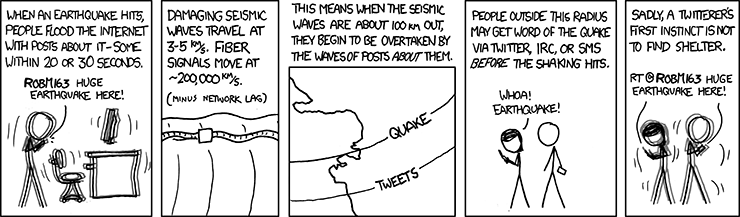
Socialnomics reported that there were 40,000 quake-related tweets within 60 seconds. It also reported that "Facebook said it had some 3 million U.S. users updating others about the event."
This included more than tweets from the public. The Socialnomics post also reported that a proportion of messages came from government agencies,
According to a FEMA spokesperson, the agency put Twitter to use to alert people impacted by the quake not to use cell phones unless absolutely necessary, thereby freeing up some of the lines for emergency calls.
Among the tweets was this one from the Department of Justice – “Quake: Tell friends/family you are OK via text, email and social media (@twitter & facebook.com). Avoid calls.”
Meantime, New York City Mayor Michael Bloomberg tweeted – “I’ve spoken w/ our Police and Fire Commissioners & we’ve activated the Emergency Management Situation Room. Thankfully, there are no reports of significant damage or injuries in NYC at this time.”
Twitter also thought it worth releasing a short 'boast' video about its speed, as republished in Mashable:
The earthquake's impact on Twitter was even presented at the G-Force conference in Melbourne the same (US) day - via this video recorded and presented by Charlie Isaacs, eServices and Social Media Engineering, Alcatel Lucent.
Back to the Socialnomics article, social media is becoming a critical important channel for emergency management,
According to a pair of June Red Cross surveys from more than 2,000 people combined:
“Social media is becoming an integral part of disaster response,” Wendy Harman, director of social strategy for the American Red Cross, said in a statement. “During the record-breaking 2011 spring storm season, people across America alerted the Red Cross to their needs via Facebook. We also used Twitter to connect to thousands of people seeking comfort, and safety information to help get them through the darkest hours of storms.”
- After television and local radio, the Internet ranks the third most popular way for people to obtain emergency information with 18 percent of both the general and the online population directly using Facebook;
- Nearly one fourth (24 percent) of the general population and a third (31 percent) of the online population would turn to social media to alert loved ones they are safe;
- Four of five (80 percent) of the general and 69 percent of the online populations surveyed think that national emergency response organizations should regularly monitor social media sites in order to respond quickly.
Now to spoil a good story, the Wired article in which I found the xkcd comic, Tweet Waves vs. Seismic Waves, did an analysis of the effectiveness of Twitter in warning people about this particular quake so that they could take action to protect themselves from its effects.
The analysis, while limited in scope to this one quake, indicated that barely anyone would have had the time between receiving information via Twitter and taking an action to seek safety.
Of course, social media isn't only useful for earthquakes - fires, floods and many other disasters spread at a slower rate conducive to social media warnings. Also larger earthquakes may have bigger radii, meaning there's greater prospect of people catching news via social media and having time to take action.
There's also still plenty of value in getting news about a disaster as, or just after it happens, elsewhere in the world, This allows emergency management mechanisms to swing into action - in this case every minute saved can preserve lives.
So I'm definitely of the view that social media has important uses in disaster and emergency situations. It can save lives directly and indirectly and help management teams do their job.
Organisations just need to ensure that social media is thoroughly integrated into official disaster management plans and appropriate channels are in place before emergencies occur.
After all, might it not be considered negligence if governments and organisations ignored social media in emergencies when it could save lives?
Monday, August 29, 2011
Avoiding the 'social media graduate' approach | Tweet |
I've commented before that it isn't a sound strategy for organisations to entrust their social media strategy to graduates, simply because they are young and "must understand social media".
I've also commented on the need to expand social media engagement beyond the communication team to entire organisations, within designated policies. This is because communication professionals see the world through a particular set of filters that can restrict an organisation's capability to gain many of the broader benefits from social media tools.
The following video does a great job of summing up my views in a single two minute long discussion, courtesy of Socialnomics author Eric Qualman (via the Digitalbuzz blog)
And to throw in another video from Socialnomics...worth a look.
Thursday, August 25, 2011
ACT Government opens discussion on open government website | Tweet |
In what I believe might be a first in Australia, the ACT Government has released the requirements and wireframes for its upcoming open government website for public scrutiny and comment at its Time to Talk website.
Essentially the ACT government has decided to allow the community to give feedback on the upcoming website's proposed functionality and design before they spend the resources to actually build it.
This step could help reduce site costs and improve community satisfaction by ensuring the site is build to a specification tested to meet public needs.
Of course, as this is the first time the ACT government has taken this kind of step, it may take time for people to become aware of the consultation, to consider the material and to comment. Also, many people are unfamiliar with specifications or web design processes, so it could be a challenge for them to understand and provide constructive advice. Hopefully a number of the web-savvy people in Canberra will step up, take a look and provide comment (as I intend to do).
Otherwise this might be a very quiet consultation and not deliver an outcome that encourages others to take similar steps in the future.
Gov 2.0 at the 2011 Public Affairs Conference | Tweet |
You may still have time to consider attending the Media, Entertainment & Arts Alliance and the Walkley Foundation's Public Affairs Conference in Canberra from 5-6 September this year.
The conference has a significant Government 2.0 and open government flavour, looking at the new toolkit of digital communication and engagement options available to public relations professionals and the effects of the FOI reforms on public relations.
There is also what looks to be a very interesting case study on the Clean Energy Future digital campaign including its social media and web engagement.
I'll be presenting a keynote (on Government 2.0) at the event and participating in one of the panels.
Other speakers specifically in the Gov 2.0/Open Government area will include Professor John McMillan, Australian Information Commissioner; Hank Jongon from DHS; Sandi Logan from Immigration; Tom Burton from ACMA; Kylie Johnson, University of Canberra journalism academic Julie Posetti; and Greg Jericho, known for his blog Grogsgamut.
if you can't attend, keep an eye on Twitter - there should be plenty of interesting titbits from the day.
Wednesday, August 24, 2011
Online-first: Building in web at the front-end, rather than the back-end of government processes | Tweet |
One of the largest challenges for all forms of online use by government is how, as a late addition to the communications, engagement and policy stable of tools, web initiatives often get added to the end of processes rather than the beginning.
A good example is in content development of all kinds. Often officers across agencies use desktop publishing packages to create communications materials, briefs, papers and reports, finalise them via publications teams and printers, then send the final 'web-ready' PDF to the online team, to be loaded online - usually within a few hours.
This poses challenges and risks throughout.
The documents may be initially created without effective use of word processor standard styles (with format issues such as the use of spaces or tabs instead of tables or paragraph marks, and poor use of nested lists), the print design process loads them up with print-quality (sometimes inaccessible) images, adds charts and tables without appropriately text alternatives and incorporates formatting that requires substantial time to replicate online or simply doesn't suit screen viewing.
The final PDF may have 'printer's edits' (last minute changes at the printer) which are not replicated in the original final word processor document. This requires the online team to convert the PDF, rather than the faster and easier final word processor document, into the web version. Often the background information for charts or descriptive text for images is unavailable. Images may also not be available as separate files to the document to make them easier to embed online.
Finally, due to approval timeframes or last minute edits to reflect changing events, the online team may receive the final document too close to the go live deadline to do justice to the web publishing. This often results in the PDF version being uploaded with an apology stating that the agency will convert the document to an accessible HTML web page as soon as possible. Depending on priorities this may take months, disadvantaging people who cannot access the printed or online PDF versions.
As sometimes all the budgeted funds for the document are spent on the physical print process, online teams may be left without sufficient budget to do the document justice, time or dollars to convert the document into a fully web-enabled deliverable, which could be higher quality and far more usable and useful than a printable PDF.
A combination of some of all of these issues adds to the cost and stress of government documents. They can put pressure on agency timelines and result in lower community satisfaction and understanding of communicated material. They may also create greater legal risks due to accessibility considerations.
These potential costs could be avoided by embedding an online-first philosophy, policies and mandate throughout an agency. This would recognise at the beginning of document creation processes that content will need to be delivered online and, indeed, this might be the only, or most important, distribution channel.
This approach would, after initial training and support costs, save significant expense and human effort, freeing up agency staff for higher value activities while delivering more effective, and timely, public outcomes.
The shift could begin with appropriate training, support and mandates for public servants creating material which will need to go online. Including websites and intranets this reflects the majority of documentation now created by government agencies.
Online teams would be engaged at the start of document creation processes, advising other staff on how specific materials can be best designed for online representation, whether as 'traditional' documents or as web services, apps, interactive modules, data feeds or in some other format.
Every document would then be created using appropriate formatting in word processing tools or the appropriate alternative, with an express goal of being able to be quickly and easily placed online in an effective manner.
The created documents may be structured and laid out quite differently depending on the eventual form they will take online - representing the range of variation we already see between a video script, report and brochure.
The document creation process would include the steps necessary to deliver a quality accessible product, identifying the text behind every chart and appropriate explanations for every image and diagram.
As documents were created, graphic templates would also be created by graphic designers, both online and print templates which can be executed through online style sheets. Using this approach documents would appear in a web browser as native webpages but, when printed, be automatically reformatted for A4 paper.
This means agencies can deliver online and print versions from a single version of the content, a 'single point of truth' that removes the need to manage multiple versions, such as HTML, RTF and PDF copies. A print-quality template would also be developed at this stage as a shell for any printed copies needed.
The document would be directed loaded into the web template with the metadata and alt tags required and viewed and edited online, or printed in the print template and hand edited, to finalise the document.
Once approved the 'document' can be simultaneously released online and in print format, appropriately formatted for the different mediums, maximising its impact. There would be no time lag for an accessible version.
Sounds too easy? Well yes, there are a number of changes that agencies need to make to implement an online-first philosophy.
The most significant and influential change in agency policies. They would need to be redeveloped for the modern age, a business process improvement step to integrate web as a core platform rather than an afterthought.
While significant, changing these processes is technically quite simple, it just involves adjusting a few words on (ahem) 'paper'. The most difficult change is related to people - changing culture and retraining staff responsible for producing documents (public or internal) to reflect the new capabilities and skills required of a public servant.
I believe it is inevitable that agencies will gradually move in the direction of online-first publishing, for cost and efficiency reasons if not due to legislative and high-level policies (such as the recent FOI changes). However the speed and difficulty of this transition can be influenced by staff.
Senior staff can set policy in their areas and embody the behaviours they support, while middle management can build their own understanding and support and encourage their teams. Those teams responsible for agency document outputs can seek out new skills through training and lobby their management to make their jobs easier, allowing them to be more productive and satisfied with their jobs.
Online teams have a large central role to play, by demonstrating and modelling the behaviour themselves, identifying processes where documents are only published as web pages and piloting improved processes which lead to efficiencies (helping themselves as well as the teams responsible for the content).
Online teams may also to lobby for improved training, so that officials across an agency understand how to use the word processors and other document creation tools they use daily more effectively - this knowledge by itself improves efficiency.
Having a given level of skills with document creation tools, or developing it once in the job, could become a requirement of recruitment processes and performance reporting. It has often surprised me how otherwise highly intelligent and capable people may simply never have had the opportunity to learn how to most effectively use the tools of their 'trade' - document and presentation creation programs - at school, university or in the workforce.
An online-first philosophy isn't native to government agencies, and it will take conscious and directed effort to make it the default approach.
However in today's world, with online increasingly the first and sometimes the only distribution platform for government information, the rising cost of print, falling budgets and the legislative requirements to deliver government content online - shouldn't we be putting in active efforts to change our philosophy and make it so?

