Friday, February 08, 2013

LinkedIn hits two million - Infographic places Australia in that mix

In January this year LinkedIn reached 200 million active users globally, demonstrating that professional social networking is beginning to be recognised as being valuable alongside personal social networking.

I've just been sent their 'early adopter' infographic, which unlike the infographic on LinkedIn's blog (which gives great demographic breakdowns by profession), provides a view on the country breakdown of usage. This places Australia as growing, but still with significantly less take-up than the US, UK or Canada.

By the numbers, using population, roughly 13.5% of Australians actively use LinkedIn, compared to 23.6% of US citizens, 20.5% of Canadians and 17.7% British.

I put this down to Australia's conservative workplace culture.

We may be innovative and tech-savvy as individuals, but in the corporate, public and NGO sectors our workplaces lag on many international indicators for innovation and technology adoption compared to other nations in the OECD and western world.

Of course this is changing as social media becomes normalised in workplaces and the initial fear, uncertainty and doubt bred by ignorance is replaced by more confident and managed approaches - so I expect there to be plenty of upside growth for professional social networking in Australia in the next ten years.

This is something government agencies and companies need to keep in mind when looking at how they reach professional stakeholders and working citizens.


Read full post...

Your help needed: Crowdfunding the Tim Berners-Lee tour

Whether or not you attended one of the events given in Australia by Sir Tim Berners-Lee in his TBLDownunder tour, it's likely his visit will have an impact on how Australian governments and their agencies think about openness, digital channels and online engagement.

During his visit Sir Tim, the inventor of the world wide web, raised the profile of open government, privacy, open data, high speed broadband amongst many of Australia's senior government Ministers and bureaucrats.

He spoke about digital democracy, privacy and open data - what governments can and should do, and what they should not - to decision-makers, policy writers and the public; 5,500 in-person at events and thousands more online.

The tour was sponsored, however at the last minute one sponsor pulled out, leaving a $20,000 shortfall.


To meet this, the tour's organisers have launched a crowdfunding exercise. As they say on the crowdfunding site's page, "If just 1000 individuals donate $20 each, we can cover this shortfall."

If you were pivileged to hear Sir Tim present during his Australian tour, consider donating.

If you were not able to hear Sir Tim speak, but believe that his tour will help you overcome barriers at your work, consider donating.

And if you don't think Sir Tim's presentations will help you in your job but will help Australian governments become more open and improve citizen engagement, consider donating.

$20,000 isn't that much to raise, if we're each prepared to give a little.

I've given. How about you?

Read full post...

Thursday, February 07, 2013

A counterpoint & follow-up to my post on: Should government agencies & councils be entitled to ban people from their social media channels?


The example I used related to a Twitter conversation I'd had with Peter Hinton, who had been blocked from Parramatta City Council's Twitter account. As a Parramatta council resident and rate-payer he was concerned at his experience.

I didn't have details of his specific case, nor did I make any claims about his comments or the council's decision, rather using the situation to explore the area of agencies blocking citizens on social media channels.

Peter has published an articulate and well-reasoned letter providing details about his experience of being blocked. I thought it worth featuring as a counterpoint to my post, which he has kindly allowed me to republish as a guest post below.

Without commenting on the specifics of Peter's situation, I believe Peter's letter supports my views from yesterday. Agencies and councils have the capability (and willingness) to block citizens on social channels and they need clear guidelines in place about why, when and how they block them (if they do).

This needs to be supported by appropriate governance and scrutiny such that inappropriate blocking can be identified and corrected, with appropriate changes to processes or staff if required.

Peter Hinton:

If you’ve got a Twitter account and even the teensiest amount of gumption, you’ll probably know what it is to be blocked. Some receive a blocking with a sense of pride while others prefer to take offense. I’ll never forget the feeling of exhilaration when I received the telltale FORBIDDEN message when attempting to access the account of a Pray Away the Gay preacher in the US.  
Whether it’s used ag ainst an ex-lover or a dissatisfied customer that just won’t stop hijacking a carefully planned social media campaign, the result is the same. The blockee can no longer view, let alone comment on, your tweets. If you include their handle (eg: @peterjhinton) in one of your own tweets, it will be seen by others but not the intended recipient.  
Throughout my 10,000 tweet career on the world’s most popular microblog, I’ve been both the blocker and the blockee on many an occasion. 
But when I was blocked by Parramatta City Council last week, my immediate feeling was one of disenfranchisement . You see, I’m a resident of Parramatta. I pay rates to its council. I participate in the local government elections that install the Councilors who decide on matters that are quite literally close to home.  
My council isn’t a celebrity whose films I can ignore or an international brand that I can choose to boycott. To be blocked by a level of government is whole other matter and, I’d like to suggest, one that challenges the role of social media in our young democracy. 
Many Australians are surprised to learn that the drafters of our Constitution neglected to explicitly include many of the rights and freedoms that we exercise on a daily basis. There’s a whole section dedicated to lighthouses and telegraphic services but you will not find one reference to ‘freedom of speech’. For a document that forms the basis of our legal system, it lacks all of the life, liberty and pursuit of shiny things that spring from the parchment of the American Declaration of Independence. 
In fact, one of the few freedoms we officially enjoy is merely inferred. In the 1997 case of Lange vs. the Australian Broadcasting Corporation, the High Court ruled that Australians had a constitutional right to freedom of political communication. While it’s not explicitly stated in the actual document, the full bench deemed free and open political communication to be vital to the preservation of democratic and responsible government. 
It’s this ruling that gave me the confidence to criticize my Lord Mayor, John Chedid, over his office’s treatment of the GLBT family support organization,Twenty10.  
On 17 January, dedicated Twenty10 volunteers were helping kids build kites at Parramatta City Council’s Family Fun Day when advisers, allegedly acting on Chedid’s advice, ordered the removal of the organisation’s signage. Chedid has never denied the allegations, instead stating that his advisers were only responding to complaints that the sign was “offensive”. Chedid eventually issued a private apology to Twenty10 but only after 12,000 people signed a Change.org petition demanding he do so
Like thousands of other netizens, I took to Twitter to hold my Lord Mayor accountable for the actions of his office. My comments swung wildly between the visceral and rational but they were always based on statements provided by either Twenty10 or Parramatta City Council. 
Council stuck to their social media crisis handbook. They knew not to block me while the crisis was still building. That would only aggravate the situation and provoke accusations that it had something to hide. Instead, it waited for the inevitable moment when the Twitterverse was caught in the gravitational pull of someone else’s very public faux pas. 
The realization that I had been blocked by my local government came on a Saturday morning one week after #ChedidGate when I attempted to review @parracity’s Twitter stream. My kids were bored and I wanted to see if Council was running any (ratepayer funded) activities. What I got was a big cross and the word FORBIDDEN. 
Forbidden? For what?! Surely not for exercising my right comment on the suitability of elected officials for public office! Surely not for defending some of Australia’s most marginalized families! You can bet it wasn’t for all of the favourable tweets that I’d submitted over the years: the photos of my kids laughing in playgrounds that were eagerly retweeted by Council’s own social media apparatchik. 
While social media offers new opportunities for citizens to converse with all three levels of government it’s a conversation for which the rules are still being defined. You only have to look at the replies to Julia Gillard’s or Tony Abbott’s tweets to know that the conversation isn’t always polite. But, then again, there was nothing in the High Court’s ruling to suggest that political communication needs to be polite. 
Constituents were insulting politicians long before Twitter, whether it was in a Letter to the Editor or a town hall meeting. Which leads conveniently to my mainpoint: there would be serious implications for the council that barred a ratepayer from a town hall meeting and quite rightly so. 
When it decided to block me, my council made a conscious decision to deny me access to its virtual town hall meeting. I’m not so unreasonable as to suggest that I’m now completely shut off from my politicians. I could still write a letter or appear before them in a real town hall meeting. 
My sense of disenfranchisement stems from the fact that somewhere inside the intensely ugly administration building of Parramatta City Council, a public servant took away a small part of my freedom. They did so without having to appear before a judge or even advise the person from which the freedom was removed. It was swift, opaque and final.  
I understand and even appreciate that social media offers few boundaries. It’s precisely because it’s not encumbered by the rules of the old guard that it’s become such a powerful tool for grass roots democracy. But, with your permission, I’d like to tender just one overarching rule: it should never be used by government to disempower its citizens.

Read full post...

Wednesday, February 06, 2013

Should government agencies & councils be entitled to ban people from their social media channels?

I've been advised of an interesting situation with a resident of the Parramatta Council area, who has been blocked by council from their Twitter account.

He's upset and has written to the Council, claiming that it is unconstitutional for a council to block its own rate-playing constituents from viewing their social media accounts, referring to the Lange vs ABC ruling in 1997.

While I'm unaware of the reason for this particular ban, it is an interesting situation and one we're likely to see more often.

Do citizens have a right to interact with government through any channel?

Do government agencies have the right to prevent individual citizens from accessing or interacting via their official social media channels?

If so, in which circumstances do agencies have this right?

In my view social media is no different from other mediums of communication with agencies in this type of situation.

Having worked for the Child Support Agency I'm broadly aware there were cases where querulant, abusive and threatening clients had restraining orders taken out to keep them away from Child Support offices and protect public servants from potential harm.

I have also heard of cases where clients have been banned from communicating with Child Support by phone, due to adversarial and abusive behaviour, and required to communicate with the agency only by writing. (Note I don't have names, places or other details, I'm just aware of these cases' existence.)

Without being a lawyer, I see bans from official social media channels as similar, subject to conditions and requirements.

Public servants have a right to go about their jobs without being abused and threatened by citizens, particularly in situations where staff have no power to influence laws or procedures. Equally agencies, like other employers, have an obligation to protect their staff from inappropriate conduct.

When people join the public service they don't give up the right to be treated with respected (although some in the media, politics and community forget this at times). Public servants should not be subjected to abuse or physical threats except where unavoidable in specific roles - police and defence personnel.

With social media it is relatively easy to set a terms of use and moderate the behaviour of participants through direct messages, moderation, temporary and permanent channel bans.

Generally citizens, constituents and clients have other avenues than social media for contacting agencies and councils, via mail, email, phone and in-person. They also have other ways to source the information they need to interact with councils in an effective manner.

So, in my non-lawyer view, as long as an agency or council makes acceptable conduct clear and other routes exist for citizens to source information and interact with government staff, banning a person from a Twitter, Facebook, or other online channel on a case by case basis, when necessary, is fine.

Of course agencies and councils should be held accountable for these bans, and should be prepared to justify the reasoning for their actions as part of their normal governance processes.

I have, myself, deleted citizen comments from government social media channels when they were off-topic, political or mildly abusive.

I have banned people from access where they were abusive, defamatory, threatening, encouraged violence or law breaking, were highly inappropriate, or where they repeatedly veered off-topic or became political in discussions where the terms of use and community guidelines made it clear that such conduct was unacceptable.

I'd always keep a copy of the term-breaking content as a record and, wherever possible with the social media tool, make it publicly clear why the deletion or ban occurred. When others I worked with managed social media channels, I advised similar scrutiny and approach.

All organisations need to be able to manage their official channels when users repeatedly ignore terms of use or engage via these social media channels for inappropriate ends.

So should government agencies & councils be entitled to ban people from their social media channels?

Yes, in my view, government agencies and councils should be entitled to delete comments and ban constituents from accessing and commenting on their official social media channels.

This is provided the terms of use are public, the moderation approach is balanced, there's appropriate governance and scrutiny in place and where citizens have other routes to source the same information or interact with agencies.

Read full post...

Tuesday, February 05, 2013

Mainstream media takes first steps in adopting open data hacker culture

On Monday 4 February The Age hosted the Data Newsroom event, where teams had an opportunity to dig into three previously publicly unreleased datasets,
  1. Political party funding data, which lists what companies donate money to which political parties.
  2. A database that includes the archives of all Age articles along with key words and relationships between those keywords.
  3. Weather data for Australia going back one-hundred years. 
 As reported by the Australian chapter of the Open Knowledge Foundation (OKFN), 14 teams consisting of journalists, hackers and citizens took on the challenge of producing an article from one of the datasets and convincing a 'Dragon's Den' panel of data journalists of the merits of their approach.

Four shortlisted teams got to go to the public lecture by web inventor, Sir Tim Berners-Lee, at Melbourne  University where the winner was to be announced.

To follow what happens and who wins, follow the OKFN blog at http://au.okfn.org/2013/02/05/the-data-newsroom/


Read full post...

Infographic: The top government Twitter accounts in Australia

In January 2013 I found that the total tweets by all government agencies and councils in Australia I track had exceeded one million.

As a reflection of that achievement I've worked through the data I have on the use of Twitter by government agencies and councils in Australia to produce the following infographic (scroll for more).

I'll be producing state by state (including territories and federal), local and topic-based infographics as a follow-up over the next few weeks, with more detailed information.

I'm considering writing an academic paper on the use of Twitter by government in Australia in case there's any academics out there who would be interested in co-authoring.

Read full post...

Monday, February 04, 2013

Infographic: How Aussies with mobile phones spend their weekends

Google has released a fascinating infographic detailing the mobile use of Aussies in their blog post, Insights into the Mobile Aussie Weekend.

Useful for communications and policy people in government, it provides insights into how Australians are using their mobile phone to search the internet over weekends based on Google's statistical data.

A Day in the Mobile Aussie Weekend


Read full post...

Register now for BarCamp Canberra

BarCamp Canberra is back, with the 6th annual event to take place on Saturday 16 March at the Inspire Centre.

The free event, which annually attracts 100-150 people, is a participation-based unconference, where every attendee is encouraged to actively participate in workshops, give a presentation on a favoured topic and to network with other attendees.

Given it is Canberra, alongside design, technology, data and similar topics, policy development and Government 2.0 are regularly subjects of discussion and presentations.

Note that third of tickets have already been booked for the event, so if you want to go, register now at: http://barcampcanberra2013.eventbrite.com

Full details are at the BarCamp Canberra website: http://barcampcanberra.org/

To learn more about BarCamps, visit: http://en.wikipedia.org/wiki/BarCamp

Caveat: I'm on the unorganising committee for BarCamp Canberra.


Read full post...

Friday, February 01, 2013

Infographic: Which federal politicians are tweeting?

I'm continuing to work on statistics around government agencies and politicians who use Twitter in Australia.

Next week I'll provide detailed statistics on agencies, however given the date of the next Federal election was announced this week, I thought I'd provide a little more information on which of our politicians are tweeting, using the infographic below.

Interestingly while the Government is slightly better represented on Twitter than the oppositions (when including Independents and Greens), the shadow Ministry is better represented than the Ministry, particularly Shadow Parliamentary Secretaries (effectively junior Ministers) who are far likelier to use Twitter than their counterparts.

More statistics are available in my post last week and via my Google spreadsheet, which can be accessed via this post: http://egovau.blogspot.sg/2012/10/update-77-of-australian-federal.html


Read full post...

Thursday, January 31, 2013

Let's crowdsource the Style Manual for government

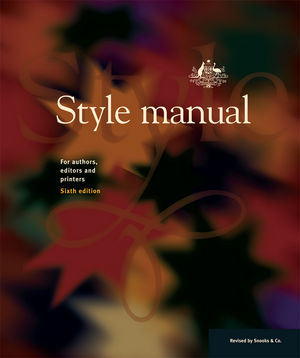
The Australian Government Style Manual:
For Authors, Editors and Printers, 6th Edition
image via Wiley Press
 
When I joined the Australian Public Service in 2006, one of the first manuals I was made aware of was the Style Manual: For Authors, Editors and Printers.

The Style Manual was the bible for communications professionals and senior executives in the APS, containing detailed advice on how to plan, design, write, structure, edit and publish content that met the standards expected of Australia's Government.

The Style Manual was, for the most part, practical; clearly and concisely written while covering a vast range of material in a relatively short 550 pages.

From my perspective the Manual only had one major flaw - it was a print-only publication with a price tag for purchase ($44.95).

What this meant, in practice, was that agencies never had enough Manuals to go around.

While Communications team always had quite a few, and many senior executives had their own copies, many people across departments, who wrote policy, program documents, business cases and other materials for a living, didn't have ready and ongoing access to a Style Manual.

Sure the price wasn't that much (and many people bought their own), however when an agency has hundreds or thousands of staff who could benefit from access to the Style Manual, the cost quickly added up.

Another issue caused by the print-only nature of the Style Manual was the speed at which it updated.

At the time I joined the public service the latest edition, the 6th, was four years old. It was already out-of-date due to rapid changes in web communications. Now the 6th Edition of the Style Manual is over ten years old, it is far out of touch with modern writing approaches and channels.

The first Style Manual was published in 1966 and, on average, editions had been published every six years. That may have been fine in the 'old days' when there were three mass media and before desktop computers and the internet, however it fails to meet the speed of change today.

So I was please earlier this week to see that the Australian Government was going to be going to market to update the Style Manual. However, when I looked into what was initially proposed I was concerned:

The Department of Finance and Deregulation (Finance) is preparing for an approach to market in mid 2013 seeking to form a joint arrangement with a suitably qualified provider to develop, publish and distribute the 7th edition of the Style manual for authors, editors and printers (Style manual). 
Phase 1 of the project involves consulting with industry in order to explore and better understand potential business models under which the 7th edition could be produced, published and distributed. Finance is particularly interested in business models where the provider recovers development costs through collecting revenue from selling the Style manual, rather than Finance providing the capital to develop the 7th edition....
Government News summed up the situation well in their article, Paywall to surround official government Style guide.

I believe it is time for a rethink of how the Style Manual is constructed, managed and distributed, matching the modern technologies we now have.

Here's my proposal.

Let's crowdsource the Style Manual

The principles under which the government Style Manual should operate, in my view, are as follows.

The Style Manual should be:
  • developed by the people who most understand it and need it - development of the new edition should involve writing and media experts, but also should involve the people who use these mediums for government every day, the users of the current 6th Edition Style Manual. Many of these people have suggestions for improvements and ideas for extensions to the Manual which aren't commonly captured or respected in a centrally managed updating process.
  • readily available - to all government officials and to all organisations and individuals who engage or contract with government on the platform and in the place of their choosing.
  • continually current - a 'living document', updated on an ongoing basis to reflect changing communication channels and language usage.
  • relevant - a communal document, with communications specialists (particularly those in government who rely on it) able to participate in its development and ongoing updating so that it addresses their needs and reflects best practice, prompting engagement and use.
  • accessible - meeting the WCAG 2.0 AA accessibility standards
  • useful - providing examples, templates and allowing people to pose challenges and respond with advice and ideas in an active communal way.
  • open and transparent - the style guide should support and reinforce the government's stated open government agenda.
On this basis, I see the 'native' format being a cross between a wiki and an online community, a living Style Manual where people can search for and reference all the content, plus additional examples and templates that cannot be delivered effectively in a print publication.

Every piece of guidance in the Style Manual would support a discussion, with the community of public servants able to ask questions, debate points of style and offer improvements, which could be implemented through a managed consensus and voting approach.

To support people who needed an offline Manual, or who prefer a printed version, regular (perhaps annual) print versions could be released from the website for departments and other organisations to print (at their own cost or via the site) as books or distribute as ebooks across mobile platforms.

If a revenue model is critical, perhaps the site can charge government departments - not individuals - an annual subscription fee based on their headcount. With around 260,000 public servants, a charge of $2 per head would be more than sufficient to cover the running costs of the site, meaning a large agency with 20,000 staff would pay only $40,000 for an annual subscription for all staff, equaivalent to buying 800 copies of the current 6th Edition Style Manual book (one book per 25 people), while a smaller 500 person agency would pay only $1,000 per year.

This subscription fee would allow full access to the online Style Manual and the right to print as many copies as they chose (at their own cost), as well as including full access to enewsletters and the ability to both suggest edits to the guide and to participate in the community, asking and answering questions related to 'gray' areas in style.

Outside organisations may be able to pay for this access as well, at a higher rate.

In summary, we need a government Style Manual. It provides a basis for standardisation of language and common understanding within and without government.

It needs to always be current and accessible, to engage and support the community by going beyond what a book or website can do by fostering a community of communicators within government - whether they use paper, video, voice or the web as their mediums for communication.

We have the technology today to do this in a cost-effective and managed way. It doesn't require a book publisher or distributor to achieve this goal. In fact these companies are often the worst placed to deliver the outcome as they are tied to legacy investments.

Finally, we need the Style Guide to demonstrate and support the government's open government agenda - something a book publisher, seeking profits, would be disinclined to do.

Read full post...

Wednesday, January 30, 2013

Eight business models for government open data

Alex Howard has written an excellent article over at the O'Reilly Radar listing eight business models for government open data, a handy list for those in government agencies attempting to justify to senior management or Ministers why releasing government data is important and valuable.

The models listed in Alex's article, Open data economy: Eight business models for open data and insight from Deloitte UK, were identified by Michele Osella, a researcher and business analyst in the Business Model & Policy Innovation Unit at the Istituto Superiore Mario Boella in Italy.

(Note that these are classified in Europe as Public Sector Information (PSI) reuse cases.)

I've included the list of eight business models below and embedded Osella's presentation on the topic as a reference - it provides more detail and case studies on each.

From the article:
  1. Premium Product / Service. HospitalRegisters.com
  2. Freemium Product / Service. None of the 13 enterprises interviewed by us falls into this case, but a slew of instances may be provided: a classic example in this vein is represented by mobile apps related to public transportation in urban areas.
  3. Open Source. OpenCorporates and OpenPolis
  4. Infrastructural Razor Blades. Public Data Sets on Amazon Web Service
  5. Demand-Orientated Platform. DataMarket and Infochimps
  6. Supply-Oriented Platform. Socrata and Microsoft Open Government Data Initiative
  7. Free, as Branded Advertising. IBM City Forward, IBM Many Eyes or Google Public Data Explorer
  8. White-Label Development. This business model has not consolidated yet, but some embryonic attempts seem to be particularly promising.

Read full post...

Bookmark and Share