Sunday, July 15, 2012

Are Australia's web developers failing to deliver accessible websites?

In a recent story in ITNews, Accessibility checker surfaces errors, John Hibbert claimed that a new Mental Health website, www.mindhealthconnect.org.au, operated by the National Health Call Centre Network and funded by the Department of Health and Ageing, didn't meet the Australian Government's minimum web standards.

Based on a review using the ACheck tool for the minimum WCAG 2.0 'A' level of compliance, John reported that the checker:
highlighted two known problems, 245 "potential problems", 20 HTML validation errors and 115 cascading style sheet problems on the site.
I tend to always take the results of these tools with a grain of salt. Many of the reported validation errors and style sheet issues are often repeats of one single issue, or are not really issues at all, and the two known problems would take a couple of minutes to fix and do not pose direct accessibility risks at all.

However this article does highlight a concern I've had for several years - whether Web Developers, contracted to produce these sites for government, always have the appropriate skills and knowledge to develop accessible websites.

I've seen this type of issue repeated a number of times. A policy or program area, possibly with support from a central communication or IT area, goes out to tender for a website. Web Developers respond, get assessed and the successful tenderer goes about creating the site.

A few months later the site is complete with days to spare before the Ministerial launch - but fails accessibility testing by the agency.

"We didn't understand how important accessibility was to you" says the Web Developer. Note that I was in the room when these exact words were said to an agency by a reputable web developer regarding a website which was developed iteratively and we'd been giving them feedback about accessibility for a number of weeks.

So what happens next?

If accessibility was not explicit mentioned in the contract, the Web Developer asks for more cash to meet the requirement, even though it is a baseline requirement for all government websites across Australia, and says it won't be ready for launch.

If an accessibility level was explicitly agreed to in the contract, the Web Developer grudgingly assigns a junior developer to 'sort it out' - with a vague promise that it will be done in a few weeks or months.

The agency is left having to launch a website which doesn't meet the minimum and fix it as soon as possible afterwards - all because the Web Developer didn't recognise and act on the legal requirement for accessibility.

Of course there's many examples where Web Developers have done exceptional accessibility work for agencies, however I have seen and heard too many issues where professional Web Developers didn't understand the accessibility requirements of governments.

Delivering an inaccessible website to a government agency will cause that agency to break the law and expose it to enormous risks of legal damages. No vendor should ever put their client in this type of position knowingly, particularly where it is so easily avoidable.

My view is that any Web Developer that doesn't deliver a government website to at least the minimum accessible standards (unless otherwise explicitly agreed to by the agency in question) should not receive any payment until they have addressed all accessibility issues.

They should also lose their right to bid for other government business until they can prove they have fully trained their staff on accessible web design.

These may be harsh and strong measures, and I doubt they will be considered due to contractual and practical issues.

However if a vendor contracted to sell a government agency a car that turned out to not be street legal or rent them a building that turned out to not meet the building code, government would walk away without paying and ask for damages, plus be very cautious about working with that vendor again.

Why should it be any different with illegal websites?

Read full post...

Friday, July 13, 2012

Australian government Twitter list expanded to 553 accounts

I've been working away in my (copious) spare time to update the list of Australian government Twitter accounts - representing all levels of government.

It has now reached 553 accounts - which has also forced me to start a new Twitter list due to their 500 follower limit.

You can view the spreadsheet embedded below, or access it at: http://spreadsheets.google.com/ccc?key=0Ap1exl80wB8OdHNKVmQ5RVlvQWpibDAxNHkzcU1nV2c&hl=en

You can subscribe to the listed australian government accounts using my Twitter lists:
Australian-gov-tweets (500 accounts)
Australian-gov-tweets2 (my new 'overflow' list)

I haven't yet created by level or by state lists yet - but will do so when I have time.

If you're aware of any Australian government Twitter accounts I've missed, or if your agency starts a new account, please update the list directly, or let me know so I can update it (my main issue in maintaining the list's currency is that government agencies are poor at telling people about their new social media accounts).

Please look at the Stats and By population tabs in the spreadsheet for the list to see how many accounts there are by category, state and government level, how long the average Twitter account name is, when accounts were started and the most popular months for starting accounts, plus the ratio of Twitter accounts to population at state and national levels.

Read full post...

What should agencies do when social media channels close down?

Last week I received the following email:

Dear Hashable Users,

We regret to inform you that the Hashable mobile apps and Hashable.com will be shutting down on July 25th. The service will be unavailable after this date.

While we are still very passionate about making better connections and meeting new people, the time has come for us to focus our energy elsewhere.  

Some of you have stored valuable information in Hashable, and we want to give you the opportunity to save that data for your own records.  If you’d like to receive a file with your complete history, please log onto Hashable.com, navigate to the "Profile" tab, then to the “Your History” section on that page. You can download the file by clicking “Export full history to .csv” and accepting the dialog that pops up.

We are incredibly grateful for all the people we have met through Hashable.   Thank you for all your support, and we hope to connect with you again in the future. 


All the best,
The Hashable Team

It made me think about the situation that faces organisations when the social media tools they use close down.

How does the organisation tell people interacting with them via the service? Where will they move the community to? Can they extract and reuse any data they or their community have entered into the service? Who else will be able to access and reuse this data?

With the thousands of social media tools that now exist it is inevitable that a proportion of them will close down. In fact I've been surprised at how few have done so - largely because of the low cost of keeping them running.

Where agencies are using these services, what is their recourse? It's hard to hold a company to a service level, or sue, if you're paying next to nothing for access and the service is domiciled in another country with no local presence.


The key is to prepare and risk-manage before beginning to use these types of services.

Define why and how you'll use a social media service, what data you will be providing into the service and what data you wish to collect (and in what timeframes and formats).

Ensure you've carefully scrutinised the privacy policy and terms of use, both for your sake and for your audience - you may have an obligation to point out differences between your privacy policy and the policy of the service.

Check that the service allows you to extract your data if necessary and, if required, also confirm whether you can delete your account and purge all data.

Devise written exit plans for likely future scenarios. These should, at minimum, include:

  • The social media service closing down in an orderly fashion,
  • the social media service closing down suddenly and unexpectedly (for a short time or permanently),
  • the social media service being bought and integrated into the offering of another company, or
  • your program ending and needing to be closed down, even when the social media services you are using are still going strong.

These plans provide a framework to help you, your management and your successors to manage any shut-down in a measured way. They also form part of your governance and risk-mitigation strategy.

It's also important to put in place a regular back-up and review strategy. Back-up data from your account by downloading it every month (or if the service doesn't support this, reconsider if you're happy using it).

Also periodically review whether your stated purpose for using the service still reflects how you, and your audience are using it, and whether you need to adjust your approach or your data management policies. This review should include checking whether the service's privacy policy or terms of use have changed - avoiding the risk of the 'slippery slope' where you create your agency's account under a strict privacy policy, but find that your rights have eroded over time.

Together with the above, keep an eye on emerging services that might build on the tools you already use. I don't recommend switching horses regularly, however if a social media service important to you and your stakeholders is closing, knowing where you can move the community to maintain the conversation is important to have at hand.

As is often quoted, failing to plan means you're planning to fail.

This is as true for social media as for any other channel or project. So prepare yourself for the future by planning and keep a watchful eye on the services you use and how and why you're using them.

Read full post...

Thursday, July 12, 2012

Transforming public engagement though social media (almost live from Singapore)

This morning I presented at the Reading Room Digital Conversations forum to a group of Singaporean government officials on the topic of Transforming public engagement through social media.

I talked through how connected Australia had become, and pointed out that the goals of public engagement have not really changed (using the IAP2 model to illustrate), only our tools.

My presentation then went through a range of different engagement examples across the IAP2 spectrum, from Inform to Empower, and then pointed out that governments weren't necessarily the driving force behind Gov 2.0 - illustrating several Gov 2.0 initiatives created outside of government.

I concluded with Zombies (as all good presentations do) - demonstrating how governments can be more playful without being unprofessional, using popular culture and memes to stimulate public engagement with hard to reach audiences.


I've embedded my presentation below - enjoy!


View more presentations from Craig Thomler.

Read full post...

Guest post: Public engagement: more customer service than comms

Today I'm featuring a guest post from Pia Waugh, former IT Advisor to Senator Lundy, convenor of the recent Canberra GovCamp and GovHack and one of the luminaries of the Australian Gov 2.0 scene.

As she plans to continue to update this post, for the latest version visit her blog at http://pipka.org/public-engagement-more-customer-service-than-comms/

Public engagement: more customer service than comms

I’ve been involved in online communities for many years. I’ve seen and been in projects that span every possible traditional barrier to collaboration (location, culture, language, politics, religion, gender, etc, etc). This experience combined with my time in government has given me some useful insights about the key elements that make for a constructive online community.

What I came to learn was the art and craft of community development and management. This skill is common in the technology world, particularly in large successful open source projects where projects either evolve to have good social infrastructure or they fail. There are of course a few exceptions to the rule where bad behaviour is part of the culture of a project, but by and large, a project that is socially inclusive and that empowers individuals to contribute meaningfully will do better than one that is not.

It turns out these skills are not as widespread as I expected. This is problematic as we are now seeing a horde of “social media experts” who often give shallow and unsustainable advice to government and companies alike, advice that is not rooted in the principles of community engagement.

The fact is that social media tools are part of a broader story. A story that sees “traditional” communications turned upside down. The skills to best navigate this space and have a meaningful outcome are not based in the outdated premise that a media office is the single source of communications due to the media being the primary mechanism to get information out to the general public. There will continue to be, I believe, a part for the media to play (we could all use professional analysis and unbiased news coverage, please). However, as governments in particular, we will have a far more meaningful and mutually beneficial relationship with citizens where we genuinely and directly engage with them on matters of policy, service delivery, democratic participation and ways that government can facilitate public and private innovation.

You might be lucky and have some media people who have adapted well to the new world order, but any social media strategy limited to the media office will have limitations in delivery that starts to chafe after a while.

It is when you get your customer service and policy people engaged online that you will start to see genuine engagement, genuine community building and the possibility to leverage crowdsourcing. It is when you start to get people skilled in community engagement involved to work alongside your media people and in collaboration with the broader organisation that you will be able to best identify sustainable and constructive ways your organisation can apply social media, or indeed, whatever comes next.

Below are some vital skills I would recommend you identify, hire or upskill in your organisation. Outsourcing can be useful but ideally, to do this stuff well, you need the skills within your organisation. Your own people who know the domain space and can engage with imprimatur on behalf of your organisation.

I’ll continue to build this post up as I have time, and would love your feedback :)

Herding Cats

In my time in online communities I came to understand the subtleties in what we in the geek world refer to as “herding cats”. That is, working with a large number of individuals who have each their own itch to scratch, skills, interests and indeed, vices. Individuals who have a lot to contribute and are motivated for myriad reasons to get involved.

I learnt how to get the best out of people by creating a compelling narrative, having a meaningful goal, uniting people over what we have in common rather than squabbling over what is different.

Herding cats is about genuinely wanting people to get involved, recognising you can’t “control” the conversation or outcomes, but you can encourage a constructive dialogue. Herding cats ends up being about leadership, building respect, being an active part of a live conversation, setting and encouraging a constructive tone, managing community expectations and being a constant presence that people can turn to and rely upon. Cat herding is about building community.

Finally, herding cats is about managing trolls in a constructive way. Sometimes trolls are just passionate people who have been burnt and feel frustrated. They can sometimes become your greatest contributors because they often care about the topic. If you always engage with trolls in a helpful and constructive way, you won’t miss the opportunities to connect with those who genuinely have something meaningful to contribute.

Community and Topic Research

You need to know the communities of interest. The thought leaders, where they are having their discussions, what one-to-many points (technical, social, events) can you tap into to encourage participation and to get your finger on the pulse of what the community really thinks. Community research is about knowing a little about the history and context of the communities involved, about the right (and wrong) language, about if and how they have engaged before and getting the information you need to build a community of interest.

Topic research means your community engagement person needs to know enough about the domain area to be able to engage intelligently with communities of interest. Your organisation is effectively represented by these people so you need them to be smart, informed, genuine, socially and emotionally intelligent, “customer service” oriented and able to say when they don’t know, but be able to follow it up.

Collaboration & Co-design

This skillset is about intuitively trying to include others in a process. Trying to connect the dots on communities, perspectives, skills and interests to draw people from industry, academia and any other relevant groups into the co-design of your project. By getting knowledgable, clever and connected people in the tent, you achieve both a better plan and a community of (possible influential) people who will hopefully want to see your initiative succeed. Co-design isn’t just about creating something and asking people’s opinion, but engaging them in the process of developing the idea in the first place.

A little thanks goes a long way. By publicly recognising the efforts of contributors you also encourage them to continue to contribute but whatever you are engaging on needs to be meaningful, and have tangible outcomes people can see and get behind.

Real outcomes of your online engagement are key in managing public expectations.

Monitoring, Analysis & Feedback Mechanisms

It is vital that you have internally the skills to monitor what is happening online, analyse both the content generated and the context around the content created (the community, individuals, location, related news, basically all the metadata that helps you understand what the data means).

By constantly monitoring and analysing, you should be able to identify iterative improvements to your online engagement strategy, your project, policy or “product”. Most people focus on one of these three (usually the latest toy with pretty but meaningless graphs spruiked by some slick salesperson), but it is by turning the data into knowledge and finally into actions or iterative improvements that you will be able to respond in a timely and appropriate manner to new opportunities and challenges.

Read full post...

Wednesday, July 11, 2012

In government in Tassie? Come along to the IPAA Forum on Transforming public engagement through social media

I'm headed to Tassie in early August and whilst there will be presenting at an IPAA forum on the topic of Transforming public engagement through social media.

If you're in a Tassie state agency or local government and interested in Gov 2.0, social media or community engagement, I'd like to invite you to consider coming along.

Details are available at the IPAA Tasmania website: http://www.tas.ipaa.org.au/events


Read full post...

Monday, July 09, 2012

Mapping government policies online - Govmonitor, a great new aussie site

For all the attention on government policies, the various announcements and documentation on political party sites, it can be very difficult to compare and contrast where different parties sit on different issues and, for governments, difficult to keep track of whether they are sticking to their election policies or amending them for pragmatic, political or other reasons.

While the capacity to provide quick and easy insights and access to party policy statements online is technically possible, it isn't often done. Even traditional media outlets tend to turn it into a shopping list or a tool for punishing parties rather than a tool for informing the public and improving policy discussions within and outside parties.

That's why prior to last election I participated in a Google doc project to map the policies of various parties, which prompted some very interesting conversations, but has not been maintained.

I suspect it is also part of the motive behind the latest attempt to 'crowdmap' the policies of political parties at govmonitor.org

The Govmonitor site (http://govmonitor.org)
This, however is a far more visual, accessible and interactive approach than the prior collaborative document idea, providing for easier searching and visual identification of what policies and positions parties support, don't support and haven't made a decision on yet.

The site offers a range of ways to view content, by party, by issue and by topic, with a full text search as well.

It also provides an easy way for people to contribute, adding party policies or positions on issues complete with evidential links and references supporting the party positions.

This is an excellent example of Gov 2.0 in action, providing information and education through evidence-backed crowd-sourcing to support people to identify the parties their views most correlate with.

It is also a great first step as a site, with the potential to expand to support robust issue-based discussions and allowing individuals to state their positions and connect them to like minded people. There's also quite broad international potential as the same approach can be applied to any level of politics anywhere in the world where citizens have a role in selecting their leaders.

Chris Doble has done a great job with this site and I hope it gains increasing attention and traction as we move closer to the next federal election.

Read full post...

Friday, July 06, 2012

If citizens can help explore galaxies, unfold proteins, track birds and transcribe texts, why can't they help analyse government data?

One area of Gov 2.0 I really think hasn't been thoroughly considered or adopted by many governments, including in Australia, is the process of having citizens help in the creation, exploration and analysis of data.

Is it due to a lack of time, money, imagination or courage?

I don't know, but I would dearly love to see more government agencies consider how they could engage citizens in crowdsourcing initiatives that could help society.

Let me give a few examples of what I mean.

Galaxy Zoo is a collaborative effort from a range of universities and astronomers to classify galaxies in our universe. The site launched in 2007 with a paltry one million galaxies visualised.

The site worked by allowing people to register to classify galaxies (as either spiral or elliptical), with multiple classifications used to verify that each classification was correct.

The team behind the site thought it might take two years to classify all million galaxies, however within 24 hours of launch, the site was receiving 70,000 classifications an hour.

In total more than 50 million classifications were received by the project during its first year, from almost 150,000 people.

This effort was so successful that the team took a selection of 250,000 galaxies and asked people to analyse them for more detailed information, calling this Galaxy Zoo 2. Over 14 months users helped the team make over 60,000,000 classifications.

This work has led into a number of lines of research and supported scientists in understanding more about how our universe works.


Planet Hunter takes a more focused approach, looking for planets around other stars. A collaboration between the group behind Galaxy Zoo and Yale University, it works on a similar basis whereby users register to look for signs of planets based on data from radio telescopes.

Users mark likely targets and, over time, when sufficient users have marked a star as a likely target, the professional astronomers analyse that star in depth.

The site is an experiment, and there's no indication of how many planets have been found using the process, however as the human eye is particularly good at detecting patterns or aberrations, while computers can struggle, it has a good shot at success. The classifications by humans may also help in improving the computer algorithms and therefore make computers better at detecting patterns in data which may indicate planets, or could be used for detecting patterns in all kinds of other data as well.


eBird is an initiative from the Cornell Lab of Ornithology and National Audubon Society launched in 2002. What it does is aggregate bird sightings by location from professionals and amateurs to better match the range, migration patterns and changing distribution of bird species.

The system is the largest database of its kind in the world and in March 2012 alone participants reported more than 3.1 million bird observations across North America - data that is valuable to educators, land managers, ornithologists, and conservation biologists amongst other groups.

The data can be viewed on maps by species or as bar and line charts to explore when in the year particular birds are in a particular region. The site also supports gamification elements, listing the top 100 eBirders and tracking each user's personal record of sightings.


Fold.it is a site where users can solve scientific math problems through playing games. The site is most famous for the speed at which gamers solved an AIDS protein puzzle that had stumped traditional scientific approaches. Gamers solved the puzzle in less than three weeks while scientists had been struggling with it for thirty years.

Supported by both universities and corporate interests, the site is exploring many biological puzzles related to protein folding that offer hope for solving many of the worse diseases and conditions afflicting humans and our domesticated animals and plants.

Again the site includes a ranked ladder of the most successful players and offers ways to socialise and share information.


Whale.fm is a great site for whale lovers as it's a place where people can listen to whale songs from Killer and Pilot whales in order to match their patterns. Supported by Scientific America, the site contains thousands of samples of whale songs.

Users can listen to snatches of song and listen for patterns, providing data that help marine researchers answer questions such as how large is the call repertoire of pilot whales and do the long and short finned pilot whales have different call repertoires (or ‘dialects’)?


Teamsurv also has a watery focus, involving mariners to help create better charts of coastal waters, by logging depth and position data whilst they are at sea, and uploading the data to the web for processing and display.

The information collected by the site helps improve nautical maps and thereby reduces risks at sea, helping sailors and reducing rescue costs.

While still in early stages and very european focused, this crowdsourcing site has great promise. I'd like to see a similar concept extended onto land, using cars with GPS as the collection point of atmospheric and traffic data that can be used to map microclimates and plan traffic measures.


BlueServo, on the other hand, focuses on collecting land-based data on the movements of illegal immigrants across the Mexican-US border. Using a range of web cameras, users are asked to watch for movement and report people crossing the border to the Texas Border Sheriff.

Called the Virtual Border Watch, the approach currently involves twelve cameras and sensors at high risk locations, though the site doesn't actually list how successful the project has been (though why would it).


reCAPTCHA is the crowdsourcing tool that people don't notice they're participating in. In fact you've probably participated in it yourself.

The system, now owned by Google, uses snippets of digitalised books and documents as 'CAPTCHA codes' - those images of letters and numbers used to help stop spambots, programs designed to break into systems to send spam messages.

Whenever you verify you are human by retyping the letters in a reCAPTCHA image you are contributing to the preservation of millions of vintage books through digitalisation, with a 99.5% accuracy rate. In fact, the accuracy of reCAPTCHA matches that of human "key and verify" transcription techniques in which two professional human transcribers independently type the data and discrepancies are corrected.


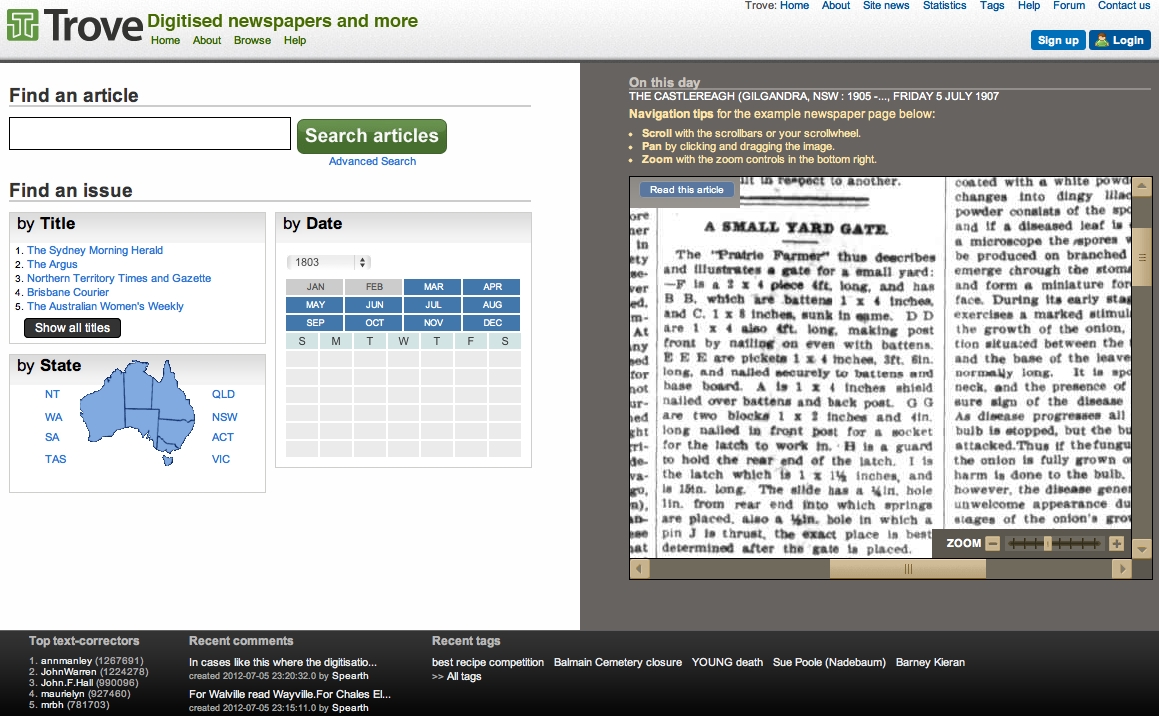
Trove is last crowdsourcing project I'll mention, but definitely not the least, the project by the National Library of Australia to digitalise old newspapers, using people to correct errors in digital scanning. I've discussed Trove before and it continues to go from strength to strength, judging from the Hall of Fame of content correctors.

Tens of millions of lines in newspapers have been corrected, improving the accuracy of Australia's historic record (the Trove site even lists my blog in its archive.


If you're interested in finding more examples of crowdsourcing, a good first stop is the Wikipedia page listing crowdsourcing projects.

Can't governments, with all that data sitting in archives, find uses for crowdsourcing too?

Read full post...

Wednesday, July 04, 2012

Great new site - The Digital Engagement Guide

Over in the UK, Helpful Technology has released 'The Digital Engagement Guide', which aims to become one of the best sources of useful examples, tools and practical advice about how UK public sector organisations can engage online.

The site touts itself as "Part bookmark collection, part reference manual, part Q&A site, it’s a place to get inspiration, shortcuts and answers."

Whether you're after online engagement techniques, strategies, examples or want the answer to questions, The Digital Engagement Guide has it.

Most of the content is as useful for Australian, US, Canadian and other governments as it is for the UK - heck it's useful to anyone seeking to engage people online.

The site also features an awesome collection of examples of online engagement and Government 2.0 initiatives from around the world.

How awesome? See the image to the right, which is a screen capture of the examples page listing every example in the site right now. Yes, it is extremely long, so long that I'm having to write extra words simply to make this blog post long enough to match the image!

Don't get daunted by this however, you can select subsets of the examples, strategies and techniques by keyword, location and topic.

And if you can't find your own online initiative in the site, you can submit it using the Contribution page.

Dang - that image was still longer than my words... so many examples!

Read full post...

Tuesday, July 03, 2012

Automating online activities without IT intervention - using web tools to make jobs easier

There's often lots of small - and not so small - activities that communications teams want to carry out online that would make their jobs easier, but aren't really tasks to give to IT teams.

For example, you may wish to update your agency's Facebook and Twitter profile pictures when your logo changes, automatically post your blog posts to LinkedIn and Facebook, be sent an email whenever someone tweets at you or receive an alert whenever your Minister is mentioned in a breaking news story.

This is where it is useful to get familiar with services like IFTTT and Yahoo Pipes.

IFTTT, or "IF This Then That" is a simple logic engine that allow you to string together a trigger  and an action to create a 'recipe' using the format IF [trigger] then [action].

For example, below is a recipe used to automatically tweet new posts on this blog:
A recipe in IFTTT
A recipe in IFTTT

This sounds very simple, but it can be a very powerful labour saving tool. Each trigger and action can be from different online services, or even physical devices.

A recipe in IFTTT
A recipe in IFTTT (click to enlarge)
Recipes can be more complex, with various parameters and settings you can configure (for example the recipe above has been configured to append #gov2au to the tweets).

For example, at right is the full page for a recipe that archives your Tweets to a text file in your Dropbox.

Besides connecting the trigger (a new tweet from you) with the action (posting your tweet in Dropbox),  you can choose whether to include retweets and @replies.

You can set the file name where your tweets will be stored and the file path in Dropbox, plus you can set the content that is saved and how it will be formated.

In this case the recipe is set to keep the text of the tweet (the 'Text' in a blue box), followed on a new line by the date it was tweeted ('CreatedAt') and then, on another new line, a permanent link to the tweet ('LinkToTweet'), followed by a line break to separate it from following tweets.

You can add additional 'ingredients' such as Tweet name and User Name - essentially whatever information that Twitter shares for each tweet.

Rather than having to invent and test your own recipes, IFTTT allows people to share their recipes with others, meaning you can often find a useful recipe, rather than having to create one from scratch.

In fact I didn't create either of the recipes I've illustrated, they were already listed.

There's currently over 36,000 recipes to choose from, for the 47 services supported - from calendars, to RSS feeds, to email, to social networks, to blogs and video services, from SMS to physical devices.

All the online services that can be 'triggers' for IFTTT
It is even possible to string together recipes in sequence.

For example, if I wanted to update my profile image in Facebook, Twitter, Blogger and LinkedIn, I can set up a series of recipes such as,
  • If [My Facebook profile picture updates] Then [Update my Twitter profile picture to match]
  • If [My Twitter profile picture updates] Then [Update my Blogger profile picture to match]
  • If [My Blogger profile picture updates] Then [Update my LinkedIn profile picture to match]
  • If [My LinkedIn profile picture updates] Then [Update my Facebook profile picture to match]
Using these four recipes, whenever I update one profile picture, they will all update.

Also it's easy to turn recipes on and off - meaning that you can stop them working when necessary (such as if you want to use different profile pictures).

However there's limits to an IF THEN system, which is where a tool like Yahoo Pipes gets interesting.

Yahoo Pipes is a service used to take inputs, such as an RSS or data feed, webpage, spreadsheet or data from a database, manipulate, filter and combine them with other data and then provide an output with no programming knowledge.

This sounds a bit vague, so here's a basic example - say you wanted to aggregate all news related to Victoria released by Australian Government agencies in media releases.

To do this in Yahoo Pipes you'd fetch RSS feeds from the agencies you were interested in, 'sploosh' them together as a single file, filter out any releases that don't mention 'Victoria', then output what is left as an RSS feed.

Building a Yahoo Pipe
Building a Yahoo Pipe (click to enlarge)
But that's getting ahead of ourselves a little... To the right is an image depicting how I did this with Yahoo Pipes.

Here's how it works...

First you'll need to go to pipes.yahoo.com and log in with a Yahoo account.

First I created a set of tools to fetch RSS from Australian Government agencies. These are the top five blue boxes. To create each I simply dragged the Fetch feed from the 'sources' section of the left-hand menu onto the main part of the screen and then pasted in each RSS feed URL into the text fields provided (drawing from the RSS list in Australia.gov.au).

Next, to combine these feeds, I used one of the 'operator' function from the left menu named Union. What this does is it allows you to combine separate functions into a single output file. To combine the Fetch feed RSS feeds all I needed to do was click on the bottom circle under each (their output circle) and drag the blue line to a top circle on the Union box (the input circle).

Then I created a Filter, also an 'operator' function and defined the three conditions I wanted to include in my final output - news items with 'Victoria', 'Victorian' or 'Melbourne'. All others get filtered out.  I linked the Filter's input circle to the Union's output circle, then linked the output from the Filter to the Pipe Output.

Then I tested the system worked by clicking on the blue header for each box and viewing their output in the Debugger window at bottom.

When satisfied it worked (and I did have to remove the filter condition 'Vic' as it picked up parts of words such as "service"), I saved my pipe using the top right save button, giving it the name 'Victoria RSS', then ran the pipe and published it at http://pipes.yahoo.com/pipes/pipe.info?_id=0392f5ec8f7450abbf650056c22f1e5d.


Note that pipes don't have to be published, you can keep them private. You can also publish their outputs as RSS feeds or as a web service (using JSON) for input into a different system. You can even get the results as a web badge for your site, by email, phone or as PHP for websites.

An IFTTT recipe built from the Yahoo Pipe above
(click to enlarge)
Alternatively you can even combine them with IFTTT - for example creating a recipe that sends you an email every time an Australian Government agency mentions Victoria in an media release.

In fact I created this recipe (in about 30 seconds) to demonstrate how easy it was. You can see it to the right, or go and access it at IFTTT at the recipe link: http://ifttt.com/recipes/43242

So that's how easy it now is to automate actions, or activities, online - with no IT skills, in a short time.

There's lots of simple, and complex, tasks that can be automated easily and quickly with a little creativity and imagination.

You can also go back and modify or turn your recipes and pipes on and off when needed, you can share them with others in your team or across agencies quickly and easily.

Have you a task you'd like to automate? 
  • Finding mentions of your Department on Twitter or Facebok
  • Tracking mentions of your program in the media releases of other agencies
  • Archiving all your Tweets and Facebook statuses
  • Receiving an SMS alert when the weather forecast is for rain (so you take your umbrella)
  • Posting your Facebook updates, Blog posts and media releases automatically on Twitter spread throughout the day (using Buffer)
The sky's the limit!

Read full post...

Friday, June 29, 2012

ACT Government planning to release a data portal and real-time bus information in reusable formats

Brought to my attention by @maxious, the ACT government has said in response to their Estimates process that they are building a data portal which they aim to have ready in July 2012.

Discussed in ACT's Hansard, Andrew Cappie-Wood, Head of Service and Director-General for ACT, said that, "There is a lot of interest in gaining access to data sets so that the community can use them more effectively.", giving the example of AllHomes' use of ACTPLA data.

Cappie-Wood went on to state that the ACT government intended to progressively make data sets available, keeping privacy issues front-of-mind, but pursuing a proactive approach so that the community could make their own apps through reusing the data and also use the data in other ways useful to the community.

Later in the Estimates session Paul Peters, Executive Director, Roads and Public Transport Division, said that there was also the intention to make real-time information on the location of ACTION buses available through data.gov.au such that various players in the market can develop and on-sell their own apps.

Read the transcript in ACT Government Hansard (PDF)

  • Data portal - refer to page 866
  • Real-time bus information - refer to page 919

Read full post...

Wednesday, June 27, 2012

Would you mandate that your staff must have a social media presence?

Would you mandate that all your staff must use social media, at least to give it a try?

That's what one company in the US, Domo (a business intelligence startup), has done.

The CEO, Josh James, has mandated that all 130 of Domo's staff complete 20 social media and online tasks over eight weeks, from creating three Google+ circles to creating a playlist on a online music service.

Called "the #domosocial experiment", as staff complete tasks they receive badges and there's rewards for individual staff who have met the full target, plus a bonus day off if the entire company achieves the goals.

If uncomfortable with the concept, they can create 'disposable' accounts - simply so that they understand how various online services work - rather than using their existing personal accounts or creating an ongoing online presence.

As reported in TechCrunch, the experiment is already delivering results,
James says he can see a difference in the way the team operates. He recalls tweeting out some company news, then seeing it retweeted by more than 50 percent of the workforce. Another time, he says he tweeted about a feature that he was really impressed by see in another product. James didn’t mention it again, but two weeks later an engineer proudly demonstrated a way to add that functionality to Domo’s product. And it’s not just about watching the boss’ Twitter account and keeping him happy. James also says that when he walks through the company’s cubicles, he’s more likely to see (or hear) consumer apps like Pandora or Rdio in action.
“It’s given us a common language,” he adds.
The company's progress is being published online at www.domo.com/what-we-do/social-status

Should other organisations take this step - mandating their staff to at least trial the use of various social media and online tools?

I think there's merit in the concept.

Staff don't need to be taught how to use television, radio or newspapers because they universally grew up exposed to them.

However the generations that grew up with social media are only at the cusp of hitting the workforce, so there's a lot of people in your organisation who are extremely familiar with traditional media but potentially lack experience in online.

While it may not be practicable to mandate that all staff must use social media, teams that deal with public and stakeholder engagement, communication, customer service and business intelligence should all be well equipped to use online channels to meet the goals of the organisation.

Using a reward based process, as Domo has done, provides a better canvass than a penalty based approach and, I think, is well worth considering.

I have begun to hear of communications teams in the private sector who will not hire staff who are not conversant with the major social media channels, and courses for senior managers - both within and outside the public service - which require as 'home work' that they establish Twitter or other accounts.

If we want to foster a 21st Century workforce then we do need to take steps to create it, not just sit back and wait.

A strategy encouraging people to use online tools, which costs little to implement, might be a good start.

Read full post...

Tuesday, June 26, 2012

Where's Australia's robust discussions on democracy, openness and transparency?

Australia is an interesting country.

We're one of the world's oldest democracies, with a strong tradition of free and independent (of government) media.

We have universal public health care and a strong separation between politics and religion and between politics and the enforcement of our laws.

We have an apolitical civil service with an extremely low corruption rate. As a nation we punch above our weight in Sports and Science globally.

However we appear to lack a robust public discussion on our own democracy, on government openness, transparency and the role of Gov 2.0 in this mix.

We have plenty of right-wing and left-wing thinktanks (with some intriguing backers) prepared to give their perspectives on various policy issues to influence government decisions, but rarely opine on the democratic institutions Australia has developed.

We have many media commentators willing to report bad or controversial news (or spin news in that way) about government decisions and activities, but rarely questioning the systems and traditions on which they are based.

We do have the OpenAustralia Foundation, building and maintaining several pro-openness tools - with little or no financial support from Australian Governments or philanthropists.

There's the New Democracy Foundation which, with some big name supports from politics and academic worlds, is looking at new ways of governing for a new millenium.

And there's the Institute of Public Affairs, which has an agenda to promote political and market freedom - though it is hard to assess its impact on public views.

Some scattered individuals also run small communities and services that look at whether and how governments should transform themselves to cope with changing environments and public needs.

However there's not really a broader discussion, as occurs through a network of organisations in the US (spearheaded by the Sunlight Foundation), or the more concentrated efforts in the UK through groups such as the Hansard Society.

Australia is not even a member of the Open Government Partnership (per the image below).

Nations that are members of the Open Government Partnership

So why is this the case? Is our government already so transparent and effective that we don't need more active discussions about our system of democracy, our openness and our processes?

Is it we're not interested in 'navel-gazing' about our own systems, or that we trust politicians, public servants, academics and the media to work out the best system for us and keep it working?

Is it simply that Australians don't actually care, so long as the government stays out of most of their lives - reflecting recent research from the Lowy Institute, as reported by the Institute of Public Affairs, that found that 23 percent of Australians aged 18 to 29 said: "For someone like me, it doesn't matter what kind of government we have." and that "Thirty-eight per cent said: "In some circumstances a non-democratic government can be preferable."

I really don't have an answer, and this worries and concerns me.

As they say in the US, "eternal vigilance is the price of liberty".

Where is Australia's vigilance regarding our democracy?

Read full post...

Monday, June 25, 2012

Liveblogging GovCamp NSW (focus on innovation)

I'm in Sydney at GovCamp NSW today, where the program is focusing on developing an innovation program for the state.

There's about 30 people in attendance and the event is being hosted by John Wells and Allison Hornery with support from Martin Stewart-Weeks.

The event is partially open, partially under Chatham House rules, so I'll be selective about posting and quoting.

I will include the hashtag (#GovCampNSW) in the liveblog, so various perspectives are captured.

Read full post...

Friday, June 22, 2012

Is this a world first? Australia's Bureau of Statistics #rickrolls its Twitter followers

Australia has been at the forefront of social media use by government agencies for a few years now (though don't tell them I said so or they might get complacent).

However I think this is possibly a world first.

The Australian Bureau of Statistics (ABS) yesterday released the first tranche of results from Australia's 2011 Census, to widespread interest - partially fuelled by their effective use of social media during the data collection process.

Today the ABS thanked Australians, via Twitter, for their support with the following message.

Thank you Australia for the great support for the Census. Please see here for a special gift from the 2011Census team

The thank you link went to a classic internet meme. The RickRoll.

As far as I know this is the first time any government agency, anywhere in the world has RickRolled it's citizens - although the Zombie Apocalypse has been featured several times, by the CDC and by Queensland Police.

I like governments with a sense of human - they feel more human, more connected and more relevant.

From the reaction on Twitter, others feel the same way.

In my view this is a brilliant step that cements the ABS's position as one of the most effective organisational users of Twitter.

They have successfully built and directed attention to the importance of statistics, supporting the census process, through their sensitive, factual and yet human use of the medium.


However I wonder if this show of humanity will be punished by those who wish to portray governments in a negative light, as monolithic, humourless, emotionless institutions.

If you make your money from criticising governments, you don't want them to seem too likeable or human.

Update
I've just been reminded on Twitter that the US government was actually the first to RickRoll its followers in July last year, as covered in this Washington Post article, Did the White House just rickroll its 2 million Twitter followers?

Still it leaves the ABS as an early adopter.

Read full post...

What may a 2.0 organisation look like?

As the world changes, so must our institutions - particularly government, including government agencies.

Without getting into how hard or easy it is for government agencies to change (recognising there's a diversity of views), any change should, necessarily be for the better.

So how should they change? In which ways should they reinvent themselves to suite a changing nation?

The wrong changes could lead to massive costs and organisational failures, so identifying the right type of changes (as near as possible) is a necessary first step once an organisation has reached a point where it recognises and accepts it need to make changes.

Fortunately there's lots of people thinking about this around the world, and in the US, over the last six months, a group of 900 people, spearheaded by Jonathan Opp and Chris Grams and as a joint collaborative effort by the MIX, Saba, and the Enterprise 2.0 Conference, have conducted a Management 2.0 hackathon (inspired by software hackathons) to consider how management and organisations will need to adapt to survive and thrive in the 21st century.

Entitled The Management 2.0 Hackathon: Using the inspiration of the web to hack management, the process resulted in the blog post (linked) and the marvellous report embedded below.

The report is available for download under a Creative Commons Attribution-Noncommercial-No Derivative Works 3.0 United States License.

I strongly recommend that you take a look at the report and consider circulating it to your senior leadership team. It may provoke new thinking and support your organisation's efforts to identify and implement the right changes to ensure your organisation remains relevant, influential and effective into the future.

Read full post...

Thursday, June 21, 2012

It's Census (data) day!

Today at 11:30am the ABS releases the first tranche of the 2011 Census's data - including the core demographics.

How is this Gov 2.0 related? There's a number of ways.

First, this is the first time the majority of Census data will be released, from day one, under a Creative Commons license as open data for reuse. This means that statisticians and interested people (like myself) will be able to download and crunch a lot of the information to find out interesting stuff.

Second, this is the first time the Census release is being announced via social media - with the @2011Census account leading the way, and a number of people already Tweeting using the #2011Census hashtag.

Third, there's a lot of data in the Census that will inform Gov 2.0 efforts. Population demographics, media usage and other data is all useful in building business cases and uncovering opportunities to use new media more effectively.

Fourth, this is the first Census in Australia to have a significant proportion of the data collected online. While the ABS did use a pilot eCensus system for last Census, this time online was a primary collection network for household data.

Finally we're likely to see some very interesting apps, infographics and maps using Census data in ways that were never before possible. These will emerge from the ABS, from other agencies and from the community and commercial sector.

To give an idea of what might come out of this, below is an interesting pre-Census infographic created by McCrindle Research to show Australia's place in the world.

Australia at 23 Million: A mid-sized country but world beating growth infographic by McCrindle Research
McCrindle Research | Know the Times

Read full post...

Paywalls for media providers mean government agencies need blogs and social media more

With the news this week that Fairfax is following News Ltd in introducing paywalls to their major metro online news mastheads, organisations need to think deeper about their social media strategy.

With a paywall strategy two things happen.

Firstly a large number of people stop using the paywalled websites. For example it's been reported in Wired's article, How The New York Times Paywall Is Working, that the New York Times, which has successfully increased online revenue using a paywall, has seen their visitors fall by more than 60% - and note that some (if not most) of their remaining visitors are not paying, therefore can only see a few articles each month.

That's with a two-tiered model, with some free content still available. If a single-tier model is used, such as by the London Times, visits can drop 90% or more.

Secondly, the reach of paywalled articles falls dramatically. Content behind paywalls cannot be easily shared via social media or email with people who do not pay for the content, reducing the 'readership' even more than the 'circulation'.

So regardless of whether paywalls work for the proprietor, raising their online revenue, they can gut readership and circulation - the reach that is important to media and PR professionals.


So let's consider the numbers based on the Sydney Morning Herald, for example.

As of their report for January - March 2012, as covered in Mumbrella, Fairfax reports that the Sydney Morning Herald receives 2,889,000 unique visitors per month and that they visit 158,656,000 pages - or an average of 55 pages per unique visitor.

Let's say that the Sydney Morning Herald introduces its paywall, on a two-tier model that allows people 20 free articles per month. Let's also assume that they are as successful as the New York Times and only shed 60% of their audience (note they're likely to shed more initially and 'win' some of it back over time, but we'll keep this simple).

Immediately we see a fall in unique visitors to 1,155,600. However page views drop far further than you'd expect as not all their remaining visitors will pay. So assuming that 50% of their remaining visitors pay and maintain a 55 page average, while the others only view 20 pages per month (the unpaid maximum), page views drop to 43,287,200 per month.

That's about a quarter of the pageviews before the paywall was introduced.

(Of course, if the fall in unique users is much greater, as may particularly be the case in the short term and was the case for the New York Times, these numbers could be much worse.)


Now assume this is happening, as planned, across Fairfax's Sydney Morning Herald, The Age and the Canberra Times, as well as across The Australian and News Ltd's other state-based mastheads.

Essentially all of Australia's major online metro news publications.

And what happens?

Suddenly all those media releases crafted and distributed to mainstream media are reaching a small fraction of the audience they reached in the pre-paywall days.

Your media release, which you could reliably claim to a Minister's office was reaching a large number of Australians, is no longer as effective by a long, long, long way.

Equally your advertising in 'mainstream' online news outlets reaches a lot less people. Hopefully this will reduce the cost as well - although historically as traditional media audiences have shrunk, advertising costs have grown.

So what should government agencies do to preserve their reach in a media landscape where the majority of Australians have abandoned traditional media in favour of free, but more niche, news sites?

Extend their social media presence and their own media channels (such as blogs) of course.


While paywalls may help traditional media players better monetise their online mastheads, they will not help organisations that need reach.

As a government agency, if you have information you MUST get out to Australians, the introduction of paywalls means you will need alternatives to traditional media channels for distribution.

So it's worth ensuring now that you have the skills, experience, procedures and governance in place to switch to a social media focused information distribution strategy to ensure that you preserve your reach while traditional media battens down their hatches to preserve their revenues.

Read full post...

Wednesday, June 20, 2012

"Read all about it" - Get your daily dose of political news from Aussie Federal politicians on Twitter

Following on from mapping all Australian Politicians using Twitter (which has unfortunately declined by two with Senators Bob Brown and Nick Sherry retiring), I've created online "newspapers" based on key groupings, so it is possible to get a daily dose of what Australia's Federal Politicians on Twitter are talking about.

To view them go to the appropriate link below:

Australian Federal Politicians
A daily round-up of tweets from all of Australia's Federal Politicians on Twitter
http://paper.li/eGovAUPollies/1340170628

Australian Senate News
A daily round-up of tweets from all of Australia's Federal Senators on Twitter
http://paper.li/eGovAUPollies/1340170870

Australian Reps News
A daily round-up of tweets from all of Australia's House of Representatives Members on Twitter
http://paper.li/eGovAUPollies/1340170945

Australian Labor Politicians
A daily round-up of tweets from all of Australia's Federal Labor Politicians on Twitter
http://paper.li/eGovAUPollies/1340170696

Australian Coalition Politicians
A daily round-up of tweets from all of Australia's Federal Coalition (Liberal and National) Politicians on Twitter
http://paper.li/eGovAUPollies/1340170821

Australian Greens Politicians
A daily round-up of tweets from all of Australia's Federal Greens Politicians on Twitter
http://paper.li/eGovAUPollies/1340171115

Australian Independent Politicians
A daily round-up of tweets from all of Australia's Federal Independent Politicians on Twitter
http://paper.li/eGovAUPollies/1340171744

Read full post...

Tuesday, June 19, 2012

How nine year olds can now reform governments, one bite at a time

With the tools available today, influence over government policy is no longer the preserve of the wealthy, the well-connected or those people with a significant TV, radio or newspaper presence.

While traditional media and interests still have significant influence, social media has allowed individuals to become far more influential.

Blogs, forums and social networks give individuals and small groups the ability to have a national or global public platform, at little or no cost, that can be used to tell their stories and present different views or facts.

This is both challenging and an opportunity for governments. Governments, including politicians and officials, that seek to ignore, marginalise or otherwise discredit individuals for standing up for their beliefs or reporting facts are much more likely to be publicly exposed, their reputations damaged and any hypocrisy cast into the public eye.

Governments that embrace the opportunity to bring more people inside the tent, balance well-connected interests with individual views and question whether traditional lobby and representative groups actually represent the groups they claim to represent, are likely to find their work more complex but ultimately more effective, with better policy and more relevant service delivery outcome.

A great example of the influence of individuals due to social media (bolstered by traditional media once the groundswell grew) has occurred over the last week.

NeverSeconds
Some of you may be aware of the NeverSeconds blog, and the struggles its 9-year author has had with the Scottish council, which banned her taking photos of her school lunches until convinced otherwise by online public opinion, celebrities and the Scottish Education Minister.

However if you're not, here's the story in a nutshell (referencing Wired's story NeverSeconds shuts down).

In April this year nine-year-old Martha Payne in Scotland, with some technical help from her father, started a blog as a writing exercise to document what she ate each day for lunch in her school, Lochgilphead Primary.

Martha's lunch on 18 June
Before starting the blog, she and her father (who is a local farmer), encouraged by her mother (a GP), surfed foodie blogs for inspiration. Martha decided as a result that she wanted to photo each of her lunches and provide a report including how much she liked the food, the number of bites each meal took to eat, the health rating (from a nine-year old's perspective), the price and the number of hairs in the food.

The blog was approved by the school and was written entirely by Martha under supervision from her father.

Over the first two months of the blog's life, Martha attracted a huge audience from around the world, with more than a million views of her posts.

Her blog started driving good outcomes. Her local council 'remembered' to tell the school that students were entitiled to unlimited salad, fruit and bread, she and her father were invited to participate in a workshop on school lunches, other students from around the world began sending her photos of their lunches (which she posted in her blog too). A newspaper sent her some money for use of her photos, which she donated to a charity (more on this later).

The media caught wind of her blog and began writing articles about it, including Time, the Telegraph, and the Daily Mail. She was interviewed on the BBC and also attracted the attention of celebrity chef Jamie Oliver, who has crusaded on the topic of healthy school lunches in Britain.

This, however, is where bureaucracy stepped in.

Martha's lunch on 30 May
An article in a newspaper used a throw-away headline, "Time to fire the dinner ladies", while discussing Martha's involvement in a thinktank on health school meals.

The local Council, Argyll and Bute Council decided that this criticism was too much, and claimed media coverage of the blog had led catering staff to fear for their jobs.

They promptly decreed on 14 June that students would no longer be allowed to take cameras into their school canteen.

Martha was accordingly called out of maths class and told that she could no longer photo her lunches.

By this time Martha had had 2 million views of her blog and had raised £2000 for charity, including £50 from the newspaper mentioned earlier.

However, as an obedient nine-year old, Martha wrote a goodbye post on her blog.

At this point her readers became activated, and the media coverage exponentially increased. She received 2,370 comments on her goodbye post and over 200 articles were posted in newspapers, plus radio and TV stories around the world. She received celebrity support from Jamie Oliver and Neil Gaiman.

Twelve hours later, the Argyll and Bute Council published an official statement (now removed from their site, but still visible online thanks to at http://www.twitlonger.com/show/hrom1r).

This statement, in part, accused Martha of misrepresenting what was on offer in the canteen,
 "The Council has directly avoided any criticism of anyone involved in the ‘never seconds’ blog for obvious reasons despite a strongly held view that the information presented in it misrepresented the options and choices available to pupils"
Martha's lunch on 16 May
It went on to state the Council's dedication to good food standards in school canteens, said they'd not received formal complaints about the food in the last two years other than from Martha's family, and that the blog had, and would have, no influence on what they served students anyway. (It is interesting to compare the quality of the statement's writing with the quality of Martha's writing.)

Around this time the charity Martha was supporting, Mary's Meals, reported that they'd now received over £40,000 in donations from her blog - more than enough to build a new kitchen at Lirangwe Primary School in Blantyre, Malawi, to feed its 1,963 students. The kitchen is to be named 'Friends of NeverSeconds'.

Three hours after the Argyll and Bute Council published its statement, the council's leader, Roddy McCuish, told the BBC that he was rescinding the ban on photos in school canteens, and the council issued a statement commending Martha's blog and indicating that the council would be involving students in their efforts to keep improving school meals,
We need to find a united way forward so I am going to bring together our catering staff, the pupils, councillors and council officials - to ensure that the council continues to provide  healthy, nutrious and attractive school meals.  That "School Meals Summit" will take place later this summer.

 I will also meet Martha and her father as soon as I can, along with our lead councillor on Education, Michael Breslin to seek her continued engagement, along with lots of other pupils, in helping the council to get this issue right.   By so doing Martha Payne and her friends  will have had a strong and lasting influence not just on school meals, but on the whole of Argyll & Bute.

Martha has resumed her blogging, and has now raised over £87,000 for the Mary's Meal charity - see her total, and give to the charity here.

Meanwhile the issue of healthy school lunches is being more widely discussed and debated, and the council has learnt it needs to more closely consider the views of its constituents and the children it serves. Shutting down debate is no longer an option for successful governance.

And the children of Lirangwe Primary School in Malawi are extremely happy, with the short video below a fitting tribute to the impact individuals can now have on governments - one bite at a time.

Read full post...

Bookmark and Share