It is also being livestreamed via the website, tedxcanberra.org and can be followed on Twitter at the hashtag #TEDxCanberra.
What's TEDx? A global phenomenon that you can learn more about here.
Craig Thomler's professional blog - AI and digital government thoughts and speculations from an Australian perspective
TedXCanberra 2011 liveblog | Tweet |
46 countries commit to the international Open Government Partnership | Tweet |
Participating countries in the Open Government Partnership pledge to deliver country action plans that elaborate concrete commitments on open government. In each country, these commitments are developed through a multi-stakeholder process, with the active engagement of citizens and civil society.
What are the top things we can do to improve government websites? | Tweet |
The US has launched an interesting discussion asking citizens how they think the Federal government can improve government websites.
Run using Ideascale, an online idea management system, the National Dialogue on improving Federal websites is running for two weeks and involves both ideas submission and voting as well as live online discussions(or dialogue-a-thons) on specific website related topics.
I'd love to see this type of initiative organised in Australia, however in the interim it is worth looking at the ideas raised in the US, beginning with the use of Plain language on government websites, Creating content around topics/customers - not agencies, make usability testing and 508 testing (accessibility) required PRIOR to launch, Make Government Website Mobile Accessible and Commit to best practices (using modern web techniques).
If Australian government agencies applied these five top ideas to their own web development (or even applied standards from some of the excellent web links and comments for several of the ideas) we could see a very different level of engagement, potential cut the number of phone calls and ministerials, address hidden issues with incomplete forms and avoid agency embarrassment (when organisations publicly identify government websites that fail basic accessibility or mobile access requirements).
Of course this requires adequately funding and resourcing web teams to carry out these tasks - however this can be offset through mandating external developers to meet government's basic accessibility and content requirements and through using low-cost modern content management frameworks which support significantly greater functionality and require less customisation than the old backroom systems still in place at many agencies.
Even more valuable would be for the Australian government to similarly ask citizens what they thought should be improved about government sites.
I do wonder why Australia appears more fearful or risk-averse to asking citizens these types of questions and building an evidence base on which it can then assess actions. Or maybe it isn't risk-aversion and is simply due to cost (though the service the US uses costs only US$999 per year - and there's even a free version) or due to lack of resources or even interest.
However if the US government, where the political process is on the nose, unemployment is high, the economy is distressed and web budgets are in decline, can ask this question, surely Australia is in a much better position to do so.
To go a little further, to offset the perceptual risk that citizens may expect government agencies to act on specific improvement requests, the consultation could be shaped as an information gathering exercise, where the outcomes will be made available to various agencies to act or not act as they can within their budgets and resourcing.
Or maybe individual agencies can ask the question as part of their website surveys (if they hold them - as I've done regularly in past positions) and share this information across the APS.
What do you think?
Toughen up - we need online anonymity | Tweet |
Rather than posting in my blog today, I am breaking one of the rules of blogging (always pull people back to your own blog) by pointing people to an opinion piece in Mumbrella that I wrote recently after reading a couple of other opinion pieces attacking the basis for allowing anonymous commentary online.
Toughen up - we need online anonymity
Please comment in Mumbrella (anonymously if you prefer) to continue the discussion.
Note that I wasn't paid for my opinion :)
Twitter tactics - demystifying Twitter | Tweet |
Earlier tonight I gave a presentation at Parliament House about the workings and uses for Twitter in government.
I've shared the presentation below.
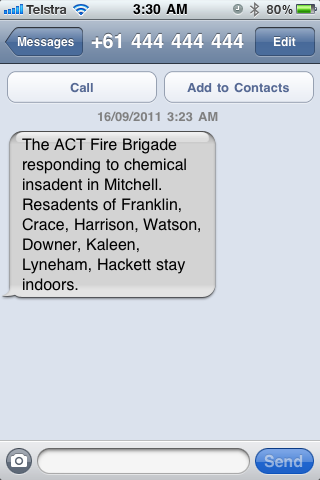
Emergency brings out ESA on Twitter in Canberra - too late? | Tweet |
"Last in first out" - is this a risk for social media expertise and channel use in government? | Tweet |
I've seen (and spoken with colleagues about) a number of austerity measures taken in government agencies around Australia over the last few months.
With various governments across the country looking to cut spending to balance budgets, or at least reduce debt levels, lower 2011-12 budgets require many agencies to look long and hard at what they can trim or where they can do more for less (without affecting services to the public).
I wonder whether digital channels and expertise has been firmly enough established in many agencies to survive any cuts. Will management focus on their established infrastructure, maintaining their legacy IT systems and 'tried and true' communications and service channels at the expense of newer and more cost-effective, but less mature digital, channels?
In other words will we see the "last in, first out" rule apply for social media channels and expertise in many agencies?
(this is slightly rhetorical as I'm already seeing this in action in a few places)
I hope agencies will use any budget tightening as an opportunity to look long and hard at their operational effectiveness and select the channels which deliver the most 'bang for the buck' and long-term sustainability and viability.
Of course even if this means cutting non-digital channels in preference to digital, there is still a loss of expertise and corporate knowledge - though potentially a more sustainable one into the future.
Do you see signs that budget pressures are impacting on your agency's online capability? (feel free to respond anonymously & keep the relevant public service code of conduct in mind)
When will we see true my.gov? | Tweet |
I've been watching, and participating, in some of the discussions around whether government agencies and entire governments should centralise or decentralise their web presence.
For some reason a number, such as the UK government, South Australia and the ACT, have decided that centralising all their websites into a single portal is the right approach, although I've seen little in way of clear benefits to citizens or government.
At the same time some agencies still follow a route of rolling out a new website for every initiative, program and event, leaving some agencies with hundreds of websites to manage.
Totalling the number of websites can be deceptive. With a single content management system at the back-end, single set of servers and bandwidth and nothing more than different design templates it is possible to release many websites with little additional cost impact. In this situation, whether the content is in one site or many, it requires almost the same effort to create and maintain.
I believe that the argument over one or many websites really misses the entire point of the exercise - to serve the public.
If we stop thinking about centralise/decentralise and begin thinking audience, how would we build and maintain the web presence, not web site(s), for a government or agency?
I've been thinking about this recently with a view to the capabilities that web 2.0 brings.
Rather than building websites around agencies, portfolios, topics or governments, why not simply provide a my.gov.au framework which can be customised to every individual citizen's needs and demographics?
Agencies could publish information in 'fragments' or 'parts' with appropriate metadata. This would allow my.gov.au to selective and display the content, services, social channels and news from government appropriate to an individual.
With this approach the entire equation is flipped. No longer are agencies or governments solely deciding what they want citizens to see. Instead citizens are presented with what they need, based on their age, gender, location, work status, interests, past behaviour and other characteristics.
Individual agencies would not need to each collect information about individuals to provide a custom online experience. They simply become content providers, with the central my.gov.au portal storing any personal information and pulling the right content (as tagged by agencies) without sharing the information with other agencies.
This approach could expand beyond a single government, integrating local planning alerts, state government services and other relevant content in a single seamless interface.
This would remove the need for citizens to go to multiple 'single sites' for different government levels. As the user is in control of my.gov.au there's no need for agencies at different levels to have their systems working together for content or sign-on - the my.gov.au framework would simply pull content and services into the common personalised interface for each person.
The system could also expand beyond government - integrating your banking and medical records and more into the same view. This would become a real killer application. See your bank and salary information as you figure out how much you need to pay government over the year ahead. Of course, none of the services viewed through the personalised page would 'talk' to each other, only to my.gov.au, preserving privacy and security.
The my.gov.au service wouldn't even have to be built and managed by governments - competing services could be developed commercially and compete - through enhancements and features - for the 'business' of citizens, all drawing on the same set of government content and data feeds.
So perhaps it is time for government to stop talking about 'one website to rule them all' and instead consider what we could achieve if we let our content out of its departmental and government 'wrappers'.
We could enable a true personalised my.gov.au service for every citizen, customised to their specific needs and wants, growing with them through various life events over a number of years.
And we could still aggregate the same content into our corporate sites, or a single portal if we chose, at no extra cost!
GovCamp Australia liveblog | Tweet |
I've been pinged by Pia Waugh to liveblog today's GovCamp AU event.
What is a GovCamp? The official definition is: GovCamp is an event in the spirit of BarCamp for governments and other public institutions to share social and technology solutions to turn them into Government 2.0.
Note this won't be a full view on the day, as there are three rooms. I'll be presenting a couple of times as well. However I'll link to other posts as I can (and include the hashtag in my liveblog to provide a separate perspective).
The event is also being filmed, so there will be a record available online shortly afterward.
It can also be directly followed on Twitter at #govcampau
For other GovCamps around the world visit govcamp.org
My presentation for the AMI Government Marketing and Communications Conference | Tweet |
I am presenting from 3.20pm today, and my presentation is now available on slideshare, viewable as below.
Liveblog from AMI Marketing & Communications Conference - Day 2 | Tweet |
I've taken some time off this morning to put together some extra slides for my presentation, so are not yet in the room, however have a liveblog running to capture the tweeters who are...
My presentation is at 3.20pm today and will be on slideshare shortly afterwards.
Liveblog from AMI Marketing & Communications Conference - Day 1 | Tweet |
Hi,
I'll be liveblogging parts of the AMI Marketing and Communications Conference today and tomorrow.
You can also follow the conference at the hashtag #amigov2011
Walkley PR Conference Liveblog | Tweet |
South Australia Local Government Association releases social media issues paper for councils | Tweet |
What impact will cyborgs have on government? | Tweet |
Booked into the CeBIT Gov 2.0 conference in October yet? | Tweet |
I'll be missing the Gov 2.0 conference that CeBIT is holding for the third time this October (25-26 October) due to my honeymoon. However I do recommend to others that they consider attending.
In my view this is the most mature Gov 2.0 conference in Australia and has managed to step beyond the '101' nature of most similar conferences.
For details visit www.gov2.com.au
What's in a name? | Tweet |
People invest an enormous amount of identity and personal energy into their own names.
Names are our unique identifiers, defining us as separate to others - even for people with common names.
So when organisations make rules about the names people can use online it can create signficant distress and dislocation for people.
It also raises questions over who can decide your identity. Can corporations deny people the use of their legal names online simply because they don't fit a narrow model of what the corporation regards as 'appropriate naming'?
A recent example I've been following is Stilgherrian's battle with Google over the use of his legal name for Google Plus. You can follow it at his blog (strong language) or read about it at The Register.
Stilgherrian changed his name over thirty years ago to a mononym - a single name. His passport and official records all reflect this and those of us who know Stilgherrian personally have never experienced any dislocation or issue with engaging with him as an individual with one name.
However Google's Plus service has defined rules for allowable names. Firstly it requires that you use your legal name (although Google is apparently not requiring evidence or checking with authorities in most cases to verify). Secondly, it requires that you have a first name and a last name and that there's no spaces or characters like an apostrophe in your name.
Now while this might fit a certain segment of the population, there's a number of people who have either only one name (as is common in a number of countries), have spaces in their names such as "Dick Van Dyke", or use apostrophes and other non-standard characters.
The net result is that Google is blocking people with names that don't match its view of what is a legal name - and requiring that people provide documented proof of their 'anomalous' legal names.
I have another friend who changed her legal name to a mononym (which includes an apostrophe) over ten years ago. About two weeks ago she announced that she was changing her name to add a 'first' name, so that she could use Facebook and other social media channels to communicate with people.
She had finally reached the point where her single name was excluding her from legitimate social interactions due to the naming policies of (mainly) US companies.
I have a real problem with this situation, for Stilgherrian, for my friend and for the millions of other people around the world who have names that don't fit Google or Facebook's views of a legal name.
Firstly, 'legal' names should be defined by governments, not corporations. Australia's governments, and many governments around the world, support a much wider variety of legal naming conventions than social networks appear to allow.
Secondly, isn't it discrimination when corporations deny you access to their service due to the format of your legal name? Denying a service to an individual just because their name is structured differently to their business rules might be legally actionable.
Finally, what right do corporations have to your legal name anyway - particularly if they make it public. Many people have good reasons for not revealing their legal name publicly. Those in witness protection programs, minors, people with embarrassing 'real' names and those who are widely publicly known by a name other than their legal name, are all candidates for using a different name to their legal name online for legitimate reasons.
It is fair to deny people access to online services, particularly when these services are in such widespread use, just because they can't publicly disclose their legal name?
All of the examples above relate to corporations. However there are examples which may also refer to government as well.
There have been calls from a number of quarters in various Australian government to restrict people to the use of their legal name when commenting online. The purported reason is that people are less likely to behave inappropriately if they can be held accountable for what they say. The subtext is that people become easier to monitor and track.
I am not a fan of this approach for governments either. Like above, there are legitimate reasons why people might choose to not use their legal name in online discussions.
It can also be very hard to identify many people from their legal name alone, given the number of duplicates that may exist. Any step taken to require legal name use would have to attach address and proof of identity in order to identify specific individuals. Even then, identity theft would lead to many misrepresented identities.
Also there are other ways authorities can identify individuals if there are legitimate reasons to do so (such as discussion of committing a crime) - using IP addresses and various analysis techniques.
What is useful for government, is being able to identify consistent identities online - whether individuals choose to use their legal names or not.
Consistent identities allow organisations to build user cases based on profiling views across different topics, supporting policy development and decision-making without compromising personal privacy or security and while allowing people to define themselves online as they choose.
ACT Virtual Community Cabinet #2 | Tweet |
The ACT is holding its second Virtual Community Cabinet tonight from 7pm to 8pm, so I have again set up a livefeed to capture the tweets for the record, and to allow analysis afterwards.
I am only capturing tweets including the hashtag for the event (#actvcc), so if you are participating, but don't include the hastag, your tweet will not appear below.
Also note that CoverItLive, the tool I am using, doesn't necessarily capture every tweet due to the way Twitter's API works, so this may not be a complete record of the discussion.
I hope that the ACT government will record it and provide an official 'transcript' after the event (although I am not aware of them doing so for the last virtual community cabinet)
UPDATE: Unfortunately there was an issue with my CoverItLive, which did not start last night as scheduled, and I wasn't near a computer to check :(
Therefore I didn't record the session and at this stage are not able to report on it.
I'll look at alternatives through other tools to see if I can get a record of the event.
A basic analysis is available from the Archivist here and a record at Twapper here.
There is also a good analysis at the blog Keikaku Doori
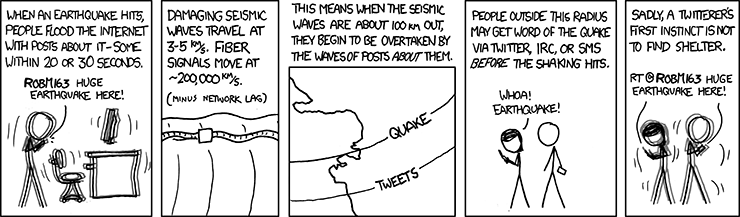
What's faster than an earthquake? Social media | Tweet |
According to a FEMA spokesperson, the agency put Twitter to use to alert people impacted by the quake not to use cell phones unless absolutely necessary, thereby freeing up some of the lines for emergency calls.
Among the tweets was this one from the Department of Justice – “Quake: Tell friends/family you are OK via text, email and social media (@twitter & facebook.com). Avoid calls.”
Meantime, New York City Mayor Michael Bloomberg tweeted – “I’ve spoken w/ our Police and Fire Commissioners & we’ve activated the Emergency Management Situation Room. Thankfully, there are no reports of significant damage or injuries in NYC at this time.”
According to a pair of June Red Cross surveys from more than 2,000 people combined:
“Social media is becoming an integral part of disaster response,” Wendy Harman, director of social strategy for the American Red Cross, said in a statement. “During the record-breaking 2011 spring storm season, people across America alerted the Red Cross to their needs via Facebook. We also used Twitter to connect to thousands of people seeking comfort, and safety information to help get them through the darkest hours of storms.”
- After television and local radio, the Internet ranks the third most popular way for people to obtain emergency information with 18 percent of both the general and the online population directly using Facebook;
- Nearly one fourth (24 percent) of the general population and a third (31 percent) of the online population would turn to social media to alert loved ones they are safe;
- Four of five (80 percent) of the general and 69 percent of the online populations surveyed think that national emergency response organizations should regularly monitor social media sites in order to respond quickly.
Avoiding the 'social media graduate' approach | Tweet |
I've commented before that it isn't a sound strategy for organisations to entrust their social media strategy to graduates, simply because they are young and "must understand social media".
I've also commented on the need to expand social media engagement beyond the communication team to entire organisations, within designated policies. This is because communication professionals see the world through a particular set of filters that can restrict an organisation's capability to gain many of the broader benefits from social media tools.
The following video does a great job of summing up my views in a single two minute long discussion, courtesy of Socialnomics author Eric Qualman (via the Digitalbuzz blog)
And to throw in another video from Socialnomics...worth a look.
This work is licenced under a Creative Commons Licence.
Please attribute in the form: Sourced from eGovAU