Tuesday, March 01, 2011

Presentation from Friday's Seamless conference

Last Friday I presented on a personal basis at the Seamless CMS Government Conference in Melbourne to a collection of Councils from around Australia and New Zealand about the state of Government 2.0 in Australia.

I've included my presentation below.

It was an interesting conference. Councils are struggling with the same issues regarding Government 2.0 as their larger cousins at state and federal level, limited resources, management buy-in and mitigating the risks of engaging online.

As the 'front-line' of government, service-focused but smaller and often very agile, local councils have some unique advantages in the practical implementation of Government 2.0. In many cases their smaller constituencies can allow for deeper engagement simply as there are less relationships to maintain at any one time.

However they may suffer as well, having insufficient constituent mass on some issues to maintain an effective conversation and their individual lack of resourcing can make it difficult to add new capability.

One topic I spoke about was how councils can work together to leverage their resources. As they generally don't compete (except over attracting population or tourists) and perform almost identical functions - garbage, roads, community services - they have many opportunities to co-design solutions across council boundaries.

I also suggested that as the first government mash-up competition was run by a local council, the District of Columbia, they have a similar capacity to run events which attract best practice ideas and solutions from around the world - not simply their own constituents.

Over time I'm expecting significant Government 2.0 innovation to come out of councils - as we've already seen from places such as Mosman Council.

Also speaking at the conference was Ben Peacock, a founder of Republic of Everyone. He laid down five guidelines for social media that I felt were worth repeating:
  1. Involve people,
  2. Show respect,
  3. Share the wisdom,
  4. Don't be boring,
  5. Be prepared to lose control


    Read full post...

    Wednesday, February 23, 2011

    How much work time spent on social media use in a government department is 'excessive'?

    According to The Australia, at least one Australian Government agency is full of 'Bureaucrats twitting at our expense' (sic - the correct term is 'tweeting').

    Based on a question which identified that, in a single week of measurement last year, staff at the Department of Innovation, Industry, Science and Research (DIISR), spent 400 hours using social media, The Australian reported that "Liberal senator Cory Bernardi said millions of dollars were being wasted as public servants whiled away the hours on social media sites."

    I thought it worth unpacking this article and this number. Government agencies are struggling to decide whether to allow, and how to manage, social media use by staff - whether on official, professional or a personal basis.

    How much social media use is appropriate? Should staff have access to the Department's official social media channels? How does a Department respond to claims that use may be excessive?


    Firstly the article didn't identify what was meant by 'social media'. Does it include newspaper websites (such as The Australian) which support comments? Does it exclude government mandated platforms such as GovDex and GovSpace?

    Is YouTube 'social media', or a video distribution service? How about Wikipedia, encyclopedia or social media?

    This makes it harder to characterise how these 400 hours were spent. I'm happy to accept a broad inclusive view and consider social media as including any website which supports multi-way interaction (public publishing of user comments), even if the user doesn't actually interact in this manner. That includes YouTube and Wikipedia, as well as newspaper websites and many government sites.


    Secondly, there are many legitimate reasons that public servants may need to use social media channels. There are many forums, social networks and other social media channels discussing topics related to the Department's portfolio areas (Innovation, Industry, Science and Research).

    In fact I'd consider it negligent if any Department was not at least monitoring and preferably participating in discussions appropriate to their portfolio interests - this level of ongoing consultation is vital for good policy formation and service delivery.

    Certainly some social media use may be incidental personal use and not interfering with agency business (similar to banking online, taking a personal call or going to the toilet), however a substantial proportion of social media use is likely to be legitimate and important business activity.


    Finally, it is important to consider the time spent using social media proportionate to the number of employees. While the article indicated that the 400 hours of social media use per week by DIISR was equivalent to ten full-time tweeters, this claim is highly misleading.

    DIISR has about 2,112 employees based on DIISR's 2009-2010 annual report.

    Spreading 400 hours of weekly social media use across 2,112 staff, led me to an average of 11 minutes and 20 seconds spent using social media per employee per week.

    That's less time than it takes to get a single coffee from a nearby coffee shop and shorter than the average smoke break.

    On that basis, in my view, 400 hours per week social media use for a 2,000 person agency, should not be considered excessive.


    So how much social media use is appropriate for a government Department?

    The right answer, I believe, is 'it depends'.

    It depends on the activities of the Department. Some agencies have a pressing need to monitor community sentiment, address enquiries and/or respond to incorrect statements to ensure that the correct information is available to the community, including in popular forums, blogs and other frequently used online channels.

    It depends on the situation. During a crisis there might be greater need to engage the public online, such as the recent example in Queensland where the Queensland Police made world class use of Twitter and Facebook.

    It depends on staff's individual job responsibilities. Following in the footsteps of the corporate sector, we're seeing more social media advisor and community management roles in the public service. These people are required to monitor, advise and respond via social media. It's their job.

    Lastly, it depends on how effectively a Department is using social media.

    In my view we're still in very early stages of adoption with few staff trained or experienced in effective official use of social media channels (but learning fast).

    The Department of Justice in Victoria requires staff to demonstrate capability using social media (via their internal Yammer service) before being allowed to use social media officially for the Department - like conducting media training before placing a senior executive in front of a journalist. However many other Departments still discourage social media use except amongst specific staff tasked with relevant duties.

    I wouldn't be surprised if a mature Department, using social media appropriately as a core communications and engagement tool, could rack up ten times the use of social media that DIISR does today - 4,000 hours per week.

    This may sound like a lot, but would still represent less than 2 hours per week per staff member, only five per cent of their time. What else do you spend two hours a week on?


    The real question to fall out of the consideration above is what activities does and will the time spent using social media replace?

    Will it replace some town hall meetings (planning, travelling and running) with online consultations; some stakeholder phone conversation and emails with stakeholder social network groups; internal staff meetings with intranet forums; or writing media releases with blog posts and tweets?

    Given the relative productivity of social media over 'old ways' of doing things - maybe politicians and senior managers need to push for MORE social media use in government Departments rather than less.

    Read full post...

    Tuesday, February 22, 2011

    Mobile internet trends - an online game changer

    Mary Meeker, managing director for Morgan Stanley's global technology research unit recently gave an excellent presentation on mobile internet trends.

    It highlights the incredible growth of tablets and apps, the rise of Android, the new uses that smartphones are being put to (only 32% of time is spent on phone calls) and the relative effectiveness of mobile and internet advertising compared to traditional media (internet matches television and mobile exceeds it).

    I've embedded it below - it is a must see.

    Read full post...

    Opening up public sector information in Australia - have your say by 1 March

    We've seen enormous movement towards the opening up of public access and permission to reuse government information in Australia over the last year, both at state and Commonwealth levels.

    However these attempts to improve transparency and increase the capability for information reuse shouldn't be led by government alone. The public, media, commercial and not-for-profit sectors have a significant interest in how, when and which information the government makes available.

    That's why I am encouraging people to read and contribute their comments to the Office of the Information Commissioner's consultation on Australia's Government Information Policy.

    If you're a support of more open government, or agree with the draft policy, go to the OIC blog and tell the Office via comments that you agree with their approach.

    If you don't agree with a point, or don't agree with the entire process, this is your opportunity to tell the Office how they should improve their approach.

    Even if you don't understand what they are doing or why it is being done, tell them. It will help the Office consider its future approach to communication and education.

    Read full post...

    Monday, February 21, 2011

    Don't let failure be the enemy of success

    Votaire said, "Don't let the perfect be the enemy of the good".

    This is often quoted in politics where the acts of creating, selling, passing, implementing and maintaining complex policies can result in challenging decisions between perfect, yet practically impossible and practical but only good outcomes.

    I'd like to suggest a similar saying for bureaucrats, "Don't let failure be the enemy of success"

    There are many situations in life when people have to choose between trying something difficult, risky or new and staying with the 'tried and true' approach.

    This is often portrayed as choosing between risking failure or accepting a lessor level of success. Indeed many people often see their choice as between failure and success - one outcome seen as negative and the other positive.

    However failure and success are not opposites, are not opposed to each other and both can be useful steps on a path to better outcomes.

    Every success is born from a range of failures, every failure occurs on the back of successes. The two are locked in a continuous dance of possibilities, risks and choices.

    When we remember successful inventors, we often overlook the failures on their path to success. When we remember failures, we often downplay the successes that were achieved and often had longer-term implications. We also forget how that failure helped us shape our thinking, abandoned an approach or otherwise consider more variables in order to improve future success.

    It is rare to find an individual, organisation or nation that has not had a share of, learnt from and built on both their failures and successes.

    So what does this mean in practical terms for public servants and government agencies?

    It means take a risk from time to time. Try something new or different - you may produce a new or different outcome.

    Even if the new approach fails it may trigger further ideas worth exploring, potential successes your organisation may not have otherwise considered. It can help your staff deal with future (inevitable) failures, test your organisation's systems and otherwise help you tune activities for the better.

    At worst you have new information and can justify not trying that approach again, given a particular set of circumstances. This can help you avoid larger, longer, more costly or more devastating failures in the future (fail small and fast as start-up wisdom goes)

    Failure is almost always a type of success, even if it is merely used to disprove an approach and help you focus on more productive channels.

    So remember, don't let failure be the enemy of success.

    Read full post...

    Tuesday, February 15, 2011

    The age of microblogging has arrived - in China

    Listening to the US's National Public Radio (NPR) last week, I caught a story about how Chinese citizens are now using micro-blogging services (similar to Twitter) to communicate about missing or stolen children and, in some cases to locate them.

    According to The Guardian article, Chinese parents turn to microblogging in hunt for missing children, China has over 80 million micro-blog users (though very few Twitter users due to blocking).

    By posting messages and pictures of missing children, and by putting photos of child beggars online, there's been at least half a dozen cases where children have been located and reunited with their parents.

    In particular a Chinese professor created a microblog called "Street Photos to Rescue Child Beggars" in t.sina.com.cn. The microblog, which was only registered on 25 January this year, has already gained more than 200,000 followers, many being Chinese police officers. Thousands of photos of child beggars have been posted to the micro-blog by Chinese citizens (the criteria is that photos must show the face of the child and the location and time the photo was taken).

    Of course the success of the micro-blog medium in China needs to be weighed with continuing government efforts to restrict debate on certain topics - as recently illustrated in this article in The Age, China micro-blogging sites censor 'Egypt'

    Must read posts:

    News stories:


    Read full post...

    Monday, February 14, 2011

    Who in QLD government is using Web 2.0 or Gov 2.0 tools?

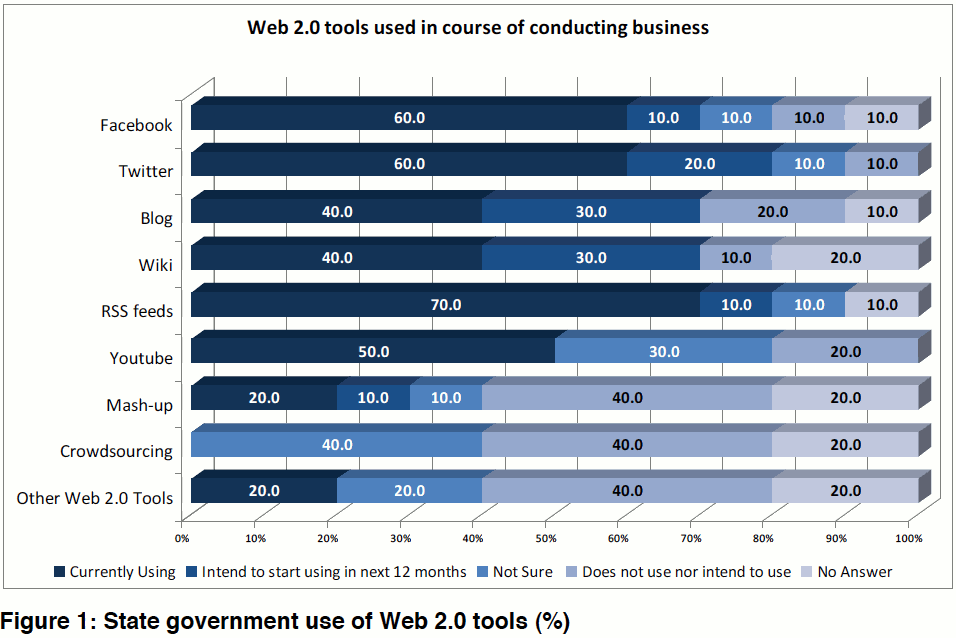
    The Queensland State Archives recently commissioned a whole of Government
    Recordkeeping and Web 2.0 online survey to investigate how Queensland's public
    authorities were using Web 2.0 and social media2 tools to conduct government business.

    The survey also asked public authorities about the policies and procedures they had in place to guide the business use of Web 2.0 tools by public sector staff.

    While the survey focused on exploring how records of Web 2.0 activity were kept, it provides some useful insights into the extent of Web 2.0 and Gov 2.0 activity across the Queensland government.

    There were 135 responses from 193 authorities invited to participate.

    The full survey is available in PDF from http://www.archives.qld.gov.au/downloads/recordkeeping_web_survey_report.pdf (this link now works!)

    Here are some highlights, paraphrased from the survey:
    • Over half the responding Queensland public authorities are currently using, or intend to use, Web 2.0 tools for business purposes.
      • All State government departments (13) responded, with 10 indicating they are currently or would soon be using Web 2.0 tools (76%) 
      • Forty-seven local government agencies responded, with 23, slightly less than half (49%) indicating they were currently or would soon use Web 2.0 tools for business purposes.
    • The most common uses by public authorities of Web 2.0 tools are to provide information, promote, or receive feedback on services or products. Community consultation is also commonly undertaken using Web 2.0 tools.
    • Public authorities are using Web 2.0 tools on externally hosted websites, on government websites and on government intranets.
    • Web 2.0 tools are used by and in diverse areas within public authorities, including communications, marketing, corporate services, IT, community engagement and customer services functions.
    • Pertaining specifically to record-keeping, while most responding Queensland public authorities had recordkeeping policies in place, they had not yet developed and implemented recordkeeping policies which specifically address Web 2.0 records.
    So what tools or services were State government agencies using?

    RSS feeds - which I wouldn't consider a Web 2.0 technology, ranked the highest, with 70% of state agencies already using the technology.

    Facebook and Twitter were the most common services used,  with 60% of state agencies currently using these services, followed by YouTube at 50% current use.

    Blogs and wikis were also quite popular, with 40% of state agencies already using these tools.

    Agencies didn't indicate any current use of crowdsourcing, however 40% of agencies indicated they intended to use crowdsourcing tools in the next twelve months.

    Mash-ups received a small mention, alongside other Web 2.0 tools.


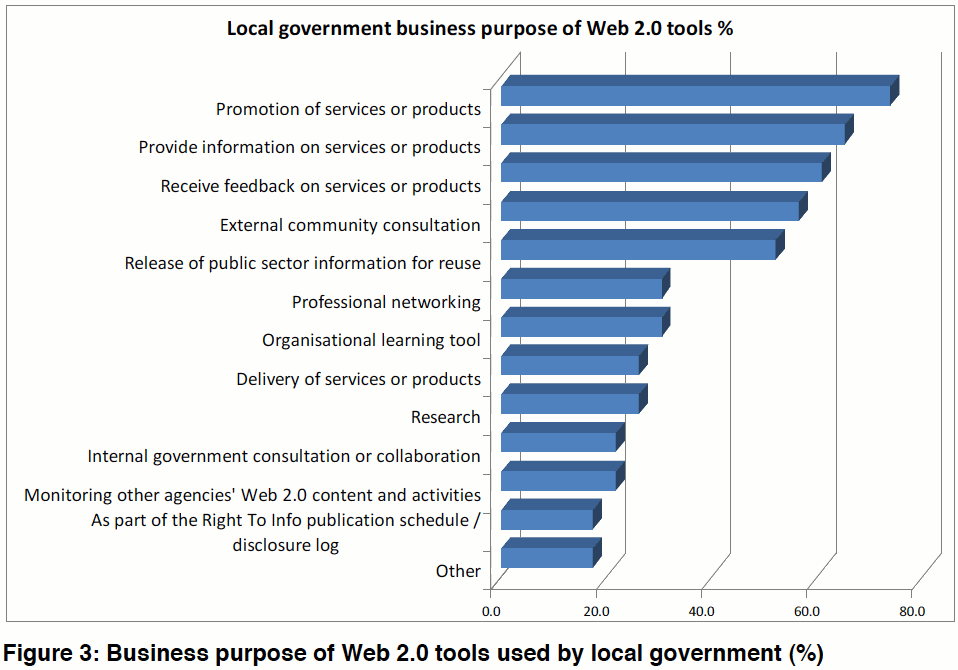
    Why did local government use Web 2.0?

    It's interesting to see the diversity of uses for Web 2.0 services and technologies - for promotion, information, feedback, consultation, information release, professional networking, organisational learning and so on (see graph below).

    It's clear that Web 2.0 services and tools have enormous horizontal utility in organisations which, in my view, supports the case for social media not being the sole preserve or under the control of government communications units.


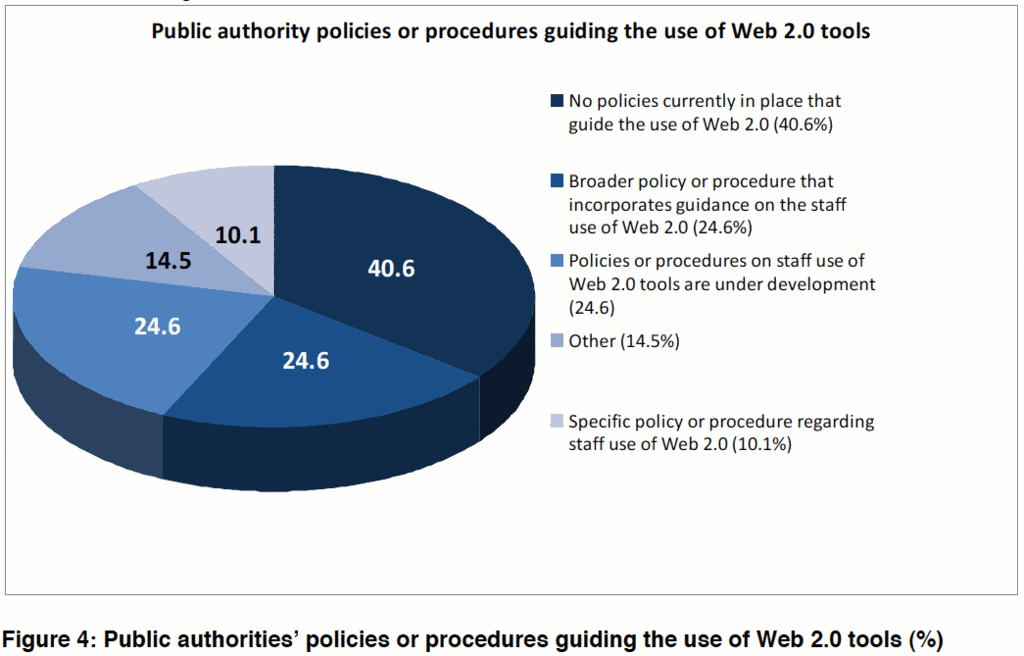
    Web 2.0 policy

    Finally, there's still an enormous gap in the area of policy and procedure for Web 2.0 use.

    Over 40% of Queensland public sector authorities who responded to the survey did not yet have guidance in place to support, educate and guide staff in the use of Web 2.0.

    In many other cases guidance was specific to a particular medium (such as Twitter) and did not adequately cross all the different forms of social media and Web 2.0 channels.

    I believe this remains an area of significant concern for government agencies. It makes it more difficult to identify, flag and address inappropriate use of digital channels, or to educate and support staff on how to use these channels effectively and appropriately for their own benefit as well as the organisation's.


    Read full post...

    Saturday, February 12, 2011

    Learning from the social media policy mistakes of the Commonwealth Bank

    Last week the Commonwealth Bank received a panning for its new social media policy.

    Going beyond guidance for staff in their use of social media, the policy made it a requirements that Commonwealth Bank staff tell their managers about any negative comments about the bank they see online. The policy also required that staff do everything in their power to have these negative comments removed from the internet, under risk of disciplinary action or even dismissal.

    You can read the CBA policy online, courtesy of the Business Spectator. Pay particular attention to Point 4 "Material posted by others" and point 6 "Breach".

    These parts of the policy particularly raised the ire of the Financial Services Union (FSU), one of the bank's largest staff unions, and led to a media storm throughout last week.
    "The FSU believes the policy is so broad that it goes beyond conduct which the bank could legitimately claim involved damage to its reputation or interest and/or was such as to give rise to a concern about an employee's implied contractual obligation of good faith and loyalty," the union says.

    Reference: SmartCompany - Commonwealth Bank social media policy raises questions over control of employee actions online

    Now I applaud the Commonwealth on taking a step all organisations should, having a clear policy and guidance for staff to help them understand how to 'not stuff up' when using social media, how to avoid conflicts of interest and prevent the media portray a staff member's views as reflecting official bank policy.

    I also applaud the bank's efforts to listen to social media and address customer issues expressed online. Realistically organisations should respond to customer comments in social media channels in a similar manner to which they'd respond to customer comments in person, by phone, email, fax or other channels. It is even better if they employ monitoring tools to proactively identify and address comments that aren't made specifically to the organisation.

    However it is both impractical and highly inappropriate for organisations to ask their staff to monitor and police the actions of their friends or total strangers under penalty of disciplinary action - whether in online social media channels, or offline (at pubs and BBQs).

    I'm not sure what steps the Commonwealth Bank took to formally or informally consult staff when developing their social media policy.

    I'm not sure whether the Commonwealth Bank referenced best practice examples of social media policies from other organisations, such as the Online Database of Social Media Governance.

    I am also not sure whether the Commonwealth bank is mature enough as an organisation to treat its staff as adults, to trust the people they employ and to effectively encourage them to be the Commonwealth's biggest advocates and supporters online.

    However I am sure that when an organisation attempts to place unworkable and inappropriate staff policies in place they will fail. Internally and publicly.

    Organisations that introduce inappropriate staff policies will reduce their public reputation, reduce their attractiveness to top people and set staff relations back years.


    When I attended the Garner Symposium late last year (to speak on a panel with Andrea Dimaio and Ann Steward), I also went to a session on Banks and Social Media to see how they were doing in coming to terms with new mediums for communication and engagement.

    The impression I walked away with was that Australian banks, in general, were several years behind the Australian Public Service in their acceptance, adoption and support for social media use by staff.

    Sure they used social media tactices for advertising campaigns, however these were at arms length. Social media was not seen as a set of tools that could support and re-energise internal cultures, underpin collaboration and innovation or transform 19th century institutions into 21st century financial powerhouses. In many cases the attitude was "block and penalise" rather than "train and manage".


    I hope that, given their relative maturity, government agencies will learn from the mistakes of the CBA in this case and avoid endorsing social media policies that are unworkable, onerous or inappropriate.

    Given the experience of the Commonwealth Department of Finance and Deregulation, the Victorian Government, the Victorian Department of Health, the South Australian Government and, also last week, the Queensland Government , I think the public sector is currently in safe hands.


    Stung by the public and staff backlash, the Commonwealth Bank has rapidly agreed to work with the FSU to make its policy workable. I'm sure we'll hear more as this progresses.


    Articles
    A non-exhaustive list of articles discussing the Commonwealth Bank's social media policy

    FSU posts
    Posts by the Financial Services Union about the CBA social media policy

    Read full post...

    Wednesday, February 09, 2011

    Where do good ideas come from? (hint - increased connectedness)

    This is a thought-provoking video that looks at where good ideas - innovation - comes from.

    It raises an interesting point about the correlation between connections and innovation. That the more we interact and connect with others, the more likely it is that we can combine our partial ideas, our hunches, the greatest the prospect of a breakthrough idea.

    That's a powerful argument for improving the connections between public servants, between government employees and citizens and for facilitating better connections between citizens - through the use of digital technologies.

    Read full post...

    Tuesday, February 08, 2011

    When government crowdsourcing doesn't work (careful you may laugh)

    Here's an excellent example of where crowdsourcing doesn't work.

    The City of Austin decided to crowdsource a new name for its Solid Waste Services Department.

    It received plenty of ideas and votes, however few were meaningful or useful - though a number are quite funny.

    However don't take this as a lesson that crowdsourcing doesn't work.

    Use Austin's experience as an example that crowdsourcing, as a strategy, must be applied in a considered and appropriate manner. Where possible the goals should be specific, meaningful and valuable to the community.

    (thanks for the link James!)

    Read full post...

    Monday, February 07, 2011

    Open Government drinks with Delib co-founder Chris Quigley tonight in Canberra

    Chris Quigley of Delib is in Australia at the moment, on a trip around capital cities talking about Open Government from a UK and US perspective.

    Today and tomorrow he's in Canberra meeting with various people around the traps (and speaking at the Gov 2.0 lunch).

    Tonight, to welcome Chris, we're having informal drinks at the Wig and Pen from 5.30pm.

    If you're in town and available, drop by - just look for the Gov 2.0 table at the back.

    Who is Chris Quigley?
    Chris's experience crosses viral marketing, social media and e-democracy. He has an ongoing interest in how people, business and government interact, and how the internet (especially social media) are changing relationships.

    He has been working in the Open Government space for almost ten years across both the UK and the US. He was involved in some of the earliest crowd-sourcing projects in the US, under the former President George Bush.

    Chris's company, Delib, was asked by the current US government to build an ideas-sharing website to "crowdsource thoughts" about how to design a portal that would monitor the US's $787bn (£510bn) stimulus plan. The result was recovery.gov.

    Chris was also involved in the design of the UK government's 'Your Freedom' website, designed to allow UK citizens to discuss laws they wanted to see changed or removed. The site received 11,546 ideas, 72,836 comments and 190,175 ratings.

    Alongside his Open Government work, Chris is also a co-founder of The Viral Ad Network, a specialist automated syndication platform for branded content and of Rubber Republic, a specialist viral ad agency (which also has a strong interest in socks).

    Learn more about Chris in The Guardian's article, "The man opening up government".

    Read full post...

    Good read: Nicholas Gruen on Gov 2.0 in Australia and cultural change

    Alex Howard over at GovFresh has a great article and video interview with Nicholas Gruen regarding Gov 2.0 in Australia and some of the challenges of the required cultural change.

    Read it over at Nicholas Gruen on Gov 2.0 in Australia and cultural change.

    Read full post...

    Friday, February 04, 2011

    Ten reasons why blogs are more useful than email newsletters

    Sometimes it surprises me how much some organisations like using email newsletters over other tools like blogs.

    They spend weeks or even months crafting news items, bundle them together into a single email and then send them out to a subscriber list - sometimes without even using a system to measure the response rate or manage the bounces, making it impossible to prove a return on their investment.

    I've long been a fan of blogs over email newsletters, here's some of the reasons why:
    1. You only have to publish one story in a blog at a time
      Email newsletters tend to be an collection of stories all published at once. With a blog, each post is a new 'story' so you can focus on one at a time rather than having to work on three, five, eight or ten different stories all at once.

    2. You can publish blog posts at your own pace
      Often with email newsletters there's a 'need' to publish regularly - every week, month or quarter. That often means uncovering some kind of 'new' content on a topic, even if there's no new information.
      With a blog you can spread out your posts over time, giving the impression of more regular updates and building your audience's engagement habits without necessarily writing any more content.
      In other words, four blog posts posted over four weeks is more effective than posting a newsletter once a month with four stories.

    3. Blogs boosts your search ratings
      It is very valuable to have results high in search engines and blogs, unlike email newsletters, get listed. In fact as blog information changes regularly (as often as you post), this means that search engines often rate blogs higher than static websites which rarely change. That's an enormous boost to peoples' ability to find and make use of your information.

    4. Blog posts can be available forever
      Sure you can keep an online archive of your email newsletters, however a blog is much easier to search and reference for people who wish to read back in time as well as forward.

    5. An email newsletter is a soliloquay, a blog is a dialogue
      Email newsletters are almost always one-way outwards communications tools. Blogs, on the other hand, are multi-way. Sure you can have a blog without comments - just like an email newsletter - however you can also support active public discussions. That provides more flexibility and options for how, why and when you communicate and allows blogs to support a wide range of inbound and two-way engagement strategies.

    6. You can leverage your blog's reach through syndication and social media
      With blogs you can provide an RSS feed that can be used by blog aggregators, news sites and other feed reading mechanisms to greatly amplify your reach. You can also leverage social networks such as Facebook and Twitter to increase your footprint even further.
      On the other hand email newsletters are largely bound by the limits of their subscriber lists. They may be re-emailed by a few recipients, however cannot tap into broader syndication or social media channels to amplify their reach.

    7. Blog post approvals don't have to tie you in knots
      The classic reason email newsletters are late is that they are waiting on lots of approvers - often different people for each news item. This complex process can mean that even if nine of your news stories are approved, you're left waiting three weeks for approval on the tenth before you can email. By then the email is a month late and your audience has lost interest and trust in your ability to deliver to deadline. With blogs, if you have nine posts approved and one still in approvals that gives you nine posts you can publish over the next three weeks while waiting for the tenth. That means you can maintain regular activity and keep your customers informed and engaged without any loss of reputation.

    8. People can subscribe to your blog
      Just like with email newsletters, with the right blog tools people are able to subscribe to your blog for updates by email or by RSS. This is more of an equaliser than an advantage, however it does mean that blogs, with their other advantages, aren't at a disadvantage in this area.

    9. A blog isn't restricted to being a blog
      Email newsletters are good at being email newsletters, providing synopses and links to news stories, but aren't usually able to provide other functionality. A blog isn't necessarily only a blog, it's a highly interactive website. You can use a blog to also deliver static information, multimedia presentations, social media tools, web services and anything else you'd provide on a 'normal' website.

    10. Your blog can be an email newsletter too!
      With the right blog tool, or with a small amount of work, you're able to bundle up your blog posts for the last week or month and send them out as an email newsletter as well. This basically allows you to have the best of both worlds - the targeted alerts of an email newsletter backed up by the flexibility, search ranking and longevity of a blog.

    Now I'm not saying that email newsletters don't have their place. They are very effective at 'push' communications. When you're confronted by a newsletter every month in your inbox you're quite likely to read it.

    However why limit yourself to just that email newsletter when you could build a blog and use an email newsletter as one of your push tools?

    The blog gives you the advantages of multi-way communication, greater leverage and amplification, more flexibility in when and how you publish content and the content becomes much easier to find.

    Build a blog and use your newsletter to drive traffic to it. That way you'll get the best of both worlds, targeting and flexibility.

    Read full post...

    Tuesday, February 01, 2011

    How will states adapt to true telecommuters?

    Today telecommuting often refers to people who work from home, logging into computer networks to prepare documents and exchange information remotely.

    However across the world we're starting to see examples of much broader and more intense forms of telecommuting.

    Warfare
    Take for example the RQ-1 Predator, an unmanned aerial vehicle that has been used since 1995 by the US Air Force. First used for reconnaissance and armed only with a high resolution camera, the Predator is now routinely equipped with missiles and used to attack ground targets. Predator operators may be hundreds, or even thousands, of mile away and operate their UAVs through video screens like modern computer games.

    Similar unmanned devices are being developed for land and sea-based conflict, allowing operators to work normal shifts from bases close to their homes (or even from their homes), while these devices are employed in combat theatres around the world.

    Emergencies
    Unmanned vehicles are also being adopted in the emergency management field, with controlled robotic devices used to explore hazardous environments ahead of human teams. These devices have been used to map the Chernobyl disaster and recently the CyberQuad was introduced into Australia to support the fire brigade in mapping and fighting large blazes.

    Space exploration
    Many people will be aware of the Mars Rovers, two robots sent to explore parts of the red planet, seeking signs of surface water and life while expanding our store of knowledge. These robots, similar to those used in emergencies, have been used as a low-cost means of exploring a hazardous and remote environment.

    Health
    There are pilot programs in a number of countries exploring the potential for doctors, particularly specialists, to remotely diagnose and treat patients. In a world with too few doctors and many remote regions, the ability to have a specialist diagnose patients from a distance is an enormous cost and time saving tool, providing improved health outcomes.

    Even more so, the potential for videoconferencing during surgeries, where experienced surgeons can view and collaborate with an on-the-spot colleague during a procedure - or even conduct surgery remotely, employing robotics.

    Adult industry
    While an area that some might find less delicate, the adult industry has a long history of innovating and employing new technologies. Much of the early innovation on the world wide web had its roots in adult pursuits. Similarly adult operators are exploring the opportunities for remote controlled devices. In fact the field even has a name, coined in 1975, 'Teledildonics' - for computer or remote operator-controlled devices for sexual pleasure.

    Entertainment
    Virtual worlds and Massive Multiplayer Online Games (MMPOGs) have been around now for a number of years (since 1974 in fact), some as games, some as social entertainment experiences and some as business tools. These worlds are growing in immersiveness and flexibility, providing more and more opportunities to conduct mass meetings remotely, demonstrate designs and working (virtual) prototypes and educate students.

    Looking forward
    With all these forms of 'telecommuting' developments there's three trends I think are important to note.
    • We are increasingly able to control physical devices and perform complex actions at great differences.
    • Our virtual environments are improving to the extent whereby almost-physical interaction is becoming possible, and
    • we are entering a time where an increasing number of people will be able to conduct their business remotely from other states or nations, significantly complicating how taxes are assessed and laws are interpreted and enforced.
    With increasing broadband speeds, such as via Australia's National Broadband Network, it will become possible for a range of telecommuting scenarios such as the following three examples.

    • Remote mining exploration and analysisA geologist sitting in their Brisbane office will be able to take control of a contracted robot in the Northern Territory, remotely guide it to an exploration site and conduct a surface analysis and even a seismic survey to assess the mineral potential of the area.

      The information and analysis could be immediately visible to their employer, a Perth-based mining company. The site could be mapped digitally and then have geologists from around the world explore the area virtually - literally 'walking' their avatars over the landscape and discussing specific areas in real-time.
    • Global industrial design
      Equally an industrial design team operating out of Newcastle as a semi-autonomous unit of a Swedish furniture manufacturer could develop new designs for bookcases and chairs and trial them via virtual worlds with other designers and potential customers around the world.

      When a final design is approved it could be automatically loaded into the systems of an offshore manufacturer and produced, either in a fully automatic or manual factory, then shipped to customers around the world.

      As a side project, the designs could also be made available for virtual sale into a range of virtual worlds and games, like the Sims - providing a secondary income.
    • Remote entertainment experiences
      A resident in a nursing home in Wagga Wagga could remain an active gardener through participation in a robotised market garden in the Adelaide Hills. Every day they could go online and check how their plot was developing, using robotic devices to plant seeds, pull weeds and water. When their vegetables were grown they could be harvested and sent to market collectively, with the profits going to offset the costs of the market garden.

      Through virtual technology the resident could walk around, or even fly over the garden with complete mobility. Integrated sensors could simulate the smells and even the feeling of digging in the soil, keeping the resident both entertained and productive, raising their self-esteem and enjoyment of life.

      Residents from nursing homes around the country and overseas could work together, sharing their experience with plants and making collective decisions on how to manage the garden. (The original Telegarden was operational from 1995-2004 as a university experiment)

    In all of these situations the data would pass through a variety of Australian states and through international jurisdictions. The individuals performing the actual work do not necessarily own the work, it could be a collaborative effort by individuals across different nations.

    We're seeing the inklings of this process now with the increasing digitalisation of products. No jurisdictional restrictions on written, audio, visual or digital interactive material can be effectively and universally enforced when they can be transmitted almost instantaneously across the internet to virtually any country in the world.

    The creators of these digital works may also be located anywhere in the world. Collaborators may each live in a different jurisdiction and be subject to different laws and regulation. Whose jurisdiction takes primacy for taxation purposes for a truly virtual organisation? What happens when a digital product is illegal in some jurisdictions and legal in others?

    It is even hard to enforce regulation or taxation over physical products, unless governments wish to inspect every single mail item - adding enormous time and cost burdens to an economy.

    Identifying which jurisdiction's guidelines apply can already be difficult - is it in the jurisdiction that the work originates, where the servers storing the information live, where the organisation is registered or where the goods and services are sold (at least for physical products, who taxes and regulates virtual items)? What if jurisdictions don't agree?

    As teleconferencing becomes more prevalent and more global in nation, governments will increasingly have to reconsider their state-based laws, regulations and taxes to contend with hyper-mobile individuals, workers who can deliver a service using remote assistance anywhere in the world, from driving a delivery vehicle to performing operations, without leaving their own home or neighbourhood.

    Perhaps governments should already be taking great strides towards normalising their regulatory approaches,to reduce inefficiencies and ensure that their laws and taxes will remain enforceable as telecommuting rises.

    Read full post...

    Monday, January 31, 2011

    Gov 2.0 lunch with Chris Quigley of Delib - Canberra, 8 Feb 2011

    I'm delighted to kick off 2011 with a Gov 2.0 lunch featuring an international speaker, Chris Quigley, a co-founder of Delib from the UK.

    Chris's experience crosses viral marketing, social media and e-democracy. He has an ongoing interest in how people, business and government interact, and how the internet (especially social media) are changing relationships.

    He has been working in the Open Government space for almost ten years across both the UK and the US. He was involved in some of the earliest crowd-sourcing projects in the US, under the former President George Bush.

    Chris's company, Delib, was asked by the current US government to build an ideas-sharing website to "crowdsource thoughts" about how to design a portal that would monitor the US's $787bn (£510bn) stimulus plan. The result was recovery.gov.

    Chris was also involved in the design of the UK government's 'Your Freedom' website, designed to allow UK citizens to discuss laws they wanted to see changed or removed. The site received 11,546 ideas, 72,836 comments and 190,175 ratings.

    Alongside his Open Government work, Chris is also a co-founder of The Viral Ad Network, a specialist automated syndication platform for branded content and of Rubber Republic, a specialist viral ad agency (which also has a strong interest in socks).

    Learn more about Chris in The Guardian's article, "The man opening up government".

    If you are able to join us at Café in the House in the Old Parliament House for lunch on 8 February 2011, Chris will be providing an overview of the Open Government experience in the UK and US.

    Register for the Gov 2.0 lunch at http://egovaufeb2011.eventbrite.com/

    Read full post...

    Thursday, January 27, 2011

    NSW electoral commission asking citizens to geolocate their own addresses

    In a initiative to improve electoral records, the NSW electoral commission is asking citizens to geocode their own location.

    The initiative relies on the prevalence of GPS units in peoples' smartphones and other devices, coupled with an online system which allows people to locate their homes online and confirm that they have been mapped correctly in the electoral database.

    Details on the initiative are available at the Elector Geo-Location System pages of the NSW electoral commission's site.

    I hope this initiative won't remain limited to NSW, there's application for this approach across all Australian electorates.

    What will be interesting after the collection of this data is how it will be used, beyond mapping electorates.

    For instance the geomapped locations of Australian addresses, appropriately de-identified, could be used to supplement other geolocational records, improving the ability for emergency services to reach addresses in a crisis.

    They could also be released freely as open data - after all the government isn't paying citizens for the data.

    That would certainly be a better outcome than locking up public data in an organisation such as PSMA Australia Limited, a government-owned corporation, which collects public data and then resells it back to Australians.

    Read full post...

    Tuesday, January 25, 2011

    How do we keep the idiots at bay?

    I read an excellent article today in the Harvard Business review by Bill Taylor about Why Do Smart People Do Such Dumb Things?.

    Taylor explores why good ideas go disastrously wrong, why innovation often appears to lead to disaster, concluding that Warren Buffet had the right of it,

    Leave it to Warren Buffet to offer a thoughtful perspective. In a memorable, hour-long PBS interview with Charlie Rose during the 2008 crisis, Buffet gave a master class in how the world got into its economic mess and what we can learn from it.

    At one point, Rose asked the question that scholars, pundits, and plaintiffs attorneys will be debating for years: "Should wise people have known better?" Of course they should have, Buffet replied, but there's a "natural progression" to how good new ideas go badly wrong. He called this progression the "three Is." First come the innovators, who see opportunities that others don't and champion new ideas that create genuine value. Then come the imitators, who copy what the innovators have done. Sometimes they improve on the original idea, often they tarnish it. Last come the idiots, whose avarice undermines the very innovations they are trying to exploit.
    This progression from innovation to imitation to idiocy is not limited to the finance market. We've seen it occur in advertising, in property, in fashion, toys and engineering. In fact it occurs in virtually every industry and profession - including in government.

    So how do we keep the idiocy at bay, keeping innovators and (effective) imitators in ascendency?

    Taylor doesn't answer this question, so I thought I might throw in a few thoughts.

    Firstly we need to train people to distinguish between imitation and idiocy. Provide them with the skills and experience to draw a line in the sand, resisting ideas and approaches that would fail.

    Secondly we need to benchmark and share in-depth case studies. Share not only what worked but why it worked and how it worked - or why it did not. The psychological, economic and engineering principles that were applied to turn an idea into an effective execution. This builds greater understanding of the principles underlying success or failure, not simply the 'bling'.

    Finally we need to foster continuous innovation. When people have the skills and experience, coupled with ready access to examples of success and failure, they are better equipped to create new concepts and build on existing ideas whilst identifying the paths that would lead to idiocy.

    Of course, at the same time, we need to educate upwards and outwards - help senior managers, political offices and external stakeholders understand what works and why. While this mightn't totally prevent them from getting caught up with a novel idea, or rejecting an effective one, it at least helps them understand afterwards.


    In Gov 2.0 we're already seeing the imitators attempting to mimic innovative successes from the past few years. That's fine, it can appear safer to go second or twenty-third - although rarely does an imitation aim to reach exactly the same audience, exist in the same environment or get executed in the same way, by the same people.

    In the end, I expect we will never be able to completely keep idiocy at bay, but we can, at least, contain it.

    Read full post...

    Monday, January 24, 2011

    Queensland Police demonstrate best practice emergency communications management via social media

    The floods across Queensland, and in other parts of Australia, over the past few months have been a national tragedy.

    They have also been a wake-up call to communications and media professionals across government on how to effectively inform and engage the public via social media.

    Queensland Police, through their twitter account, @QPSMedia, Facebook page, Queensland Police and YouTube channel, have demonstrated world's best practice emergency communications management through social media.

    Their activities have been well documented in the media and blogs, some of which I've linked below, so all I'm going to say is well done Queensland Police.

    I hope other government agencies around the country learn from your efforts.

    A few good articles and posts about social media use during the Queensland floods


    Read full post...

    Friday, December 24, 2010

    Have a great holiday break and see you in the new year

    I'd like to wish everyone who reads my blog a fantastic holiday break with their nearest and dearest and a great New Year.

    I'm taking a break from writing this blog and plan to continue this conversation with you in early January.

    Looking back
    Reflecting back, I believe that 2010 has been a solid year for Government 2.0 in Australia. There's been the start of the process for bedding down the Gov 2.0 Taskforce's recommendations, the Federal introduction of FOI amendments and the move towards Creative Commons as a default license. States and local governments have been very active, with particularly highlights the Victorian Government's Gov 2.0 action plan and whole-of-government program and South Australia's social media guidelines. Locally we've seen councils bring the public into the tent on a wide variety of consultations and more collaborative planning around local areas.

    Outside of the government we've seen hundreds of applications and websites created through state competitions, OpenAustralia going from strength to strength and a number of other sites created to help demystify and improve the accountability of government - though I don't think there's been the same level of activity or funding as we've seen in the UK and US thus far.

    At all levels of government we've seen a great deal of 'practice' initiatives as agencies experimented and innovated with Government 2.0 approaches in non-critical areas and a few steps towards authentic online engagement by public servants in public forums, although significant reluctance is still evident and the number of public servants actually engaging in conversations online is still small.

    Looking forward
    I expect 2011 to be the year we begin sharing more case studies from current and new agency initiatives and Government 2.0 will become more embedded as a practice and discipline - a set of tools and techniques that are recognised as a core skillset for a subset (at least) of public servants.

    I hope we'll see greater use of Gov 2.0 approaches in emergency and issues management and more agencies prepared to invest in building their Government 2.0 capabilities, although skilled practitioners will remain extremely thin on the ground and we will remain limited in our ability to source practical skills from the private sector.


    For me Government 2.0 is about,

    • aligning government engagement and decision-making processes with our public's preferred channels and culture, 
    • improving productivity through knowledge sharing and connecting within and between agencies,
    • improving social outcomes through authentic ongoing community engagement, and
    • improving the accountability of governments and agencies through improving access to information, analysis and well-considered opinions. 
    It is also about remaining internationally competitive as a nation by leveraging our greatest asset - our collective skills and intelligence - by bringing more people 'inside the tent' through collaboration.

    I think we'll begin seeing significant value in all of these areas in 2011.


    Why not contribute?
    If you're also considering the future of Government 2.0 in Australia, and around the world - perhaps in regards to your own career, or to the future of Australian society - why not provide a comment, your ideas or a contribution to the Gov 2.0 Future Project, the book and blog project Kate Carruthers and I have in motion over at www.gov2au.net.

    We have already had expressions of interest to contribute from over 60 leading Government 2.0 practitioners and thinkers, from all around the world, and are looking for a diverse set of views to help us provide a tool for politicians, public servants and the public to help them think about the long-term consequences of a Government 2.0 world.

    Later!

    Read full post...

    US releases national survey of social media use in State Governments

    The National Association of State Chief Information Officers (NASCIO) in the US has released an excellent report, NASCIO: Friends, Followers, and Feeds (PDF), which looks at social media adoption by US states, identifying best practice and sharing knowledge on how tools are being deployed.

    To quote the report,

    The survey examined adoption trends, current applications and expectations of social media technologies, the extent to which implementation is governed by formal policies or individual agency initiative, and perceptions of risk associated with social media tool use.

    This is a fantastic resource for other governments as well and provides some key insights into who, how and why social media is being used by US state governments.

    It is a must read for senior managers - particularly CIOs and Secretaries.

    I strongly recommend distributing this report within your agency because, as the report says about Web 2.0 and social media,
    CIOs may not have been immediately convinced of the business value of these tools as they entered the workplace, but the fact is that this is how effective governments are communicating now, and this is not just a fad.

    Read full post...

    Thursday, December 23, 2010

    A great read - 5 necessary truths about Gov 2.0 by Andrea Di Maio

    Andrea Di Maio's article, 5 necessary truths about Gov 2.0, over at Federal Computer week has just been brought to my attention, and I commend it to everyone involve or interested in Government 2.0.

    It makes some excellent points which I feel are often not understood or appreciated by governments, that Government 2.0 isn't all about them (politicians or agencies), that it is not all about communication, it is a toolkit for solving problems and that Government 2.0 should align with business goals - not just be deployed as a shiny toy.

    Sometimes I think that the rush to push government to use Government 2.0 tools and techniques does as much harm as good. While it does force agencies to consider new approaches and take active steps, it can also create and reinforce a shallow view of Gov 2.0, or leave it marginalised in government Communication Branches, rather than embedding it within program, policy and customer service/engagement areas.

    Read full post...

    Wednesday, December 22, 2010

    The rise of the networked enterprise

    There's still people who believe the internet and social media are flash-in-the-pan technologies - or simply aren't relevant to their role.

    This group doesn't include most senior executives at organisations around the world, as this McKinsey report indicates.

    The rise of the networked enterprise: Web 2.0 finds its payday (PDF) provides insights from 3,200 executives, finding that companies using the Web intensively gain greater market share and higher margins.

    In government terms these gains could be expressed as lower costs, improved reputation, better community engagement and more reliable policy outcomes.

    To quote the report,

    A new class of company is emerging—one that uses collaborative Web 2.0 technologies intensively to connect the internal efforts of employees and to extend the organization’s reach to customers, partners, and suppliers. We call this new kind of company the networked enterprise. Results from our analysis of proprietary survey data show that the Web 2.0 use of these companies is significantly improving their reported performance. In fact, our data show that fully networked enterprises are not only more likely to be market leaders or to be gaining market share but also use management practices that lead to margins higher than those of companies using the Web in more limited ways.

    Social media channels are becoming mission critical corporate tools,
    Our research, for instance, shows significant increases in the percentage of companies using social networking (40 percent) and blogs (38 percent). Furthermore, our surveys show that the number of employees using the dozen Web 2.0 technologies continues to increase.4 Respondents at nearly half of the companies that use social networking say, for example, that at least 51 percent of their employees use it. And in 2010, nearly two-thirds of respondents at companies using Web 2.0 say they will increase future investments in these technologies, compared with just over half in 2009. The healthy spending plans during both of these difficult years underscore the value companies expect to gain.

    Among respondents at companies using Web 2.0, a large majority continue to report that they are receiving measurable business benefits—with nearly nine out of ten reporting at least one. These benefits ranged from more effective marketing to faster access to knowledge (Exhibit 1).

    Organisations using less social media channels, or using them less frequently reported less - or no - productivity improvements from social media. However the greater the use of social media, the greater the perceived and measured benefits.
    Fully networked enterprises. Finally, some companies use Web 2.0 in revolutionary ways. This elite group of organizations—3 percent of those in our survey—derives very high levels of benefits from Web 2.0’s widespread use, involving employees, customers, and business partners, according to the survey. Respondents at these organizations reported higher levels of employee benefits than internally networked organizations did and higher levels of customer and partner benefits than did externally networked organizations. In applying Web 2.0 technologies, fully networked enterprises seem to have moved much further along the learning curve than other organizations have. The integration of Web 2.0 into day-to-day activities is high, executives say, and they report that these technologies are promoting higher levels of collaboration by helping to break down organizational barriers that impede information flows.

    The research closely matches the same type of research in the 1980s for desktop computer use or in the 1950s regarding telephone access as these were rolled out throughout organisations. The more staff that had access to these technologies, the greater the benefits to the organisation.

    Of course there are also challenges that need to be addressed. We have codes of conduct for phones and computers, monitor their use and have management processes to rectify any inappropriate use. Precisely the same approaches are needed for internet and specifically social media usage inside organisations.

    However we've done this all before, several times, so it isn't really a big leap to address.

    So are these benefits really measurable? McKinsey believes they are...
    We performed a series of statistical analyses to better understand the relationship between our categories of networked organizations and three core self-reported performance metrics: market share gains, operating profits, and market leadership. Exhibit 3 shows the results.

    Market share gains reported by respondents were significantly correlated with fully networked and externally networked organizations. This, we believe, is statistically significant evidence that technology-enabled collaboration with external stakeholders helps organizations gain market share from the competition. They do this, in our experience, by forging closer marketing relationships with customers and by involving them in customer support and product-development efforts. Respondents at companies that used Web 2.0 to collaborate across organizational silos and to share information more broadly also reported improved market shares.

    The attainment of higher operating margins (again, self-reported) than competitors correlated with a different set of factors: the ability to make decisions lower in the corporate hierarchy and a willingness to allow the formation of working teams comprising both in-house employees and individuals outside the organization. These findings suggest that Web technologies can underwrite a more agile organization where frontline staff members make local decisions and companies are better at leveraging outside resources to raise productivity and to create more valuable products and services. The result, the survey suggests, is higher profits.

    Market leadership, which we ascribed to those organizations where respondents reported a top ranking in industry market share, correlated positively with internally networked organizations that have high levels of organizational collaboration.

    McKinsey finishes with a very strong conclusion:
    The imperative for business leaders is clear: falling behind in creating internal and external networks could be a critical mistake. Executives need to push their organizations toward becoming fully networked enterprises.

    And details some specific steps to get there...
    • Integrate the use of Web 2.0 into employees’ day-to-day work activities. This practice is the key success factor in all of our analyses, as well as other research we have done. What’s in the work flow is what gets used by employees and what leads to benefits.
    • Continue to drive adoption and usage. Benefits appear to be limited without a base level of adoption and usage. Respondents who reported the lowest levels of both also reported the lowest levels of benefits.
    • Break down the barriers to organizational change. Fully networked organizations appear to have more fluid information flows, deploy talent more flexibly to deal with problems, and allow employees lower in the corporate hierarchy to make decisions. Organizational collaboration is correlated with self-reported market share gains; distributed decision making and work, with increased self-reported profitability.
    • Apply Web 2.0 technologies to interactions with customers, business partners, and employees. External interactions are correlated with self-reported market share gains. So are internal organizational collaboration and flexibility, and the benefits appear to be multiplicative. Fully networked organizations can achieve the highest levels of self-reported benefits in all types of interactions.
    Food for thought for all public service and private sector leaders.

    Read full post...

    Monday, December 20, 2010

    Yammer use in WA Health

    Given I've been paying some attention to Yammer recently, I thought it worth drawing attention to this post in Croakey regarding Yammer use in WA Health.

    I've also been speaking with another Commonwealth agency where Yammer has gone viral, with more than 1,000 users in a short period of time.

    Another Commonwealth agency has begun inducting all of its new staff into Yammer, using it to help them learn how to engage effectively via social media. This sounds like a good way to give people practical experience before letting them loose on the public.

    Read full post...

    Saturday, December 18, 2010

    How to solve the digital divide - do nothing

    There's still talk, from time to time, about the digital divide between internet users and those without internet access.

    It is said that the divide will produce a long-term group of privileged people with ready access to the world, while leaving those in remote areas, with low literacy or low incomes, trapped in a cycle of poverty.

    I've long been a sceptic about this divide. The internet is still a relatively young technology and is evolving rapidly, as are our tools for access it. I see the divide shrinking rapidly and naturally as competitive pressures generate innovation and reduce access costs.

    Kevin Kelly, a noted technology thinker, old Whole Earth editor and co-founder of Wired, shares my scepticism in his book, What technology wants.

    He points out that it is more of a case of the 'haves' and 'have-laters'. When a technology is first introduced it is adopted by, well, the first adopters. These people are interested in the technology for the technology's sake - often before its uses become clear.

    They are willing to pay more for the (barely-functional new) technology to experiment and innovate and through their investment of money and time help grow the technology's range of uses and attractiveness to the broader community.

    Over time the technology, if it suits a communal purpose, becomes more useful, usable and cheaper. More and more people jump on it. At some point it reaches critical mass and those who are using it outnumber those who do not.

    At this time there's a brief surge of concern over the 'divide' between those using the technology and the advantages they may be getting over those not using it, then the remaining 'have nots' finally start using it - or opt out altogether and talk about the divide disappears.

    This happened with telephones, mobile phones, televisions, cars, sewing machines, computers and many other technologies. We're simply following the same curve with internet.

    Kelly says that,

    "the fiercest critics of technology still focus on the ephemeral have-and-have-not divide, but that flimsy border is a distraction. The significant threshold of technological development lies between commonplace and ubiquity, between the have-laters and the 'all-have'."

    He says that instead what we need to worry about what we are going to do when everyone is online.

    "When the internet has six billion people, and they are all e-mailing at once, when no one is disconnected and always on day and night, when everything is digital and nothing offline, when the internet is ubiquitous. That will produce unintended consequences worth worrying about." 

    Read full post...

    Friday, December 17, 2010

    Yammer study from QLD government department

    I've been fortunate enough to have a QLD government department share with me the results of a survey they held following a large scale Yammer trial.

    They have also allowed me to share the (anonymised) results more widely (see below).

    The survey responses paint an interesting picture as to why and how public servants would choose to use this type of social networking service within an agency. It reinforces for me that this type of service may fill a collaboration and knowledge sharing gap for agencies that some may not even realise they have.

    Hopefully the survey results will help other agencies to decide on intranet social media tools in an evidence-based and informed manner, noting that there are already about 13,000 Australian public servants using Yammer - and an unknown number are using similar tools (such as Presently).

    On with the survey results...

    Use the tabs at the bottom of the embedded sheet (below) to move between questions, or go directly to the spreadsheet at: https://spreadsheets.google.com/ccc?key=0Ap1exl80wB8OdDV5TlFibHlGYTlldkFxdW5BUWc0RHc&hl=en


    By the way, here's a couple of other case studies, one from Australian government, provided as comments to one of my earlier posts by James Dellow of Headshift (who makes the point that if government wishes to be social on the outside it needs to be social on the inside):


    And, from Social Media Today, Extensive List of over 40 e2.0 Micro-Blogging Case Studies and Resources from around the world.

    Read full post...

    Thursday, December 16, 2010

    ABS launches CodePlay competition for tertiary students

    The ABS has launched the CodePlay initiative as a Gov 2.0 approach to help drive collaboration between students, developers and national and international statistical agencies.

    The competition challenges Australian tertiary students to help the ABS design the next generation of open-data tools to help people access, view and use statistical information.

    While I'm not sure why the ABS believes that all the great ideas will come from university students - why not include everyone - this is a strong initiative and should produce a very interesting outcome.

    To learn more, visit the CodePlay website or their twitter account at @ABSCodePlay.

    Read full post...

    Monday, December 13, 2010

    How workplaces can use social media

    Commoncraft, one of my favourite instructional video developers, has created a new video on Social Media and the Workplace.

    In about four minutes it provides an excellent summary of how social media can be used to address reputation issues, provide customer service and otherwise support organisations in a managed and safe manner.

    Unfortunately the video isn't embeddable yet, so you'll have to click over to the Commoncraft website to view it.

    View social media and the workplace.

    Read full post...

    Which Commonwealth agencies use which social media tools?

    Based on information I've collected over the last year, and using the data collected via the Vic Government, I have prepared a Google Spreadsheet designed to identify who in the Commonwealth Government is using which social media channels in their activities.

    It is fairly basic at this stage;

    • it is only Commonwealth for now (sorry to the state and local government guys - I will be building the same system for you soon);
    • it doesn't look at how many of each channel your agency runs;
    • it doesn't link to the channels;
    • it doesn't link to agency websites;
    • it may miss some smaller offices and agencies (I sourced the data from Australia.gov.au, so it should be fairly accurate, but it is hard to be sure, given the frequent changes and that not everyone might inform AGIMO of them).
    • there are no contact details for the teams managing the channels.
    The sheet also looks at engagement via third-party channels and at whether or not staff are allowed to access social media channels from within.

    I need your help filling it out and expanding it into a useful tool for helping agencies identify which of their colleagues are actively using these channels on an official basis.

    All contributions are anonymous - please circulate it to your peers. The more data we have, the more useful it becomes.

    To give a taste of the spreadsheet - the stats are below.

    Click on the link below, choose edit and then 'External social media' to add your data.

    You can go to the full spreadsheet at: https://spreadsheets.google.com/pub?key=0Ap1exl80wB8OdENTTHE1VkJmZURzaGRPUHV4ZW1teGc&output=html

    Read full post...

    Friday, December 10, 2010

    Should government policy be discussed in social media?

    There's a fantastic series of articles being published over at FutureGov Asia-Pacific at the moment, introducing some very interesting perspectives on social media and government.

    One asks, Should policy be debated in social media?, providing perspectives from senior leaders in different jurisdictions across the region.

    There is a fair amount of diversity in the viewpoints, however the overall consensus appears to be that it should.

    Several of those asked to comment pointed out that it is happening anyway - regardless of what governments may wish.

    It is my view that we're past the point where government agencies and politicians have the luxury to choose where and how they form their policy. They can no longer fall back on government-controlled due process.

    The crowd is now in command. Australians have many ways to make their views known, and are doing so on the matters of most concern to them.

    Government agencies ignore active discussions at their own and at their ministers' peril. If they don't consider the views being expressed through social media channels - even when they are not being expressed through a government social media channel - there is the potential for them to damage their own credibility and reputation and even to call the APS and Government into disrepute.

    The most recent example has been the Australian Government's approach to Wikileaks founder Julian Assange. Regardless of whether people support the actions of Wikileaks, there's been enormous public support for Australia to treat him 'fairly', providing appropriate consular support for him whilst under arrest in the UK.

    For example, the Open letter: To Julia Gillard, re Julian Assange, hosted at ABC The Drum, has attracted over 4,600 comments (predominantly in support) alongside the more than 180 people directly signing the letter.

    There have been large numbers of comments on other articles, blog posts, forum discussions, videos and tweets about the Wikileaks situation, with the same general viewpoint. The poll at the SMH (Should government agencies take more action to stop WikiLeaks operating?) is trending in the same way.

    These comments have not been made directly to the Australian Government through channels and processes it had established for this purpose. There's certainly been no direct 'public consultation' on Wikileaks to help the Government consider its policy.

    We've now seen public assurances from several senior Ministers that Julian Assange will, and is, receiving consular support, as would any other Australian in a difficult situation overseas.


    This should be a wake-up call for all Australian public servants and politicians.

    Ministers and agencies can still choose whether and how they hold a defined consultation around a given policy proposal. However Australians won't necessarily only make their views known when and through these processes, they will use social media - in spades.

    Ignore them at your own risk.

    Read full post...

    Thursday, December 09, 2010

    Australia is the second largest government user of Yammer - over 110 active networks

    There's recently been some controversy in Australian government over the use of Yammer, a private and secure enterprise social network, which I discussed in my post, The ongoing struggles to balance IT security and staff empowerment.

    I asked Simon Spencer, Yammer's newly appointed Asia-Pacific General Manager, how many government agencies in Australia were using Yammer.

    I was expecting him to answer maybe 30-40 agencies.

    He told me that, counting state and federal government, there were at least 110 Australian agencies now using Yammer - with a total of around 13,000 users.

    I was surprised, I hadn't expected that much adoption.

    However I was even more surprised when he gave me the global figures on take-up.

    Simon said that Australia represents 29% of all government networks using Yammer. The US represents 33% and the UK about 26%. The rest of the world accounts for the other 12%.

    I checked this with Simon three times and yes, it was correct. Despite our relatively small population, Australia as a nation is the second largest government user of Yammer in the world.

    I was quite surprised. While I knew the NSW, Vic and QLD governments were all rapidly adopting Yammer, I had no idea that so many public sector organisations had found the service useful.

    Admittedly Yammer is no newcomer. The company counts over 90,000 organisations as its customers across about 130 countries (Yammer now supports 94 languages). Around 80% of the Fortune 500 companies now use the service.

    However for Australia to be the second largest government adopter of the service suggests there's a few things going on under the hood.

    Firstly, this indicates to me that we're earlier adopters of social media tools in enterprise environments than I had expected. Speaking to Simon, he believes that Australia has adopted social media much faster than other countries, including within organisational networks. He said that he believes that Australia is on the leading edge of collaboration and use of social media.

    Secondly the figures suggest to me that Australian public servants are seeking to use the tools they find productive in their personal lives.

    Finally, given the example in my last post and other examples brought to my attention by staff at other agencies, it suggests to me that senior management and ICT are finding it challenging to meet their staff's needs within current infrastructure and policy settings.

    ICT teams are finding that more and more of their effort and money is spent on maintaining ageing mainframes and legacy systems. This leaves less and less of their capacity available to discover, assess and implement productivity saving tools.

    Equally senior managers are busy keeping Web 1.0 informational websites running effectively and managing all the other responsibilities of their jobs. They are struggling to find the time to research, understand and grasp the opportunities of Web 2.0

    The Yammer example indicates to me that many public service knowledge workers want to keep improving their performance and agency productivity.

    Clearly they aren't sitting back and waiting until ICT or senior managers are able to assess whether staff could be more productive with a particular tool. Public servants are going out and finding the tools themselves.

    Want to learn more about Yammer?
    Ross Hill's post Watching a Yammer network explode, is an excellent place to start.

    I also recommend the following post and video from Deloittes following up Ross's post, How to keep a Yammer network exploding.

    Read full post...

    Wednesday, December 08, 2010

    What Australian government data would you like to see online under an open reuse license?

    The NSW government has introduced a new service where people can provide suggestions on what government information they would like to access via a web or mobile front-end.

    Thus far the eight suggestions focus heavily on public transport information - knowing when and where buses, trains and ferries may be found.

    You can add your own ideas here.

    However I'd like to ask a broader question.

    Out of all the data that Australian governments collect or may hold, what would you like to see available online in a machine-readable format under an open license supporting reuse?

    And how would you use it?

    If you're short on ideas, why not check out the results of the iOpendataday & the International Hackathon, where thousands of people in over 73 cities across 5 continents participated in creating applications using open government data.

    In fact it took place pretty much everywhere except Australia - bringing me in mind of Chris Moore's quote...

    Here's a list of some of the applications created.

    Read full post...

    Tuesday, December 07, 2010

    What should be included in a Gov 2.0/Web 2.0 university subject?

    Tom Worthington, a well-known lecturer at the ANU, is revamping the COMP7420: Electronic Data Management summer session course to integrate more Gov 2.0 and Web 2.0 features.

    Tom has invited input from those in government with experience in the Gov 2.0 field.

    For more information, and to provide feedback, visit Tom's blog Net Traveller.

    Read full post...

    Is it really a lack of trust, or a fear of connecting that leads to discouragement of social media in workplaces?

    I hear a great deal of discussion by colleagues (and have engaged in it myself) about the lack of trust within organisations.

    • "There's all this process because our senior leadership doesn't trust its own staff."
    • "If they'd just trust the [Communications/Web/IT/Finance/Procurement/Program/Policy] team - we know what we are doing and have some very talented people here"
    • "If you want to influence managers, get in a consultant - bosses trust them more because they are not staff."
    • "What does someone with twenty years experience and a successful track record have to do to be trusted around here?"

    What if it is not really about trust? What if fears of senior management about use of social media in the office, while expressed or viewed as trust issues, are really just about preserving professional distance.

    Managers often find there is a need to stay slightly separate from their staff. They may be advised not to go out and party like a team member, or to get too close to the personal lives of younger people (particularly of the opposite gender) in the organisation.

    This separation is to 'keep the relationship professional', to avoid forming personal connections which might interfere with professional responsibilities, to avoid perceptions (or actual) favouritism or bias and to preserve a sense of authority. This allows difficult business decisions to be made more objectively - people disciplined or let go, changes that are painful to individuals but better for an organisation to be made, critical information to be kept secret when needed.

    Thinking about the situation in this way, it isn't that senior managers distrust their staff - in most cases they probably hold them in high regard - it is that they have been trained to maintain distance.

    If so those endeavouring to introduce social tools into organisations might find a different tact works best. Managers can use social media in different ways to staff - just as they can use email and phones differently.

    Sure, allow teams to socialise - humans are social creatures, we perform better and more productively when we know enough about our colleagues to work with them well.

    However managers can still use them with professional distance - communicating facts and announcements teams need to know, seeking and providing feedback on work, mentoring, instructing - even chastising.

    Perhaps that's some food for thought next time your senior managers appear to block a social media channel. It's not that they distrust their staff. It could be that they fear connecting too closely.

    Read full post...

    Bookmark and Share